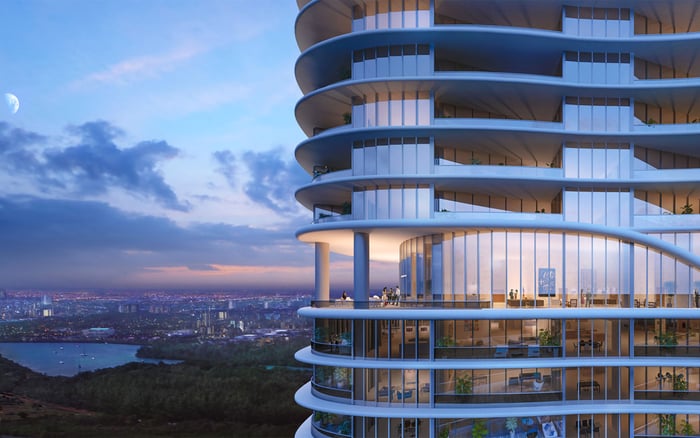
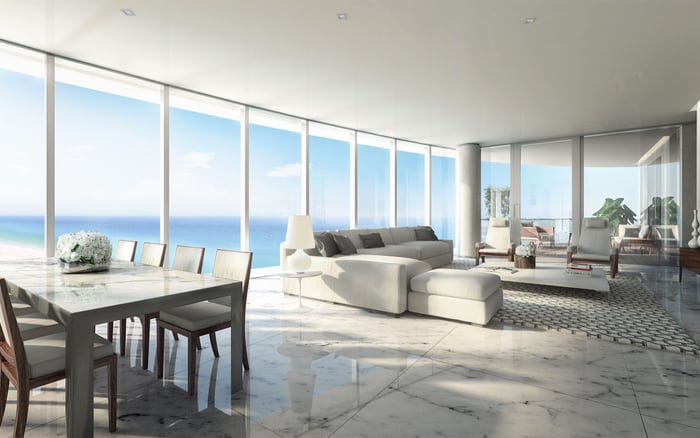
In ultra-luxury oceanfront living, the most consequential design decisions are often the ones you do not see. Dedicated staff quarters and true service circulation separate a beautiful residence from a genuinely effortless one, protecting privacy, preserving finishes, and enabling discreet, hotel-caliber operations at home. This editorial examines what sophisticated buyers should evaluate at St. Regis Residences Sunny Isles and how to compare service planning across the Sunny Isles market.

Luxury is often marketed through views, ceiling heights, and amenity decks. But for an owner who expects a residence to operate with the composure of a five-star property, the decisive layer is operational: where staff park, how they enter, how deliveries move, and whether the household can function without crossing paths with vendors, trades, or back-of-house activity.
Dedicated staff quarters, when thoughtfully planned, do more than add a room. They protect the tone of the primary suite wing, keep early-morning routines quieter, and allow childcare, housekeeping, or chef support to be present without making the home feel crowded. A true service entrance, similarly, is not simply a second door for convenience. It is an architectural agreement: resident arrival remains ceremonial, while operations stay discreet.
At St. Regis® Residences Sunny Isles, the conversation should start with that principle. For many buyers, the building’s appeal will be less about a single finish schedule and more about whether the property can sustain discretion at scale-day after day.
Sophisticated buyers often assume staff quarters are a universal feature at this level. In practice, the label can describe very different outcomes-from a properly separated, suite-like room to a compact multipurpose space that functions better as storage.
Evaluate staff quarters the way you would evaluate a secondary primary suite, but through an operational lens:
First, separation. The strongest layouts place staff quarters off a service corridor or near a secondary entry, allowing household support to come and go without moving through the main living room. When staff access requires crossing the social core of the residence, privacy becomes a daily negotiation.
Second, acoustic calm. Look for physical buffering between staff quarters and the primary suite. Even in a well-run household, noise can travel through laundry cycles, equipment, and early departures. Placement in the plan matters as much as the number of doors.
Third, functionality. A staff room that truly supports day-to-day operations should have practical adjacency to laundry, storage, and service circulation. When the staff space sits far from these zones, the home’s operation becomes inefficient-and that inefficiency eventually shows up in the resident experience.
Finally, dignity. Ultra-premium living is defined by respect for everyone in the home. Staff areas that feel cramped, poorly ventilated, or treated as an afterthought tend to create turnover, friction, and inconsistent service-none of which aligns with the lifestyle St. Regis buyers typically seek.
A service entrance delivers the most value when it connects to a service system-not when it functions as a second doorway.
Buyers evaluating St. Regis Residences Sunny Isles should ask: does the service entry connect cleanly to service elevators, back-of-house corridors, waste handling, and package logistics? Is it positioned so deliveries can happen without lingering in resident-facing lobbies or corridors? Can vendors access the home without creating a parade through the building?
In well-considered towers, resident arrival is a narrative: porte-cochère, attended lobby, controlled elevator access, quiet corridor, then the front door. Service arrival is a different story, with a different route and different expectations. When those stories collide, you feel it in small moments: crowded hallways, propped doors, carts near fine finishes, and residents who begin scheduling their own comings and goings around building activity.
This is where comparisons within Sunny Isles become useful. Buildings known for high-privacy planning, such as Regalia Sunny Isles Beach, have conditioned many buyers to expect limited residence count, quiet corridors, and a sense that building movement is controlled. Meanwhile, newer, highly programmed projects like Bentley Residences Sunny Isles raise expectations around arrival choreography and logistics for daily living. The question for St. Regis is not whether it is luxury, but whether its service circulation supports the level of discretion implied by the flag.
Because specific operational details vary by building and may evolve as management policies change, focus on how the building is designed to perform-and how it is managed to protect that design.
Ask to walk the “service path” conceptually. Where does a housekeeper arrive? Where does a caterer stage? How do flowers, groceries, and larger deliveries reach the residence? Where do moving crews wait, and what protections exist for corridors and elevators? If the answers are vague, the system may be more improvised than intentional.
Confirm elevator strategy. Many premium towers separate resident and service elevator usage to reduce corridor traffic and wear. If separation exists, confirm how it is enforced and under what circumstances staff may use resident-facing elevators.
Understand the relationship between the service entrance and the kitchen. The ideal is direct access for supplies, catering, and daily deliveries-without crossing the living room. A service entry that still forces navigation through the main social area solves only half the problem.
Clarify package handling. Package rooms and concierge protocols matter more than ever. A building can present a beautiful lobby yet still feel operationally chaotic if deliveries are not routed and staged with intention.
Review household staffing expectations. Some owners want live-in help; others prefer scheduled support. Ensure the staff quarters and service circulation can support your preference without compromising privacy.
Sunny Isles is an oceanfront corridor with a broad spectrum of building personalities. Some properties prioritize intimate residence counts and quieter circulation; others embrace higher-energy amenity ecosystems and larger scale.
When staff quarters and service entrances are priorities, calibrate expectations around density. More residences typically mean more daily movement: more deliveries, more vendors, more contractors, and more opportunity for resident experience to be shaped by operations.
In that context, adjacent market references can sharpen your criteria. For example, The Ritz-Carlton Residences® Sunny Isles occupies a similar mental category for many buyers seeking a branded, service-forward lifestyle. Whether you ultimately prefer St. Regis or a neighboring alternative, compare how each building separates “home” from “hotel back-of-house.”
Discretion is not only about celebrity-level privacy. It is about being able to work from home, host guests, or enjoy a quiet morning without the subtle noise of building operations pressing into the residential experience.
Without leaning on numbers or marketing claims, a few design signals tend to correlate with stronger service planning.
One is corridor behavior. If corridors feel narrow, heavily trafficked, or visually cluttered during daytime tours, that may indicate service flows are not sufficiently separated or staged.
Another is door logic. In higher-performing layouts, the primary entry reads as a true front door, while the service entry reads as deliberate and proximate to the working zones of the home. If the two entries feel interchangeable, the plan may not be genuinely hierarchical.
A third is material resilience where it counts. Even refined finishes will show wear if carts and deliveries constantly rub corners. Better-performing luxury buildings anticipate this with protective strategies, service-friendly routes, and operational rules designed to prevent damage.
Finally, staff quarters that feel integrated rather than appended typically sit near other practical spaces: laundry, storage, pantry zones, and mechanical considerations. When these adjacencies are missing, staff quarters can become nominal rather than meaningful.
For the buyer evaluating St. Regis Residences Sunny Isles, dedicated staff quarters and a true service entrance should be assessed as a single system: space, circulation, rules, and daily choreography.
If you plan to use household support frequently, prioritize a plan where staff circulation does not cut through entertaining zones. If you host often, prioritize supply access that ties naturally to kitchen and pantry functions. If you value quiet, prioritize separation from the primary suite wing and a building culture that protects resident calm.
The goal is not merely convenience. It is a residence that maintains its composure under real life: school mornings, late arrivals, catered evenings, service calls, and the continuous rhythm of oceanfront living.
What is a service entrance in a luxury condominium? It is a secondary entry designed for staff, deliveries, and vendors to access the home with minimal impact on resident privacy.
Why do dedicated staff quarters matter if I do not have live-in help? They still provide flexibility for childcare, housekeeping, or a chef, and they can preserve privacy during longer visits.
Should staff quarters be near the kitchen? Ideally, yes-because daily operations and deliveries often route through the kitchen and pantry zones.
What is the biggest red flag when evaluating service circulation? When deliveries or vendors must pass through resident-facing lobbies, elevators, or living areas to reach the unit.
Do service entrances affect resale value? In the ultra-luxury segment, strong service planning can materially improve buyer appeal and marketability.
How can I assess noise risk from staff quarters? Review proximity to the primary suite and ask about buffering via closets, corridors, and door placement.
Are service elevators always separate from resident elevators? Not always, so confirm the building’s elevator strategy and how service use is managed day to day.
What should I ask about package deliveries? Ask where packages are received, staged, and delivered, and whether the system avoids corridor clutter.
Do service entrances help protect interior finishes? Yes, because they reduce cart traffic through formal areas and keep higher-wear movement on intended routes.
Is a second door enough to call it a service entrance? No, it should connect to a broader back-of-house system that supports discreet circulation.
To compare the best-fit options with clarity, connect with MILLION Luxury.
If branded residences are on your mind — as a home or as an allocation — we would be glad to share what we are seeing, privately.
Begin a quiet conversation