Ground-floor retail is no longer a simple convenience in Downtown Miami towers; it is a value driver that shapes arrival, privacy, walkability, and long-term resilience. This MILLION Luxury editorial evaluates when retail enhances a residential experience, when it compromises it, and what sophisticated buyers should underwrite before committing capital.
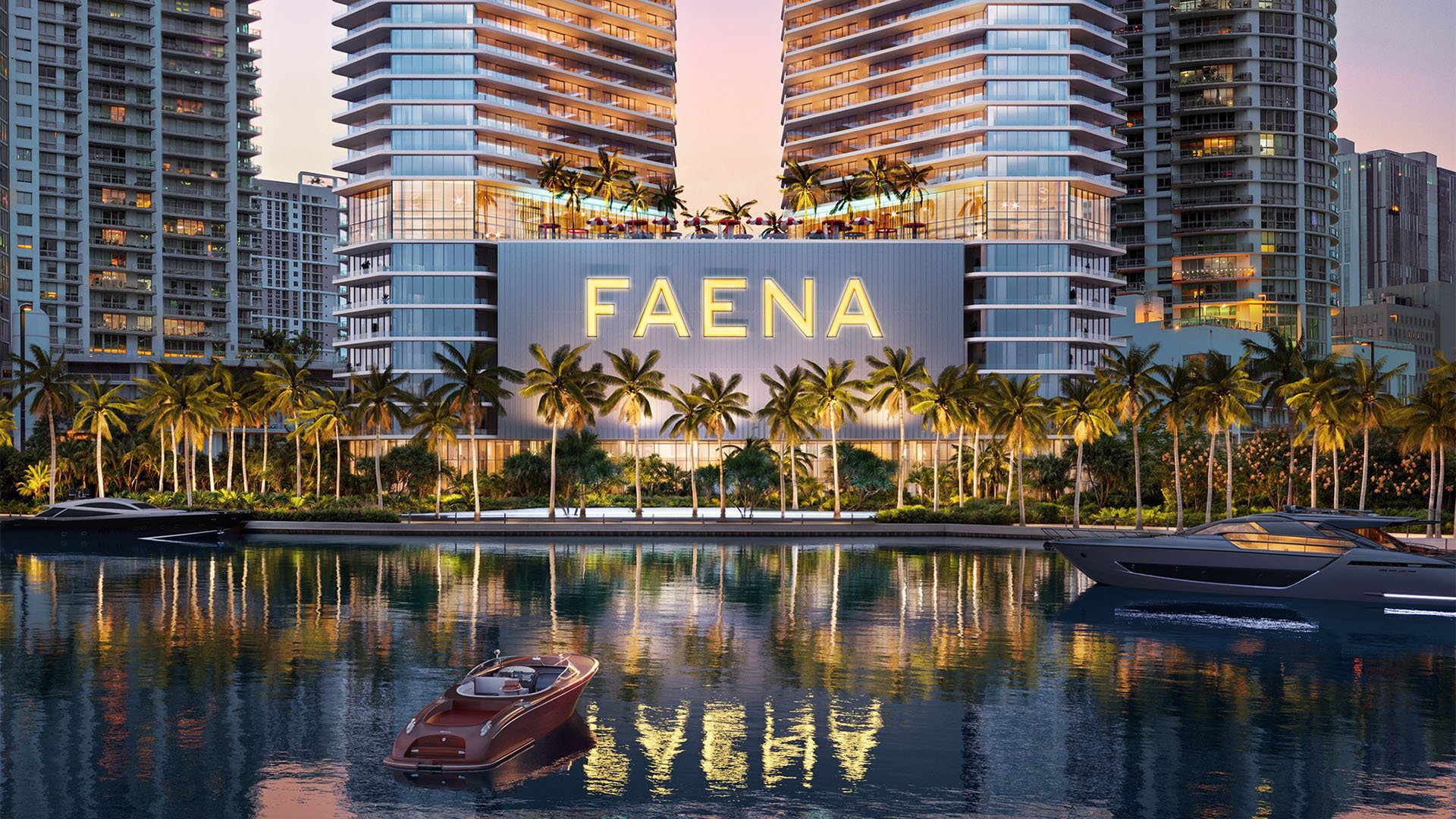
In Downtown Miami, “retail at the base” is often framed as an amenity. In practice, it functions more like core infrastructure-shaping how residents arrive, how they move through the neighborhood, and how the address presents itself to guests, tenants, and future buyers.
At its best, integrated retail turns a high-rise from a standalone object into a lived-in piece of city. A coffee shop that opens early, a tailored fitness studio, a discreet market, or a chef-driven restaurant can compress daily errands into a few minutes on foot. For buyers seeking an urban lifestyle without sacrificing polish, that kind of frictionless routine can matter as much as ceiling height or view corridors.
But for a luxury buyer, the decision is more layered than convenience. Retail brings operating hours, service corridors, deliveries, odor control requirements, and direct impact on the lobby experience. A tower can be impeccably designed above and still feel compromised at street level if the ground plane is noisy, crowded, or confusing. Retail is a multiplier: it amplifies what the building already is-and it can amplify the wrong things when it isn’t carefully curated.
Downtown and Brickell buyers tend to fall into two camps.
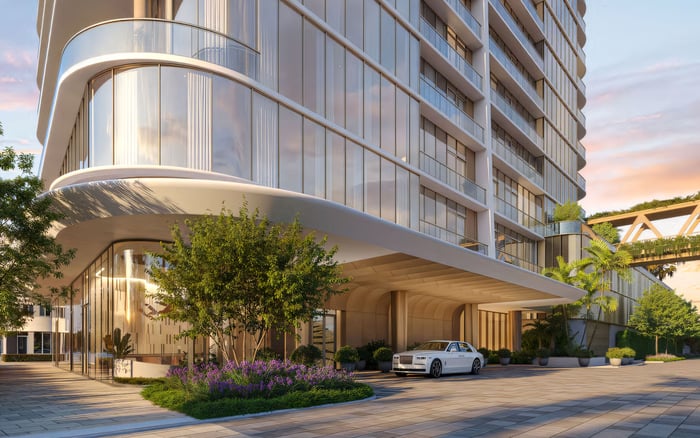
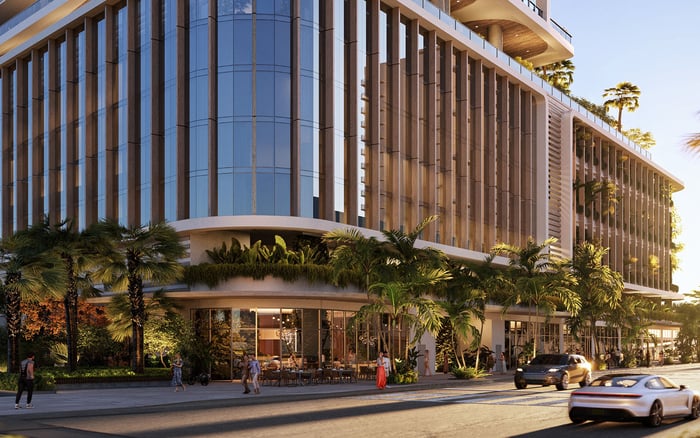
The first favors a curated podium: an address that functions like a micro-district, where retail is part of a composed arrival sequence. The ground floor reads as intentional-canopies, lighting, storefront transparency, and landscaping that feel designed, not merely leased. This is where “hotel logic” applies: the public-facing layer stays active, while the residential entry remains calm, legible, and controlled.
The second camp prioritizes a protected base: minimal public interface, fewer unknowns, and an emphasis on privacy. These buyers may still want restaurants and shops nearby, but prefer that energy across the street rather than directly beneath their home.
Neither is inherently superior. The right choice depends on how the building separates public and private circulation. A well-executed podium can feel more exclusive than a quiet base when it’s paired with strong access control and disciplined back-of-house planning.
Luxury is often defined by what you never have to notice. Retail integration should be judged through that exact lens.
Arrival choreography.
When valet, rideshare drop-off, and resident parking all converge at a single curb cut, the experience can feel purely transactional. Stronger solutions separate resident arrival from retail foot traffic-or at least separate it visually through landscaping, grade changes, or a covered motor court.
Lobby sovereignty.
Retail should not borrow prestige from the residential lobby by sharing the same doors, desk, or corridor. The best-performing buildings treat the lobby as sovereign territory, with a distinct address, clear sightlines, and a defined security posture.
Elevator integrity.
Dedicated residential elevator banks become even more critical when the podium is active. If residents share elevators with retail staff, service vendors, or restaurant patrons, the building will feel busier than it should.
Line management.
Even excellent retail can create friction if queuing spills onto the sidewalk at peak hours. The premium version of integration anticipates demand and includes space to absorb it-without making the building feel crowded.
A luxury buyer should underwrite retail with the same seriousness as a building engineer.
Loading and deliveries.
The line between seamless and disruptive often comes down to the loading plan. Ideal arrangements keep deliveries off the primary street frontage and away from residential drop-off. If trucks routinely double-park in front of the lobby, you will feel it as a resident-and so will future buyers.
Trash and odor control.
Restaurants can be an asset, but only with properly designed grease management, exhaust routing, and odor mitigation. Even non-restaurant tenants can introduce issues: frequent cardboard pickups, cleaning chemical smells, or late-night waste hauling. Sophisticated buyers look for separation, filtration, and a service route that avoids resident-facing space.
Acoustics and vibration.
Fitness concepts, music-forward venues, and certain mechanical systems can transmit vibration into residential slabs if they aren’t isolated. The most desirable towers plan for this early, using structural isolation and acoustic assemblies rather than trying to manage it with operational rules after opening.
Fire and life safety boundaries.
Retail adds complexity to egress and compartmentation. You don’t need to review drawings to ask the essential question: are the retail and residential components truly independent in an emergency, or is the residential experience dependent on the retail plan working perfectly?
Retail can strengthen value in three primary ways.
1) Daily-life premium.
Walkability isn’t a slogan; it’s time saved, fewer car trips, and the sense that the neighborhood meets you where you are. In Downtown, where schedules can be dense, that premium tends to hold.
2) Brand adjacency and place-making.
Curated retail can add narrative to an address. When the podium is anchored by concepts that align with the building’s design, buyers perceive the whole as more deliberate. That perception can support pricing power even when the broader market fluctuates.
3) Liquidity through broader buyer appeal.
A tower that lives well at street level often attracts multiple buyer profiles: end-users who want lifestyle, investors who want rentability, and pieds-à-terre owners who want convenience without friction.
In Brickell, for example, podium activation complements the district’s rhythm of work, dining, and waterfront promenades. Buyers exploring 2200 Brickell often evaluate not only interiors and amenities, but also whether the immediate streetscape truly supports an on-foot routine.
Retail is not automatic “upside.” The most common downside risks are predictable-and underwritable.
Nuisance externalities.
Noise, late operating hours, and congested curb space are the obvious culprits, but subtler issues matter too: brighter-than-expected signage, delivery activity at dawn, and odor plumes that only appear when the wind shifts.
Brand dilution.
Luxury towers trade on cohesion. If the retail feels generic-or if signage and storefronts aren’t coordinated-the base can read like an afterthought. That doesn’t just weaken curb appeal; it changes how it feels to come home.
Tenant churn.
Retail turnover can trigger a cycle of construction, permitting, and reopening. Even when temporary, it adds disruption and an undertone of instability at the base. Buildings with strong curation and leasing discipline typically mitigate this by controlling fit-out standards and limiting incompatible uses.
Downtown iconography can help frame the decision. A waterfront address such as Aston Martin Residences Downtown Miami speaks to a specific buyer psychology: design-forward, city-connected, and comfortable with an activated urban edge-provided the private realm remains uncompromised.
Retail integration is easiest to evaluate when you translate it into questions that expose the building’s intent.
Access and circulation
Is the residential lobby entry clearly separate from retail entries?
Are residential elevators accessible without passing through retail corridors?
Where do rideshare and valet stack during peak dinner hours?
Operations and rules
Are there restrictions on hours, music, exterior speakers, or outdoor seating?
Are certain uses prohibited (late-night venues, heavy fitness, high-odor kitchens)?
Service design
Where is loading, and can trucks avoid the lobby frontage?
How does trash move from retail to pickup without crossing resident paths?
Physical mitigation
What acoustic and vibration measures are in place between retail and residences?
How is kitchen exhaust routed, and where does it terminate?
Even without technical documents, these questions clarify whether the tower was designed for luxury living first-or whether retail was accommodated later.
Retail integration reads differently depending on the neighborhood.
Downtown.
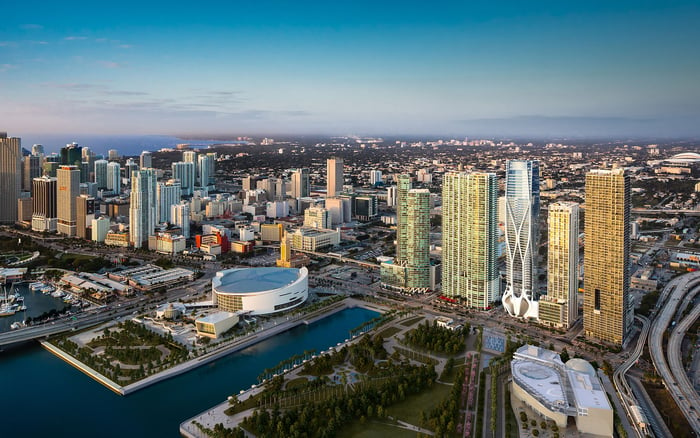
Downtown’s appeal is its cultural gravity and evolving live-work-play identity. Ground-floor retail can help a tower feel embedded rather than isolated, especially as streets become more pedestrian-friendly. The strongest Downtown podiums prioritize legibility: you should know where to enter, where to wait, and how to move-without feeling like you’re navigating a mixed-use maze.
Brickell.
Brickell’s retail runs at a higher frequency: coffee runs, quick lunches, after-work dining. A tower benefits when the retail matches that cadence while preserving residential calm. Buyers considering branded environments such as 888 Brickell by Dolce & Gabbana tend to be especially sensitive to whether the public realm delivers on the brand promise at the door.
Edgewater and the urban waterfront.
In Edgewater, the podium question often comes down to balance. Buyers may want proximity to conveniences, but also value a quieter, more residential streetscape. Developments like Aria Reserve Miami can be evaluated for how the neighborhood layer complements bayside living rather than competing with it.
A luxury buyer can often read integration quality within minutes.
Clear hierarchy.
The residential entrance remains the focal point. Retail is present, but never dominant.
Material continuity.
Stone, metalwork, and lighting that carry from the retail frontage into the residential arrival signal unified design intent.
Thoughtful transparency.
Storefronts that are elegant and properly proportioned keep the sidewalk lively without turning the base into a billboard.
Landscape as buffer.
Trees, planters, and setbacks act as soft security. They also dampen noise and create a sense of distance.
Discreet back-of-house.
The less you see of service doors, the more expensive the building feels.
For investors and second-home buyers, retail introduces an additional variable in underwriting.
Revenue is not your only metric.
Even when the retail component contributes to building economics, residents care more about quality of life and long-term marketability.
Governance matters.
Focus on who controls retail leasing and standards. A strategy guided by long-term brand stewardship typically produces a more stable, more valuable residential environment than one optimized purely for short-term rent.
Exit matters.
In resale, buyers will ask whether the retail is an asset or a headache. Buildings with consistent, compatible tenants tend to have cleaner resale conversations because the podium is already “understood” by the market.
Ground-floor retail in Downtown Miami high-rises is compelling when it feels curated, buffered, and operationally invisible to residents. It becomes a liability when it blurs public and private space, introduces persistent nuisances, or dilutes the address with mismatched tenants.
For the ultra-premium buyer, the question isn’t whether retail exists. It’s whether the building treats retail as part of a designed experience-one where privacy, logistics, and acoustics are engineered to protect the home above.
Does ground-floor retail always increase a condo’s value? Not always; it performs best when the tenant mix and operations reinforce a luxury arrival.
What is the biggest privacy risk with retail integration? Shared circulation-especially lobbies or elevators that mix residents and visitors.
Are restaurants under a tower automatically a problem? No, but they require strong odor control, exhaust routing, and delivery management.
What should I listen for during a tour? Curb noise, loading activity, and interior vibration near lower residential floors.
Do higher floors eliminate retail-related issues? They can reduce noise, but deliveries, odors, and crowding can still affect arrival.
How can a building prevent retail lines from affecting residents? With setbacks, dedicated queuing space, and a clearly separate residential entry.
Is tenant turnover a meaningful concern? Yes; turnover can mean repeated construction cycles and inconsistent street presence.
What retail uses tend to conflict with luxury living? High-volume late-night concepts and vibration-heavy fitness uses are common friction points.
Should I avoid buying on the lowest residential floors above retail? Not necessarily, but those floors deserve extra scrutiny for acoustics and privacy.
What is the simplest sign of a well-designed mixed-use tower? You can enter as a resident without ever feeling like you are in the retail zone.
If you'd like a private walkthrough and a curated shortlist, connect with MILLION Luxury.
If branded residences are on your mind — as a home or as an allocation — we would be glad to share what we are seeing, privately.
Begin a quiet conversation