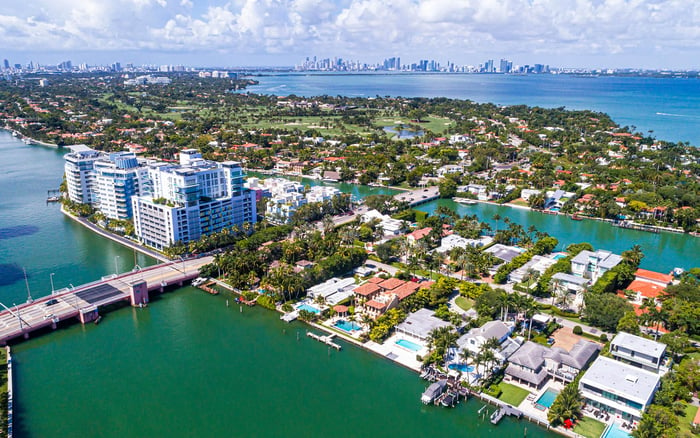
For affluent families relocating to South Florida, Florida residency is not merely a closing. Domicile, homestead, school enrollment, guardianship and federal estate planning should be coordinated before the purchase contract is signed.

For families with school-age children, buying in South Florida is rarely just a lifestyle decision. The home can become the visible center of a broader legal and tax position: where the parents intend to live, where the children attend school, where estate documents should operate, and how a primary residence will pass if a parent dies unexpectedly.
Florida is compelling for affluent buyers because the state does not impose an estate or inheritance tax, and its constitution prohibits a state tax on the income of residents or citizens. Florida estate tax is also not imposed for estates of decedents who died on or after January 1, 2005. Still, the planning conversation should not stop with taxes. For families with minor children, Florida homestead rules can be more consequential than the headline tax savings.
The most sophisticated buyers treat a South Florida purchase as a coordination exercise. A waterfront condominium near Brickell schools, such as 2200 Brickell, may support a new daily rhythm, but domicile depends on the family’s broader pattern of conduct. Time spent in Florida, school enrollment, driver licenses, voter registration, homestead filings and estate documents should all tell the same story.
Florida allows an individual to file a sworn Declaration of Domicile stating that they reside in and maintain a Florida place of abode as their predominant, principal home. That declaration can be useful, but it is only one part of the record. For relocating families, facts involving the children often become highly practical evidence: where they are enrolled, where the school calendar is centered, and where the family actually spends ordinary weeks.
Florida compulsory school attendance generally applies to children who have reached age 6 but not age 16. As a result, school timing often drives the relocation calendar. Private-school admissions, public school enrollment, tutoring transitions and extracurricular commitments should be organized before closing whenever possible. Florida new-resident guidance also ties driver licensing obligations to acts such as registering to vote, accepting employment, filing for homestead exemption or enrolling children in public school.
That is why a Coconut Grove purchase, for example, may require more than design review and financing. A family considering Four Seasons Residences Coconut Grove should also ask counsel when to update wills, revocable trusts, health care documents, durable powers of attorney and guardian designations, so the family’s paper life matches its physical move.
Florida homestead is one of the state’s most powerful planning concepts. A qualifying primary residence can receive a homestead exemption that reduces taxable value by up to $50,000, although the second $25,000 does not apply to school district taxes. Applications are generally due by March 1 for the relevant tax year.
Once homestead is established, the Save Our Homes limitation generally caps annual increases in assessed value at the lower of 3% or the change in the Consumer Price Index. If a family later moves within Florida, portability rules may allow the homeowner to transfer up to $500,000 of Save Our Homes benefit to a new Florida homestead.
For families purchasing in West Palm Beach, Boca Raton or Miami Beach, these rules can matter across multiple ownership cycles. A buyer evaluating The Ritz-Carlton Residences® West Palm Beach may be focused on the first school chapter, while portability planning may affect the next residence after the children graduate.
Homestead also offers creditor protection. Florida homestead property is protected from forced sale by most creditors, with exceptions for obligations such as taxes, purchase, improvement or repair obligations, and labor performed on the property. The protection is subject to acreage limits: up to 160 acres outside a municipality and up to one-half acre within a municipality.
The critical point for parents is that Florida homestead cannot be freely devised if the owner is survived by a spouse or minor child. That rule can disrupt a preferred trust-based inheritance plan if the residence is not titled and planned properly.
If a decedent is survived by a spouse and descendants, Florida homestead generally passes as a life estate to the spouse with a vested remainder to descendants, unless the spouse elects a one-half tenancy-in-common interest. In a blended family, a second marriage or a structure involving children from prior relationships, that result may not match the parents’ private intentions.
Florida’s elective share adds another layer. A surviving spouse has a right to 30% of the elective estate, so prenuptial agreements, trusts, beneficiary designations and homestead planning should be coordinated before purchase. For a Boca Raton family reviewing The Residences at Mandarin Oriental Boca Raton, the purchase agreement and the estate plan should be addressed in the same planning cycle, not months apart.
Parents should also consider a Florida pre-need guardian declaration for minor children. A written declaration can become important if the last surviving parent dies or becomes incapacitated. For high-net-worth families, guardian planning should be separated from financial inheritance planning: the best guardian of a child may not be the best trustee of complex assets.
Florida residency does not eliminate federal estate tax. For 2025, the federal basic exclusion amount is $13.99 million, and the annual gift tax exclusion is $19,000 per recipient. Families with concentrated business interests, carried interests, art, aircraft, multi-state real estate or closely held entities should continue to model federal exposure.
Ownership structure also matters if the buyer is not yet a Florida resident. If a nonresident dies owning Florida real property, ancillary administration may be required. That possibility is a reason to coordinate Florida real estate ownership with wills, revocable trusts, entity planning and domicile strategy before title is taken.
Education planning belongs in the same conversation. 529 plan planning can intersect with estate planning because federal rules allow tax-free treatment for qualified education expenses when requirements are met. Florida’s 529 Savings Plan can be used for qualified education expenses such as tuition, fees, books, supplies, equipment, computers and certain room-and-board costs.
For families drawn to Miami Beach, a residence such as The Perigon Miami Beach may represent permanence, but the planning should also cover liquidity for education, guardianship if both parents are unavailable, and administrative simplicity for trustees.
Before signing, buyers should meet with Florida estate counsel and tax advisors. This is not legal advice, but it is a practical sequence: confirm whether Florida domicile is truly intended, review current wills and trusts, decide how title should be held, analyze homestead eligibility, coordinate marital agreements, prepare guardian documents, and time school enrollment with driver licensing and voter registration steps.
Families should also keep records that support the move. Calendar days in Florida, school documentation, physician relationships, club memberships, charitable involvement, banking, insurance and professional licenses can all help demonstrate that Florida is not merely a seasonal address. Private-school timing should be treated as a domicile fact, not only an admissions matter.
South Florida offers remarkable choices, from Brickell to Coconut Grove, Boca Raton, West Palm Beach and Miami Beach. The more valuable the home, and the younger the children, the more important it is to make the residence fit the estate plan rather than forcing the estate plan to repair a rushed purchase later.
Does buying a South Florida home automatically make me a Florida resident? No. A purchase can support Florida domicile, but conduct such as school enrollment, licensing, voting, homestead filing and time spent in Florida should align.
Should I file a Declaration of Domicile? It can be useful because Florida allows a sworn declaration of a predominant, principal home, but it should not be the only step.
Why is homestead planning different when I have minor children? Florida homestead cannot be freely devised if the owner is survived by a spouse or minor child, which can override a preferred inheritance structure.
Can Florida homestead reduce property taxes? A qualifying primary residence can reduce taxable value by up to $50,000, with the second $25,000 not applying to school district taxes.
When is the homestead exemption application generally due? Applications are generally due by March 1 for the tax year, so closing and residency timing should be reviewed early.
What is Save Our Homes? Once homestead is established, annual assessed value increases are generally capped at the lower of 3% or the Consumer Price Index change.
Can I transfer a homestead tax benefit to another Florida home? Florida portability rules may allow transfer of up to $500,000 of Save Our Homes benefit to a new Florida homestead.
Does Florida residency remove federal estate tax concerns? No. Federal estate tax still applies above federal thresholds, with a 2025 basic exclusion amount of $13.99 million.
Should guardianship documents be updated after moving? Yes. Parents can make a Florida pre-need guardian declaration for minor children, which should coordinate with the broader estate plan.
Do 529 plans belong in the estate planning conversation? Yes. 529 planning can support qualified education expenses and should be coordinated with gifting, liquidity and trustee planning.
To compare the best-fit options with clarity, connect with MILLION.
If branded residences are on your mind — as a home or as an allocation — we would be glad to share what we are seeing, privately.
Begin a quiet conversation