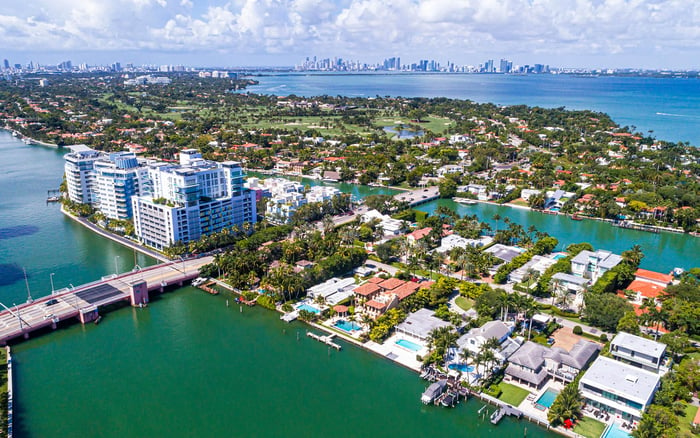
A discreet buyer’s guide to South Florida wealth migration for Dubai-based and globally mobile families, focused on lifestyle fit, ownership discipline, privacy and project selection.

For globally mobile buyers, South Florida is no longer merely a winter escape. It is increasingly a question of where family capital, daily life and long-term flexibility can coexist with discretion. Buyers arriving from Dubai, or from a wider Gulf and international context, tend to assess South Florida through a sophisticated lens: privacy, flight access, service culture, schools, waterfront quality, security, tax planning, estate planning and the ability to move between business and leisure without friction.
Palm Beach sits at the center of that conversation because it offers a particular kind of permanence. The island’s appeal is not simply ocean or architecture, although both matter. It is the sense of social continuity, controlled scale and residential calm. A buyer accustomed to Dubai’s new-build precision may find Palm Beach more understated, more house-led and more relationship-driven. The purchase process can also feel different. The best properties may not behave like commodity inventory, and timing, representation and discretion can matter as much as price.
Dubai has conditioned many luxury buyers to expect highly serviced environments, ambitious design, branded hospitality and new construction delivered at scale. South Florida answers that expectation unevenly, which makes area selection critical. Some neighborhoods offer vertical luxury with amenities, concierge environments and skyline views. Others offer low-density residential privacy, private clubs, beaches, marinas and established single-family streets.
In Brickell, the language is international, high-rise and finance-oriented. It suits buyers who want immediate access to dining, offices, waterfront towers and a cosmopolitan daily rhythm. Projects such as St. Regis® Residences Brickell speak to the branded-residence buyer who values service standards, arrival sequence and a building identity understood across borders.
Miami Beach is more lifestyle-led, with a strong emphasis on ocean proximity, design pedigree and cultural access. A residence such as The Perigon Miami Beach may appeal to buyers seeking a refined coastal address with a more resort-like sense of place. The tradeoff is that coastal condominium ownership requires careful review of building governance, reserves, insurance, maintenance obligations and rental rules.
Palm Beach and West Palm Beach are often discussed together, but they solve different buyer problems. Palm Beach is about scarcity, privacy, established prestige and a quieter rhythm. It is especially relevant for families seeking a long-duration foothold rather than a purely tactical purchase. The island’s housing stock can be highly individual, and buyers should be prepared for a process shaped by condition, renovation potential, landmark character and micro-location.
West Palm Beach, by contrast, has become a natural companion market for buyers who want convenience, newer residential formats and immediate access to an expanding urban core. It can offer a more turnkey condominium path while maintaining proximity to Palm Beach. For those evaluating the Flagler corridor and the broader waterfront, Alba West Palm Beach provides one example of how buyers are reading West Palm Beach as a residential alternative with views, services and access.
For a buyer moving between Dubai, London, New York and South Florida, the distinction matters. Palm Beach may serve as the family’s private anchor. West Palm Beach may serve as the practical lock-and-leave residence, staff apartment, executive base or next-generation foothold. The right answer depends less on prestige than on how the property will actually be used.
Boca Raton is often compelling for families who want a broader daily-life infrastructure: schools, clubs, wellness, golf, shopping, dining and a more residential suburban pattern. It is not trying to be Miami or Palm Beach. Its appeal lies in a polished, self-contained lifestyle that can feel particularly intuitive for buyers who value security, convenience and space.
In Boca Raton, the decision often comes down to whether the family prefers a single-family estate, a club environment or a serviced condominium residence. The Residences at Mandarin Oriental Boca Raton belongs in the conversation for buyers who understand hospitality as part of residential life and want a recognizable service framework. For families planning extended stays, due diligence should include pet policies, guest protocols, parking, storage, fitness amenities, food and beverage access and the day-to-day standards of building management.
Investment should be treated with restraint. South Florida can be a compelling store of lifestyle value, but buyers should avoid reducing the decision to a simple appreciation narrative. Ultra-prime property is local, emotional and deeply specific. Two residences in the same building can carry very different liquidity profiles because of view, floor height, terrace depth, condition, ceiling height, parking and the quality of prior customization.
A disciplined buyer begins with structure. Will the property be owned personally, through an entity or within a broader estate plan? Will financing be used for liquidity management, or will the purchase be cash-led? Are there currency considerations, family governance issues or succession goals? These are not administrative details. They can shape the practical value of the asset over time.
The second layer is operating cost. Condominium fees, insurance, property taxes, assessments, staff, maintenance and renovations should be reviewed before emotional attachment sets in. A glamorous residence can become frustrating if the ownership experience is misaligned with how the family travels, entertains and delegates.
South Florida offers three broad luxury archetypes. The first is the waterfront condominium, prized for views, amenities and lock-and-leave simplicity. The second is the branded or hospitality-led residence, where service culture and identity carry weight. The third is the private estate or low-density residential address, where land, privacy and control matter most.
For buyers comparing these models, the question is not which is best. It is which risk profile and lifestyle profile fit the family. A waterfront condominium may offer convenience but less control over building decisions. A single-family estate may provide privacy but require more management. A branded residence may simplify service expectations but should still be evaluated on floor plan, governance and resale depth.
In Palm Beach, Palm Beach Residences can be considered within the broader search for residences aligned with the area’s understated appeal. In Miami, the calculus may be more urban. Brickell buyers may prioritize views, arrival, security and dining access, while Miami Beach buyers may place more value on ocean proximity, cultural life and an indoor-outdoor rhythm.
The most successful buyers arrive with a written brief. It should identify who will use the property, how many months per year it will be occupied, whether staff will be present, how guests will be hosted, whether children or parents are part of the plan and how much management the owner is willing to tolerate.
A second checklist should address the asset itself: title, inspections, condominium documents, budgets, reserves, insurance, pending work, alteration rules, rental limitations and closing logistics. For new construction or pre-construction, buyers should review deposit structure, delivery assumptions, developer track record, finish specifications and what is included versus what remains optional.
The final lens is personal. South Florida is not one decision. It is a series of neighborhoods with different codes of behavior. A buyer who wants global energy may feel at home in Brickell. A buyer who wants heritage and privacy may prefer Palm Beach. A buyer who wants culture and beach life may choose Miami Beach. A buyer who wants a polished family base may find Boca Raton more practical than expected.
Is Palm Beach the natural choice for buyers coming from Dubai? It can be, especially for buyers seeking privacy, scarcity and a long-term family anchor. Others may prefer Miami or Boca Raton depending on lifestyle and access needs.
How is West Palm Beach different from Palm Beach? West Palm Beach generally offers a more urban, practical and condominium-led experience. Palm Beach is more established, lower density and privacy-oriented.
Is Brickell appropriate for a second home? Yes, particularly for buyers who want skyline living, dining, business access and a lock-and-leave format. It is less suited to those seeking quiet estate living.
Should international buyers focus on branded residences? Branded residences can provide recognizable service standards and operational comfort. Buyers should still review governance, fees, floor plans and resale dynamics.
What should buyers review before purchasing a condominium? Review budgets, reserves, insurance, assessments, rules, parking, storage and alteration policies. The operating experience matters as much as the view.
Is Miami Beach more lifestyle-driven than investment-driven? Often, yes. Its strongest appeal is coastal living, cultural access and design-led residences, although each property should be evaluated individually.
Can Boca Raton work for ultra-luxury families? Yes. Boca Raton can be highly practical for families prioritizing schools, clubs, wellness, space and a polished daily routine.
Should buyers use financing or purchase in cash? That depends on liquidity, tax planning and broader family strategy. The decision should be coordinated with legal, tax and banking advisors.
What is the biggest mistake wealth-migration buyers make? The most common mistake is choosing by reputation alone. Micro-location, building quality and daily usability often determine long-term satisfaction.
How should a buyer begin the search? Start with a written lifestyle and ownership brief before touring properties. That discipline keeps the search aligned with privacy, service and capital goals.
For a tailored shortlist and next-step guidance, connect with MILLION.
If branded residences are on your mind — as a home or as an allocation — we would be glad to share what we are seeing, privately.
Begin a quiet conversation