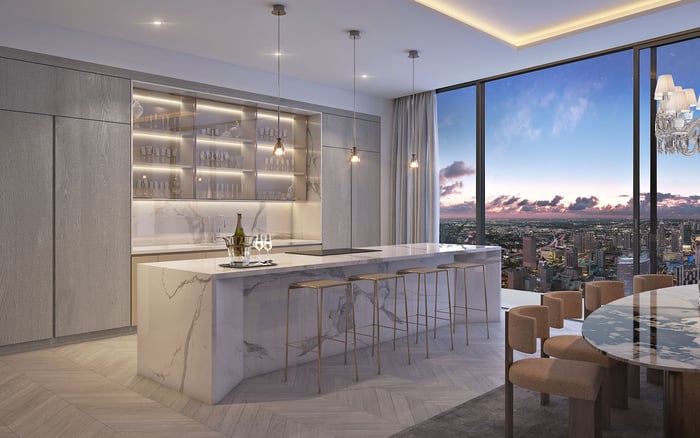
A discreet back-of-house plan has become one of the defining marks of a truly sophisticated private estate. In South Florida, the most accomplished homes separate owner life from operational movement through hidden corridors, self-contained staff suites, acoustic control, screened service entries, and code-compliant life-safety planning.

In the finest private estates, what remains unseen is often as important as what is immediately visible. Grand salons, sculptural staircases, pool terraces, and waterfront entertaining rooms may shape a residence’s public identity, yet the true measure of refinement often lies in the choreography behind them. Designing staff quarters and invisible service corridors is no longer a secondary exercise. It has become a defining layer of estate planning for owners who expect privacy, operational ease, and gracious hosting without friction.
The contemporary approach is typically anchored by a service core. Rather than scattering utility rooms and staff functions throughout the plan, designers increasingly group kitchens, laundries, mechanical rooms, and staff areas into a dedicated back-of-house zone set apart from owner and guest circulation. That move creates two residences in one: the front-of-house experience, calm and elevated, and the hidden operational network that supports it.
For South Florida buyers, this matters at every scale, from expansive waterfront compounds to highly serviced branded residences. Even in vertical luxury living, the same design intelligence appears in the way support spaces are concealed and circulation is separated. The restrained elegance associated with projects such as The Residences at 1428 Brickell reflects a broader market expectation: the home should feel effortless, even when the infrastructure behind it is highly complex.
A successful service corridor does not announce itself. It is typically placed behind walls, folded into secondary circulation bands, or aligned with mechanical zones so it never registers from formal rooms. The point is not simply concealment for its own sake. It is to preserve the residence’s visual calm and prevent operational movement from interrupting owner life.
In practice, that means staff can move from prep kitchen to dining-room support zone, from laundry to linen storage, or from outdoor service entry to utility areas without crossing the main arrival sequence. Side and rear service entries are often screened with landscape walls, gates, or architectural panels so deliveries and routine household movement remain out of sight. Outdoor circulation may also wrap around the perimeter of the estate through hardscaped garden paths, allowing staff to move between functions without cutting across courtyards, terraces, or pool decks.
In large multistory homes, vertical circulation follows the same logic. Service elevators are often designed with separate landings so they do not intersect with owner-facing lift lobbies. Dumbwaiters also remain relevant in larger estates, especially where linens, provisions, glassware, or plated service need to move discreetly between floors.
This is where design begins to resemble hospitality planning. Many of the most polished homes in Miami Beach and Surfside borrow a hotel-grade discipline in the way service routes are visually suppressed while remaining highly functional. That same sensibility can be seen in residences shaped around privacy and ceremonial arrival, including The Delmore Surfside.
In older luxury homes, staff accommodation was often treated as an afterthought. In today’s private estates, the expectation is markedly different. Staff quarters are commonly conceived as self-contained suites with private baths and compact food-prep capability, reducing unnecessary overlap with the principal household. This arrangement supports privacy on both sides. Owners preserve the residential atmosphere of the main home, while resident staff gain autonomy and dignity in their day-to-day routine.
In more elaborate compounds, a hierarchy may also emerge. Senior household roles may be given larger accommodations or more private placement within the service wing, reflecting the estate’s operational structure. Flexibility is increasingly important as well. A room planned for live-in staff today may need to function as an office, security room, wellness support suite, or multigenerational overflow space in the future.
That adaptability is especially relevant in South Florida, where households can evolve seasonally and service needs may shift between full-time residence, holiday occupancy, and event-heavy entertaining. Whether in a substantial single-family setting or a more managed luxury environment such as Villa Miami, buyers increasingly understand that support space should be livable, not merely hidden.
The illusion of effortlessness breaks instantly when a residence sounds operational. For that reason, acoustic control is central to hidden service design. Walls, floors, and corridor assemblies are often treated with sound-dampening strategies that exceed ordinary residential expectations, particularly where staff areas sit near owner suites, libraries, cinemas, or formal entertaining rooms.
Mechanical planning matters just as much. Separate HVAC zoning for staff and service areas improves privacy, gives households more precise operational control, and creates air separation from the principal residence. Hidden service design also relies on dedicated chases, plenum zones, and wall cavities that conceal ductwork, piping, and wiring behind finished surfaces. Without these hidden layers, a corridor may appear discreet while still performing poorly.
Laundry and utility rooms are frequently stacked vertically in larger homes to shorten plumbing runs and keep wet functions away from the quietest parts of the house. Butler’s pantries and secondary prep kitchens are often concealed with pocket doors or similarly low-visibility detailing, allowing entertaining to feel polished even when service is moving at full pace behind the scenes.
For discerning buyers in Brickell, Downtown, or Coral Gables, this is one of the clearest distinctions between surface luxury and deeply resolved planning. Buildings and estates that privilege serenity over spectacle tend to feel better over time, particularly in homes intended for frequent hosting.
Today’s back-of-house planning is not merely spatial. It is increasingly digital. Motion-activated lighting, controlled-access locks, and discreet communication systems are now common in service zones, helping staff move efficiently while preserving a quiet residential atmosphere. Privacy glass and carefully managed sightlines can also provide situational awareness between adjacent rooms without exposing back-of-house movement.
In Florida, however, discretion never exempts a project from compliance. Staff quarters still must satisfy core residential building requirements, including habitable space, egress, and life-safety provisions. Depending on project scope and code path, fire-safety planning may require rated doors, clear egress routes, and integrated alarm or sprinkler coordination. Where accessibility considerations apply, service routes and staff accommodations may also need to address accessible-design standards in fixtures and layout.
This is particularly relevant in Broward and other local jurisdictions where enforcement happens through permitting and inspection rather than through a special estate category. The message for owners is simple: hidden does not mean informal. The finest estates treat staff quarters and service circulation with the same seriousness given to a primary suite or gallery hall.
A beautiful floor plan can still fail operationally if back-of-house circulation has been compressed too aggressively. Buyers should ask whether the residence has a genuinely separate service core, whether staff can move from entry to work zones without crossing guest rooms, and whether vertical service routes remain independent in multilevel designs.
They should also look closely at acoustic strategy, HVAC zoning, and the placement of concealed support spaces such as prep kitchens, laundry stacks, and mechanical rooms. If staff accommodation is included, the better question is not simply whether there is a room, but whether the suite functions properly as daily living space and can adapt over time.
For the South Florida audience, this lens applies across product types. A Palm Beach compound, a Fisher Island residence, or a new ultra-luxury tower may express it differently, but the principle remains constant: privacy is designed through circulation. The most persuasive homes understand that service should feel proximate in performance and invisible in experience.
What is an invisible service corridor in a luxury estate? It is a circulation route designed for staff and household operations that remains separate from the main living and entertaining areas.
Why are staff quarters now more self-contained? Self-contained suites reduce overlap with household spaces and support privacy, autonomy, and smoother daily operations.
Do large estates still use service elevators? Yes. In multistory homes, separate service elevators and landings help keep operational movement out of owner-facing circulation.
How do designers hide service entries? They are often placed at the side or rear of the property and screened with landscaping, walls, or architectural panels.
What role does acoustics play in back-of-house design? Acoustic isolation helps prevent staff movement, laundry noise, and mechanical sound from reaching bedrooms or formal rooms.
Why is separate HVAC zoning valuable in staff areas? It improves privacy, gives better operational control, and helps separate air handling from the principal residence.
Can staff quarters be flexible over time? Yes. Many are planned to convert between sleeping rooms, offices, and multipurpose support spaces as needs change.
Are dumbwaiters still relevant in modern estates? They are, especially in large homes where linens, dishes, and provisions need to move discreetly between floors.
Do Florida rules apply differently to estate staff quarters? No. They still must comply with standard residential requirements for habitable space, egress, and life safety.
What should a buyer review first in a luxury floor plan? Start with circulation, not finishes. A strong separation between owner and service movement is often what makes a home feel truly effortless.
To compare the best-fit options with clarity, connect with MILLION Luxury.
If branded residences are on your mind — as a home or as an allocation — we would be glad to share what we are seeing, privately.
Begin a quiet conversation