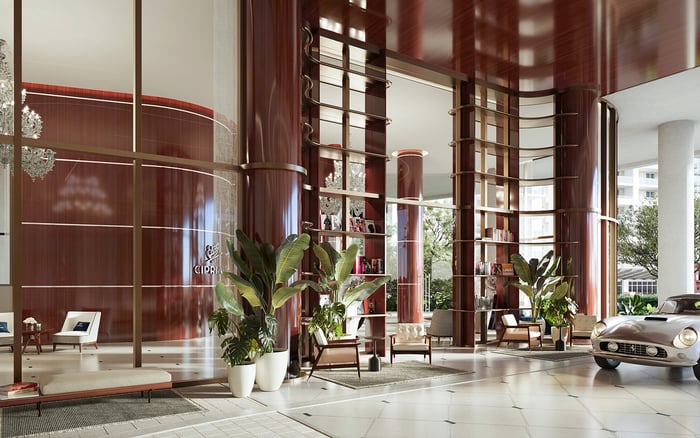
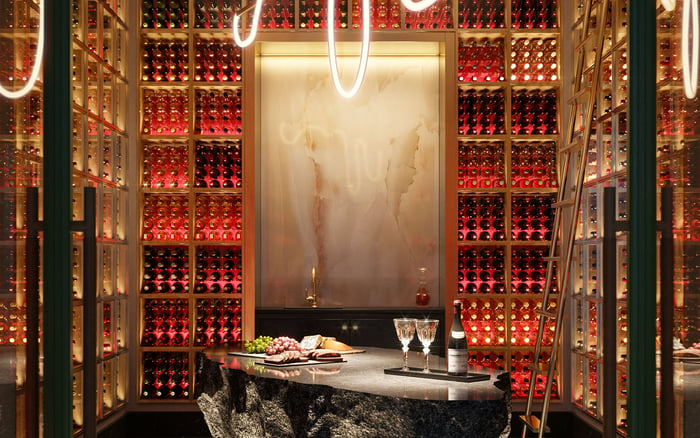
A discreet, buyer-oriented comparison of how resident-only dining signals privacy, access control, and social texture in two Brickell addresses.
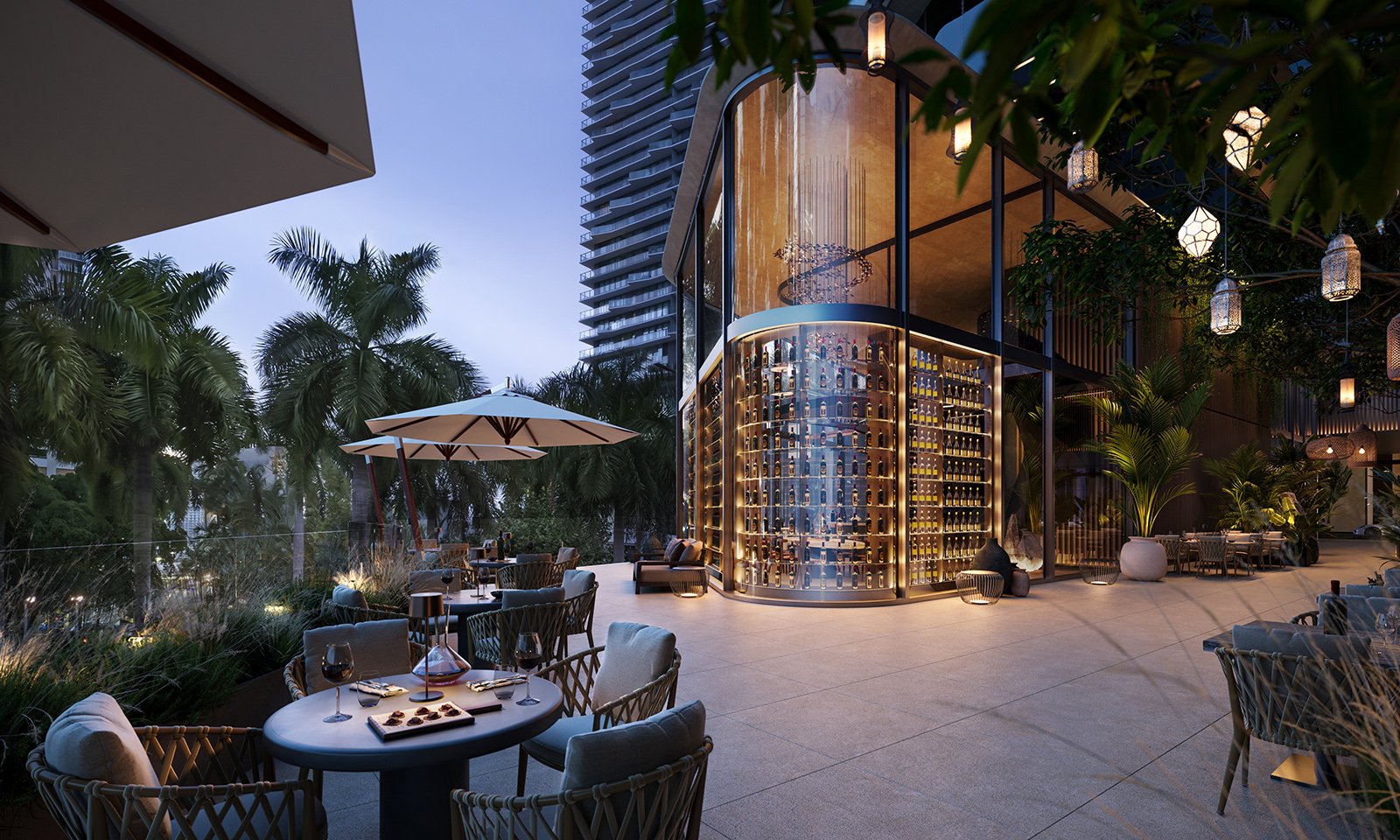
In ultra-premium Miami, resident-only dining is rarely just a convenience. It is a filter. Often, the real value is not the room itself, but who can enter it, how that access is managed, and what it signals about a building’s culture.
In Brickell-where five-star hospitality cues have migrated into residential towers-dining becomes a proxy for an address’s internal hierarchy: front-of-house discretion, reservation priority, the visibility of outsiders, and the subtle ways a building buffers residents from the friction of a public-facing scene. When dining is explicitly resident-only, the question is not simply “Is there a restaurant?” It is “Is there a protected social room that functions like an extension of my home?”
This is the lens through which sophisticated buyers often compare ORA by Casa Tua Brickell and Colette Residences Brickell. Rather than over-indexing on any single promise, the sharper approach is to evaluate how resident-only dining shapes privacy, predictability, and the relationships that form inside the building.
Exclusivity in dining is often misread as a function of price point or a celebrated name. In a residential tower, it is typically more architectural and operational than culinary.
Consider exclusivity across five practical dimensions:
Access control: Is entry physically and procedurally restricted to residents and their guests? The tighter and more legible the gatekeeping, the more the space operates as a true private club.
Visibility: Can the dining venue be seen from high-traffic public areas, or is it embedded within resident circulation? A dining room that feels truly “inside the building” tends to preserve a calmer social temperature.
Reservation friction: How easy is it to secure a table on a whim? Exclusivity erodes when the space is treated like an event venue-constantly programmed and consistently crowded.
Guest policy: The details are decisive. Are guests welcome only when accompanied? Is there a soft cap on party size? The best resident-only dining feels warm, but not porous.
Service culture: True discretion shows up in staffing patterns, recognition, and the ability to deliver consistent hospitality without spectacle.
In other words, the dining room is not just an amenity. It is an operating system for how private the building will feel, day after day.
With ORA by Casa Tua Brickell, the appeal for many high-net-worth buyers is dining that reads as a resident privilege rather than a public destination. In a market saturated with lobby bars and “hotel-adjacent” concepts, a resident-only format can move the experience from performance to comfort.
In practical terms, resident-only dining at ORA suggests a relationship-based rhythm. When the same faces return, staff recognition and preference memory become part of the value. For buyers who entertain often, that difference is tangible: hosting in a controlled environment, where timing, seating, and privacy are less variable than in a crowded scene.
The exclusivity signal here is not necessarily about formality; it is about predictability. A resident dining room that behaves like a private extension of home can support spontaneous decisions: a late dinner without negotiating the city’s reservations economy, or a discreet meeting that does not require a public-facing venue.
For some, the most meaningful luxury is the ability to be social without being exposed. Resident-only dining, when executed well, delivers exactly that.
At Colette Residences Brickell, exclusivity can be assessed less as a single “amenity headline” and more as an ecosystem: the building’s tone, the residents it attracts, and how internal spaces encourage repeat interaction.
A resident-only dining component, where present, tends to matter most when it reinforces a coherent community. Some buildings cultivate a quieter, more design-forward sensibility; others skew toward an extroverted, nightlife-adjacent cadence. The right fit is not universal. It is personal-and it becomes obvious in how residents use shared spaces on ordinary weekdays.
For buyers who prioritize understated luxury, the most exclusive dining room is not the one that tries to impress. It is the one residents actually use because it is comfortable, controlled, and operationally smooth.
The guiding question at Colette is this: does the dining experience feel like a true resident advantage, or does it read as a flexible space that could be repurposed? In a top-tier purchase, permanence and clarity of use are often part of what you are underwriting.
When comparing exclusivity between ORA and Colette in Brickell, it helps to focus on what dilutes resident-only dining.
Permeability shows up when the dining venue becomes a magnet for non-residents-even informally-or when guest policies are loosely enforced. It also appears when the space is treated as a marketing stage rather than a resident utility.
A more private execution tends to include:
Clear separation between resident circulation and any public-facing arrival points.
Consistent enforcement of access rules without awkwardness.
A service culture designed for regulars rather than one-off diners.
Buyers who are frequently in town for short periods often prefer the most frictionless privacy. Full-time residents sometimes prefer a touch more energy, provided it does not compromise control. Either way, the key is alignment: your ideal level of social openness should match the building’s dining philosophy.
Because specifics can evolve over time, the most useful diligence is operational. On a tour, you are not only evaluating finishes-you are testing whether exclusivity is structural.
Ask questions that reveal how the building actually behaves:
Who can reserve a table, and how is eligibility verified?
Are guests allowed without the resident present?
Is there priority access during peak periods?
Where does the dining room sit relative to the lobby and elevators?
Can dining be delivered to residences, and does it preserve the same discretion?
The answers help you price the intangible. In Brickell, the intangible is often what protects long-term satisfaction.
Brickell’s benchmark for “private living with hospitality cues” continues to rise. Even if you are not choosing a branded residence, the surrounding ecosystem shapes expectations.
For example, Cipriani Residences Brickell sets a clear tone around service and ritual, and St. Regis® Residences Brickell underscores how a strong hospitality identity can translate into resident experience. Meanwhile, The Residences at 1428 Brickell illustrates how the district’s luxury buyer increasingly expects amenity spaces to feel architectural, not generic.
These references matter because they sharpen the comparison between ORA and Colette. Resident-only dining is not evaluated in isolation; it is evaluated against a neighborhood where elevated service is increasingly normalized. Exclusivity, then, becomes less about having a dining room and more about how convincingly it is protected.
Even within the same neighborhood, exclusivity can express itself differently.
ORA by Casa Tua Brickell
Tends to appeal to buyers who want their building to function as a private social instrument: controlled, consistent, and suited to entertaining without exposure. If your lifestyle includes frequent hosting, last-minute dinners, or private meetings, a resident-only dining model can feel like an essential layer of convenience and discretion.
Colette Residences Brickell
Can suit buyers who value curation and community fit as much as any single amenity. The question is whether the dining experience, as part of the amenity ecosystem, supports the cadence you want: quieter and composed, or more outward-facing. The most exclusive option is the one that best protects your time and your privacy.
In both cases, the right decision is rarely about comparing a concept to a concept. It is about comparing operating realities: how access is managed, how predictable the experience is, and whether the dining room functions like a private room you can rely on.
In Brickell, resident-only dining signals how a building sees itself. When it is truly resident-only in practice, it becomes a meaningful asset: a controlled social environment, a convenience that does not compromise privacy, and a daily-life feature that reduces friction.
Comparing ORA by Casa Tua Brickell against Colette Residences Brickell through this lens keeps the analysis buyer-oriented. Look past the headline and toward the mechanics: access, visibility, reservation reality, guest policy, and service culture. Exclusivity is not a promise. It is a pattern you can observe.
Is resident-only dining always more exclusive than a public restaurant in the building? Usually, yes, because access control reduces outside traffic and stabilizes the atmosphere.
Does resident-only dining increase resale value in Brickell? It can, but value depends on execution and whether buyers view it as truly private and useful.
What should I look for to confirm a dining venue is genuinely resident-only? Ask how reservations are verified and observe whether access is controlled at arrival.
Can resident-only dining still feel crowded? Yes, especially in peak seasons or in buildings with highly social resident communities.
Is exclusivity mainly about a famous name attached to the dining concept? Not in a residential context; day-to-day access and discretion matter more than branding.
How important is the dining room’s location within the building? Very important, because separation from lobby traffic usually improves privacy and calm.
Do guest policies meaningfully affect exclusivity? Yes, clear guest rules are often the difference between a private room and a porous scene.
Is in-residence dining delivery part of the exclusivity equation? It can be, since discreet delivery extends the private experience beyond the dining room.
Should buyers prioritize dining over wellness or pool amenities? Prioritize what you will use weekly; dining can be a stronger daily-life lever than a pool.
What is the simplest way to compare ORA and Colette for dining exclusivity? Compare access control, reservation ease, and how consistently the space feels resident-led.
When you're ready to tour or underwrite the options, connect with MILLION Luxury.
If branded residences are on your mind — as a home or as an allocation — we would be glad to share what we are seeing, privately.
Begin a quiet conversation