In South Florida, the most valuable asset in a residence is not always the view. For a certain buyer, it is secure, climate-considered space for a prized automobile and a lifestyle that eliminates friction between garage and great room. “Sky garage” living sits at the intersection of privacy, convenience, and design theater, where parking is treated like a curated collection. This guide breaks down what luxury buyers should ask, how to evaluate a building’s policies and logistics, and where this trend resonates most across Brickell, Miami-beach, and Sunny-isles.
In Miami, luxury is often framed as a panorama, a concierge desk, or a signature finish package. For serious collector-car owners, the hierarchy shifts. The prized amenity is control: the ability to come and go on your terms, without queues, without performative handoffs, and without the low-grade tension that comes from leaving something irreplaceable out of your sight.
“Sky garage” living is not, at its best, a theatrical gimmick. It is a practical upgrade to daily life. The goal is a discreet, private arrival; a storage environment that treats mechanical art with respect; and building operations that recognize a vehicle can be more than transportation. For many buyers, it is personal identity. For some, it is also part of a portfolio.
This is why the most exacting collector does not tour only the residence. They tour the route. They evaluate the full sequence from curb to access point to parking and back, then repeat the exercise mentally after a late dinner, during peak season, when privacy and predictability matter most. In South Florida, that path can be the difference between a beautiful home that feels effortless and one that feels like an ongoing negotiation.
The term gets used broadly, so define it before you fall in love with a listing. In practice, “sky garage” can describe several approaches, each with different consequences for security, convenience, and resale.
For some buyers, it means a resident-controlled parking setup designed to minimize third-party handling. For others, it refers to a building configuration that allows a car to be stored closer to the residence than a conventional garage would, sometimes in a dedicated space that reads more like a private bay than a shared stall. You will also hear the phrase applied to any elevated, secure parking arrangement where the access experience feels premium and insulated from the public.
The takeaway is simple: lifestyle is defined by the journey, not the label. A residence can be architecturally flawless and still fail a collector’s standard if the arrival sequence is chaotic, exposed, or dependent on too many people. Conversely, a building with modest branding can feel exceptional if it delivers calm, repeatable control.
Miami attracts buyers who are global in reach and pragmatic in decision-making. The collector-car buyer often manages multiple homes, multiple vehicles, and a schedule built on short windows and quick pivots. They want a set of conditions that remain consistent when the city is at full volume:
A predictable arrival that works during peak season, not only on a quiet weekday. A low-touch environment where staff and passersby do not become an audience. A storage plan that respects humidity, salt air, and the realities of coastal living. A building culture that is comfortable with high-value personal property and clear procedures.
South Florida also has a notable overlap between luxury real estate and automotive enthusiasm. Many owners want to move from water to dinner to a private event without adding friction to the day. When that rhythm is paired with an apartment that genuinely protects privacy, the residence becomes a base of operations rather than a destination that requires ongoing management.
When evaluating any condo for a collector-car lifestyle, concentrate on four categories: access, governance, risk, and livability. These are the topics that determine whether the experience stays composed after closing.
Access Ask how arrivals work at peak load. Not the controlled version during a midweek tour, but the real version during weekends, holidays, and major events. Observe whether the building’s design supports resident control, or whether you are dependent on third parties to retrieve, stage, and move your vehicle. The more steps and handoffs involved, the more opportunities for delay and exposure.
Governance Condo living is as much about documents as it is about design. Rules can shape what is permitted on site, how long a vehicle may remain parked, and what activities are prohibited. Even if you never plan to touch a wrench, review the policies on cleaning, idling, charging, and storage. Clarity here matters, because ambiguity becomes conflict.
Risk A collector’s first concern is not always theft. Often it is liability and claims complexity. Confirm how responsibility is handled if a vehicle is moved by someone else, if incidental damage occurs, or if an emergency requires access. Ask what is expected of your insurance, and what coverage the building carries. Your goal is to understand, in advance, what happens on the worst day, not only on the best one.
Livability A residence can support a car-forward lifestyle and still feel like a home, but only if operations and design remain quiet. Consider noise, odor control, ventilation, and the building’s social tempo. The most refined solutions are elegant precisely because they do not announce themselves.
Automotive-focused living introduces design and engineering questions most condo buyers never ask. If you are considering any scenario where a vehicle is stored closer to living areas than a conventional garage would allow, treat the standards as non-negotiable.
Air quality and odor Even an immaculate collector car can introduce smells that do not belong near textiles and artwork. Ask how air is handled in transitional spaces, where air moves, and what the operational expectations are for arrivals and departures. Consider where exhaust could accumulate and whether the building’s practices align with your definition of a luxury environment.
Acoustics and vibration A residence can feel serene during a showing and read completely differently at night when arrivals and departures cluster. Sound transmission through corridors, lobbies, and structural elements is not a minor detail. If calm is part of your lifestyle definition, then acoustic behavior becomes a primary selection filter.
Floor and surface durability High-end cars have low clearance, sensitive finishes, and tire compounds that can react to surfaces differently than everyday vehicles. Ramps, turning radii, and surface transitions can be a deal-breaker. If you cannot evaluate the route yourself, bring a trusted advisor who understands how these variables translate into daily usability and long-term wear.
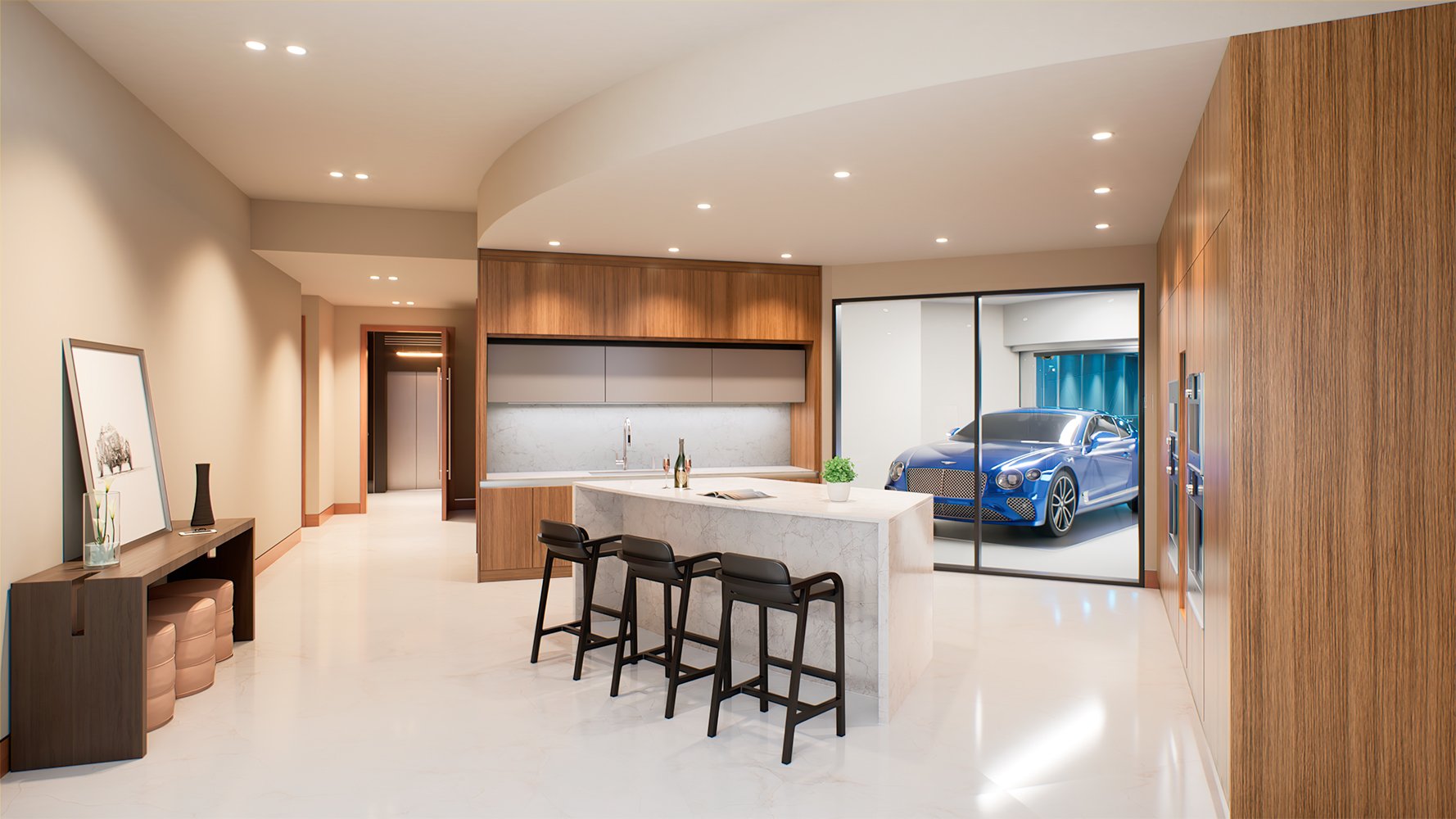
Aesthetic integration If the car is meant to be part of your interior story, the design must be intentional. Otherwise, it reads as improvised. The most sophisticated residences treat the vehicle as a curated object, with lighting, proportions, and visual privacy handled with restraint, so the effect feels deliberate rather than loud.
Miami’s luxury towers often have strong service DNA. For many residents, valet is an advantage. For collector-car owners, valet can also be the friction point.
If your priorities include condition, documentation, and repeatable handling, owner control is the gold standard. That does not automatically mean you reject valet. It means you demand clarity: who touches the car, when, under what policies, and with what accountability. A collector is not being difficult by asking these questions. They are protecting value and reducing unnecessary variables.
In some buildings, valet is excellent and discreet, staffed by people who understand residents, time, and care. In others, valet is optimized for volume rather than precision. The difference tends to show up in small, costly moments: rushed handoffs, tight turns, inconsistent staging, and the absence of a single point of responsibility.
A useful way to evaluate operations is to think of the building as a private club. Your vehicle is a member, too. The culture, procedures, and expectations should match your standards, and they should be consistent on ordinary days, not only when management is trying to impress a buyer.
A collector-car-friendly condo is not only a question of how a building functions. It is also about how you live once you leave the garage. Neighborhood friction can either amplify the value of a controlled arrival or make it feel like a partial solution.
Brickell Brickell appeals to buyers who want a cosmopolitan center of gravity, with a polished high-rise rhythm and immediate access to dining, business, and daily needs. For a collector, the upside is convenience and a lifestyle that compresses meetings and errands into a tight footprint. The trade-off can be traffic patterns and the need for predictable ingress and egress. In this context, a building that truly minimizes friction is not a bonus. It is the point.
Miami-beach Miami-beach is built on mood: privacy, design, and a social calendar that can be high-profile and intimate in the same week. For collectors, the environment is visually rewarding, but the coastal reality requires more attention to storage standards and routine. A strong plan accounts for salt air and seasonal congestion, and it preserves a calm arrival even when the neighborhood is operating at full volume.
Sunny-isles Sunny-isles draws buyers who want ocean-oriented living with a sleek, resort-adjacent feel. For a collector, the appeal can be balance: close enough to Miami’s energy, with a more controlled residential pace. The right building makes day-to-day life feel secure and streamlined, supported by policies that align with owners who travel often and expect consistency when they return.
Even if you are still defining what “sky garage” means for you, it can help to study a current ultra-luxury new-development narrative and see how the market speaks about convenience, brand, and lifestyle positioning. For reference, explore Bentley Residences Sunny Isles and treat it as a benchmark for the level of storytelling and expectation-setting modern buyers bring to the table.
The discipline is separating marketing language from operational reality. The correct decision is the one that passes your personal checklist. Do not let a headline amenity override how you actually live.
Collector-car living in a condo can be deeply satisfying, but it also changes how you should think about resale, privacy, and long-term flexibility. The purchase is not only about today’s convenience. It is about whether the setup remains an asset as your collection and schedule evolve.
Resale audience The more specialized the solution, the more specialized the buyer pool can become. In a luxury market, that is not inherently negative, but it affects positioning. A residence that reads as perfect to a collector can feel confusing to a buyer who does not share that lens. When the time comes, the sale benefits from an agent who understands how to translate the lifestyle into value without assuming the next buyer already knows the language.
Privacy as value For many ultra-high-net-worth buyers, privacy is the true luxury. A car-forward lifestyle often includes arriving and leaving without being observed. If the building’s layout makes your movements public, that is a structural issue you cannot remodel away. Privacy should be evaluated as an architectural and operational feature, not a feeling.
Collection management Think like a curator. Decide which car lives with you, which stays in long-term storage, and which rotates seasonally. The best setup supports rotation without stress. It should not require advance coordination that feels like moving a yacht. The goal is to make the collection a daily pleasure, not a scheduling exercise.
Guest and staff logistics A collector’s home is often active: friends visit, staff supports the household, deliveries arrive, and occasional events occur. Consider where guests park, how deliveries are handled, and whether the building’s rhythm supports a home that can be lively without becoming exposed. In practical terms, this is about ensuring your privacy standards do not collapse the moment other people enter the picture.
In any luxury condo purchase, the truth lives in the documents, the operations, and the people who run the building day to day. For a collector-car buyer, the same process applies, but the margin for ambiguity is smaller.
Confirm rules in writing If your lifestyle depends on specific permissions, do not rely on verbal assurances. Ensure condo documents and written policies align with how you intend to live. If a requirement is essential, it should be confirmable on paper.
Tour at realistic times Schedule at least one visit during a high-activity window. Arrive as you would on a real weekend. Watch how the building handles volume, how staff communicates, and whether the entry experience stays calm. This is also when you will learn whether a building’s culture matches its marketing.
Clarify responsibility and procedures Ask for clarity on incident handling. If something occurs in a garage or arrival area, who documents it, who communicates next steps, and what the process is. Precision here is the difference between peace of mind and prolonged frustration.
Align your insurance advisor early High-value personal property creates complexity. Loop in your insurance professional during the evaluation phase, not after. The goal is to prevent surprises at closing and ensure the building’s expectations match your coverage strategy.
The real promise of a collector-car-friendly condo is emotional, not technical. It is the feeling that your day stays composed, that your possessions are respected, and that your residence reflects your identity without needing to announce it.
In the best scenarios, the car belongs to the home’s private world. You arrive quietly. You leave easily. Your collection becomes a form of daily pleasure rather than a logistical project. That is the luxury, and it is why this niche continues to resonate with South Florida buyers who value design, privacy, and control in equal measure.
How do I evaluate whether a building truly supports a collector-car lifestyle?
Start with the full arrival sequence, not the unit. Tour the path from street to parking to residence during a busy window, and confirm whether you can maintain control over access. Then review written policies on parking, handling, storage, and any restrictions that would affect how you use the space.
What condo rules should I review if I want maximum control over my vehicle’s access and storage?
Focus on the documents that govern parking assignment, access permissions, vehicle movement, and time limits. Also look for rules on cleaning, idling, charging, and any prohibited activities, even if you do not plan to perform maintenance. The point is to eliminate surprises and ensure the lifestyle you want is allowed.
What should I ask about liability if anyone besides me can move the car?
Ask who is authorized to move vehicles, under what circumstances, and what documentation is created if an incident occurs. Confirm how responsibility is allocated for incidental damage and what insurance is expected from you versus what coverage the building carries. You are looking for a clear process, not a vague reassurance.
Which neighborhoods in Miami-Dade feel most compatible with discreet arrivals and predictable routines?
Brickell suits buyers who want immediacy and a dense daily footprint, provided the building reduces friction around ingress and egress. Miami-beach can deliver privacy and atmosphere but requires extra discipline around coastal realities and seasonal congestion. Sunny-isles often appeals to buyers seeking an ocean-oriented pace with a more controlled residential rhythm.
For discreet guidance tailored to your lifestyle priorities, connect with MILLION Luxury.
If branded residences are on your mind — as a home or as an allocation — we would be glad to share what we are seeing, privately.
Begin a quiet conversation