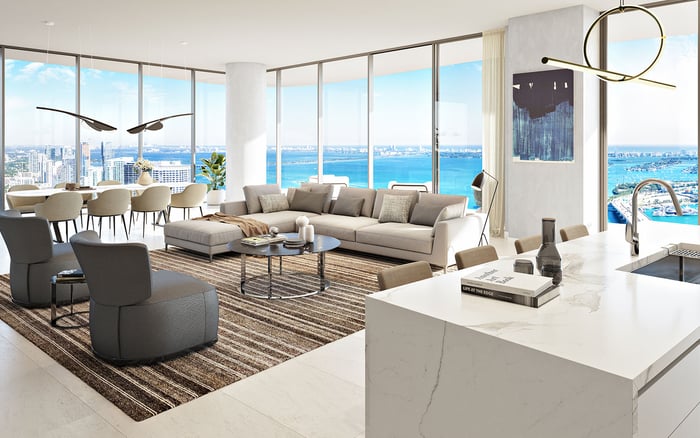
A discreet buyer’s guide to comparing three Miami luxury condominium decisions through reserves, insurance structure, and the practical certainty of delivery and ownership.

Luxury condominium buying in Miami has entered a more disciplined era. The conversation no longer stops at views, ceiling heights, private elevators, and brand cachet. For sophisticated purchasers, the first layer of due diligence is increasingly financial and structural: reserve exposure, insurance structure, and the degree of certainty surrounding the building itself.
That is why Casa Bella by B&B Italia Downtown Miami, EDITION Edgewater, and The Residences at 1428 Brickell belong in the same buyer conversation, even though each speaks to a distinct lifestyle geography. Downtown offers cultural proximity and urban energy. Edgewater offers a quieter residential rhythm close to the center of the city. Brickell remains Miami’s most legible high-rise financial district, where liquidity and daily convenience often shape the ownership thesis.
The essential question is not which name feels more fashionable. It is which form of certainty matters most to the buyer standing in front of the contract.
Reserve exposure is the least glamorous part of the luxury condo conversation, yet it is among the most consequential. A monthly association figure can appear manageable until a buyer understands what is, and is not, being funded for future capital needs. In premium buildings, reserves are not merely a compliance item. They influence the probability of special assessments, the predictability of carrying costs, and the confidence a future purchaser may bring to resale negotiations.
For a buyer evaluating Casa Bella by B&B Italia Downtown Miami, the reserve discussion should sit beside the design discussion. A polished lobby, branded interiors, and a central Downtown address may shape desire, but the ownership experience is also governed by the association’s financial architecture. Buyers should request the budget, reserve schedule, insurance summary, maintenance assumptions, and any available building documentation before treating the quoted carrying cost as the full story.
The luxury buyer’s advantage is preparation. An attorney, lender, and property advisor can review whether reserves appear aligned with the building’s age, systems, amenities, and long-term maintenance obligations. The goal is not to avoid costs altogether. In a serious building, costs exist because quality must be maintained. The goal is to distinguish planned stewardship from uncertain future exposure.
Insurance has become one of the defining variables in South Florida condominium ownership. It affects not only the association budget, but also financing, liquidity, and buyer confidence. A purchaser focused on EDITION Edgewater should ask a precise set of questions: what is covered at the association level, what must be covered individually, how deductibles are structured, and how renewal risk could move through future budgets.
This is especially important in a market where luxury amenities can add both appeal and complexity. Pools, wellness spaces, valet operations, elevators, mechanical systems, and common areas all belong in the insurance conversation. The more elaborate the lifestyle program, the more important it becomes to understand whether the building’s operating model is being priced conservatively.
Edgewater also attracts buyers who want proximity without the full daily intensity of Brickell. That preference often comes with a desire for calm ownership. Insurance structure is central to that calm. A buyer should not simply ask whether a building is insured. The sharper question is how the policy, deductibles, exclusions, and renewal expectations interact with the association’s financial plan.
This is where a discerning buyer separates presentation from governance. Marketing materials can explain the lifestyle. Due diligence explains the risk allocation.
Completed-building certainty is not only about whether a residence is physically finished. It is about how much uncertainty remains between intention and ownership. Buyers considering The Residences at 1428 Brickell should think in layers: contract certainty, financing certainty, construction certainty, closing certainty, and post-closing association certainty.
Brickell buyers tend to be highly attuned to timing. Many are relocating, upgrading, purchasing a second home, or aligning a residence with a broader wealth plan. For these buyers, delays, document gaps, or shifting carrying-cost assumptions can matter as much as design. A spectacular residence can still be the wrong fit if the buyer’s timeline requires more certainty than the purchase path can currently provide.
The solution is not to avoid pre-completion opportunities or to prefer only standing inventory. It is to match the purchase structure to the buyer’s tolerance for open variables. Some buyers value early access, selection, and long-term positioning. Others will pay a premium for visible delivery, active operations, and a clearer picture of how the building actually functions.
In Brickell, where resale comparison is often more immediate than in less dense enclaves, clarity can become a form of value. The more transparent the path to ownership, the easier it is to underwrite both personal use and a future exit.
The three-project comparison should begin with a written framework, not a tour schedule. First, determine whether the primary concern is reserve exposure, insurance structure, or completed-building certainty. Second, assign each concern a practical consequence: future assessment risk, carrying-cost volatility, financing comfort, closing timing, or resale confidence. Third, evaluate the building through that lens before being influenced by finishes or amenity language.
Casa Bella by B&B Italia Downtown Miami may appeal to a buyer who wants Downtown access and a design-forward residence, but that buyer should still treat reserves as part of the acquisition price. EDITION Edgewater may appeal to someone seeking a more composed urban setting, but insurance structure should be reviewed with unusual care. The Residences at 1428 Brickell may appeal to a buyer who wants a prominent Brickell ownership position, but the timing and certainty analysis should be explicit from the beginning.
This is not a defensive way to buy luxury real estate. It is an elegant one. In the current Miami market, the best purchasers are not less emotional. They are more prepared. They understand that beauty and balance sheet must coexist.
The strongest Miami condo decision is rarely the one with the most dramatic sales language. It is the one where the buyer understands the risks, prices them intelligently, and still wants the keys. Reserve exposure, insurance structure, and completed-building certainty are not obstacles to desire. They are the tools that help preserve it.
For South Florida’s ultra-premium audience, that standard is becoming nonnegotiable. A residence should feel effortless, but the acquisition should be exacting. When those two qualities meet, ownership has a different texture: quieter, steadier, and better aligned with long-term value.
Why do reserves matter in a luxury condo purchase? Reserves help fund future building needs and can influence the likelihood of special assessments or budget pressure.
Is a higher monthly association fee always negative? Not necessarily. A higher fee may reflect a more complete operating plan, but it should be reviewed against the building’s actual obligations.
What should a buyer ask about insurance structure? Buyers should ask what the association policy covers, how deductibles work, and what coverage must be carried individually.
Why is insurance especially important in South Florida? Insurance can materially affect carrying costs, lender comfort, and future resale confidence in condominium ownership.
How should Casa Bella by B&B Italia Downtown Miami be evaluated? Buyers should pair the design and Downtown lifestyle appeal with a careful review of reserves, budgets, and association documents.
How should EDITION Edgewater be evaluated? Buyers should consider the Edgewater lifestyle while paying close attention to insurance structure and operating assumptions.
How should The Residences at 1428 Brickell be evaluated? Buyers should analyze the Brickell location together with timing, contract terms, and the level of certainty available before closing.
Does completed-building certainty only apply to finished properties? No. It also refers to how clear the buyer’s path is regarding delivery, financing, closing, and post-closing operations.
Should amenities be reviewed before financial documents? Amenities matter, but serious buyers should review financial documents early so lifestyle appeal is measured against ownership risk.
What is the best way to compare these three Miami options? Start with the buyer’s main concern, then test each building against reserve exposure, insurance structure, and certainty of ownership.
For a discreet conversation and a curated building-by-building shortlist, connect with MILLION.
If branded residences are on your mind — as a home or as an allocation — we would be glad to share what we are seeing, privately.
Begin a quiet conversation