A discreet buyer’s guide to balancing airport access with the everyday pleasures that make South Florida ownership feel effortless, from Bal Harbour and Bay Harbor Islands to Brickell, Coconut Grove, Sunny Isles Beach, and Fort Lauderdale.
For a buyer traveling between Buenos Aires and South Florida, airport access is never a minor detail. It shapes the first hour of every visit, the final hour before departure, and the ease with which family, advisers, guests, and staff move around the property. Yet the strongest purchase is not necessarily the one closest to a terminal. It is the home where access fades into the background because daily life feels precisely aligned.
That distinction matters in the ultra-premium market. A residence selected only for arrival convenience can begin to feel transactional. A residence selected only for lifestyle can become frustrating if every trip starts with friction. The goal is balance: a home that respects the realities of international travel while protecting the rituals that made South Florida desirable in the first place.
For some buyers, that answer may be Bal Harbour, with its composed seaside identity and quiet sense of arrival. For others, it may be Brickell, Coconut Grove, Sunny Isles Beach, Fort Lauderdale, or a bayfront enclave that feels removed without becoming remote. The right choice depends less on the map than on how the owner actually lives.
Airport access is personal. A principal visiting for long weekends has different needs from a family spending school holidays in residence. A buyer hosting parents, adult children, or guests from abroad may care as much about predictability as speed. Another may place a premium on leaving dinner, returning to the residence gracefully, and departing the next morning without reorganizing the household.
Instead of asking which neighborhood is “best for the airport,” define the rhythm first. How often will the home be used? Are arrivals usually late, early, or tied to business meetings? Will the residence require staff coordination before each stay? Is the buyer likely to split time between beach, club, restaurants, medical appointments, schools, or boating?
Once those questions are answered, access becomes one element in a wider lifestyle equation. A calm building arrival, intuitive valet operation, easy family circulation, secure parking, and a neighborhood that does not require constant logistical planning may matter as much as the drive itself.
Bal Harbour appeals to buyers who want a polished coastal address without the feeling of living inside a constant social theater. Its appeal is not only sand and water; it is the emotional quiet of a place where privacy, service, and refinement are part of the daily expectation.
For a Buenos Aires buyer, that can be especially compelling. The return from travel should feel like a soft landing, not another urban negotiation. In this context, a residence such as Rivage Bal Harbour belongs in the conversation for buyers who want the Bal Harbour identity to be central rather than incidental.
Nearby Bay Harbor Islands offers a different expression of the same northern-beach logic. It feels residential, connected, and less overtly resort-driven, which can suit buyers who want proximity to the coast while favoring a quieter daily cadence. The Well Bay Harbor Islands is an example of how wellness-oriented living can fit a buyer who wants the home to support recovery after travel, not simply receive luggage.
The key is to test the area through real routines. Morning coffee, evening dinners, family walks, guest arrivals, and the owner’s preferred level of visibility all reveal whether the location is a true match.
Brickell is often considered by buyers who want a more urban South Florida base. It can suit those whose trips are tied to finance, professional meetings, restaurants, and a denser social calendar. For some international owners, the appeal is psychological: arrive, settle, and remain close to the energy of the city.
But urban convenience has its own texture. A buyer should evaluate building ingress, valet discipline, elevator privacy, and the feel of the immediate streets at different times of day. The right Brickell residence can make the city feel effortless; the wrong one can make every return feel busy.
A project such as Una Residences Brickell can be considered by buyers who want the Brickell address while still thinking carefully about water, privacy, and residence-scaled living. The question is not whether Brickell is convenient in the abstract. It is whether its version of convenience matches the buyer’s temperament.
Coconut Grove offers a different proposition. It is not a choice made only for airport logic or social visibility. Its appeal lies in atmosphere, canopy, gardens, dining, schools for those who need them, and a village-like rhythm that feels more residential than performative.
For a buyer arriving from abroad, the Grove can function as a decompression chamber. It is the kind of place where the home becomes part of a broader daily ritual: walking, dining quietly, seeing familiar faces, and maintaining privacy without total isolation.
In that context, Four Seasons Residences Coconut Grove may speak to buyers who want a service-forward residential experience in a neighborhood defined by restraint rather than spectacle. The access question remains important, but it is filtered through a softer lifestyle priority: how calm the owner feels once the door closes.
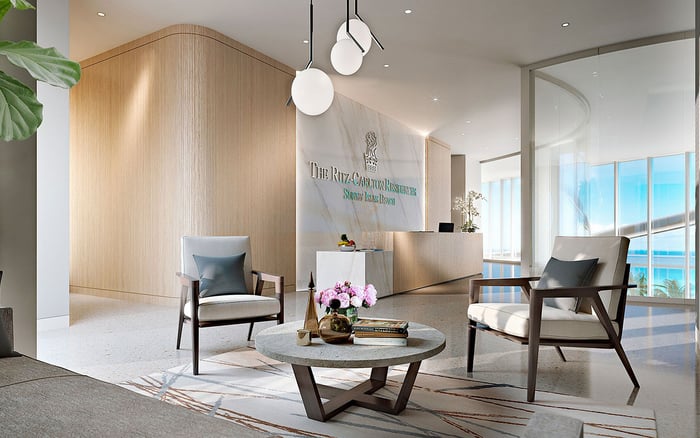
Sunny Isles Beach tends to enter the discussion when buyers want a strong beach lifestyle with a more vertical residential character. The area can appeal to those who prioritize ocean views, full-service buildings, family stays, and a sense of being firmly on the coast. The Ritz-Carlton Residences® Sunny Isles is a relevant reference for buyers who prefer a branded-residence context and a polished beachfront identity.
Fort Lauderdale can be attractive for a different reason. For some buyers, its value lies in a lifestyle that may include boating, a more relaxed urban scale, or a preference for Broward over Miami-Dade. It should not be treated as merely an alternative airport strategy. It is its own decision, with its own social geography and daily pace.
The practical guidance is simple: do not choose an address because it solves one travel day. Choose it because it supports the whole ownership pattern.
The most revealing due diligence is experiential. Visit the short list at different times, and do not limit the showing to the residence. Arrive as you would after a flight. Sit in the lobby. Watch the valet sequence. Walk to the places you expect to use. Notice whether the neighborhood gives energy or takes it away.
Then reverse the process. Leave the residence with luggage, imagine a guest doing the same, and ask whether the experience feels dignified. Luxury is often found in the absence of small irritations: no awkward handoffs, no unnecessary waiting, no sense that the home works only when traffic is forgiving.
A South Florida residence for a Buenos Aires buyer should feel like an extension of the owner’s life, not a compromise between two airports and a beach. When access and pleasure are properly balanced, the property becomes easier to use, easier to share, and easier to keep.
Should airport access be the first filter for a Buenos Aires buyer? It should be an early filter, but not the only one. The better starting point is how the home will be used once the owner arrives.
Is Bal Harbour only about beach lifestyle? No. Bal Harbour also appeals to buyers who value discretion, polish, service, and a calm residential rhythm.
Can Brickell work for a second-home buyer? Yes, especially for buyers who want urban immediacy, restaurants, business access, and a more energetic setting.
Why consider Coconut Grove instead of the beach? Coconut Grove may suit buyers who want softness, greenery, privacy, and a village-like daily cadence.
Does Sunny Isles Beach make sense for families? It can, particularly for buyers prioritizing beachfront living, views, services, and extended family stays.
Should Fort Lauderdale be considered separately from Miami? Yes. Fort Lauderdale has its own lifestyle profile and should not be evaluated only as a travel convenience.
How many neighborhoods should a buyer compare? A focused comparison of three to four areas is usually more useful than a broad, unfocused tour.
What matters inside the building for frequent travelers? Arrival sequence, valet operation, privacy, elevator flow, staff coordination, and storage all matter.
Should buyers test the route before purchasing? Yes. The route should be experienced in conditions that resemble the owner’s real arrival and departure patterns.
What is the best final decision rule? Choose the home where travel feels managed and the daily lifestyle feels natural, not the other way around.
When you're ready to tour or underwrite the options, connect with MILLION.
If branded residences are on your mind — as a home or as an allocation — we would be glad to share what we are seeing, privately.
Begin a quiet conversation