A buyer-focused look at how access control, valet choreography, and elevator privacy shape the daily experience of luxury high-rise living in Brickell.
In Brickell, luxury is no longer defined only by skyline views, water exposure, or a recognizable hospitality name. For many buyers, the quieter measure of value is how calmly a building manages movement: who enters, how vehicles arrive, how guests are received, and whether the journey from curb to residence feels private rather than public.
Security in a luxury tower should not feel theatrical. The strongest experience is discreet, layered, and intuitive. A resident should not have to consider whether the lobby is exposed, whether a visitor has been cleared, or whether an elevator ride will become an accidental social encounter. These details are not glamorous in the brochure sense, but they shape everyday comfort.
This is especially relevant in Brickell, where towers sit within a dense urban environment of restaurants, offices, hotels, retail, and constant traffic. The neighborhood’s energy is part of its appeal, yet that same energy raises the standard for residential separation. Buyers considering buildings such as Baccarat Residences Brickell or Cipriani Residences Brickell should think beyond finishes and amenity renderings. The essential question is how the property filters the city before it reaches the home.
Access control begins before the front desk. It includes the configuration of vehicle entries, pedestrian approaches, package areas, service routes, guest registration, resident credentials, amenity access, and back-of-house circulation. In a well-considered tower, these systems work together so residents, visitors, staff, deliveries, and vendors are not all using the same pathways at the same moments.
For ultra-premium buyers, the issue is not simply whether a building has a staffed lobby. Staffing matters, but so does choreography. A composed arrival sequence allows the team to identify residents, anticipate guests, and manage exceptions without making the lobby feel defensive. The goal is hospitality with boundaries.
Ask how guests are announced, where they wait, and whether staff can control access to residential floors. Ask whether amenity spaces can be reached without crossing sensitive residential zones. Ask how service providers enter, how long they remain in common areas, and whether their movement is separated from resident arrivals.
At the top end of the market, privacy should be designed into the building rather than improvised by staff. Residences such as The Residences at 1428 Brickell bring this conversation into focus because buyers of vertical estates often expect the same sense of controlled entry they associate with a gated single-family property, translated into a high-rise format.
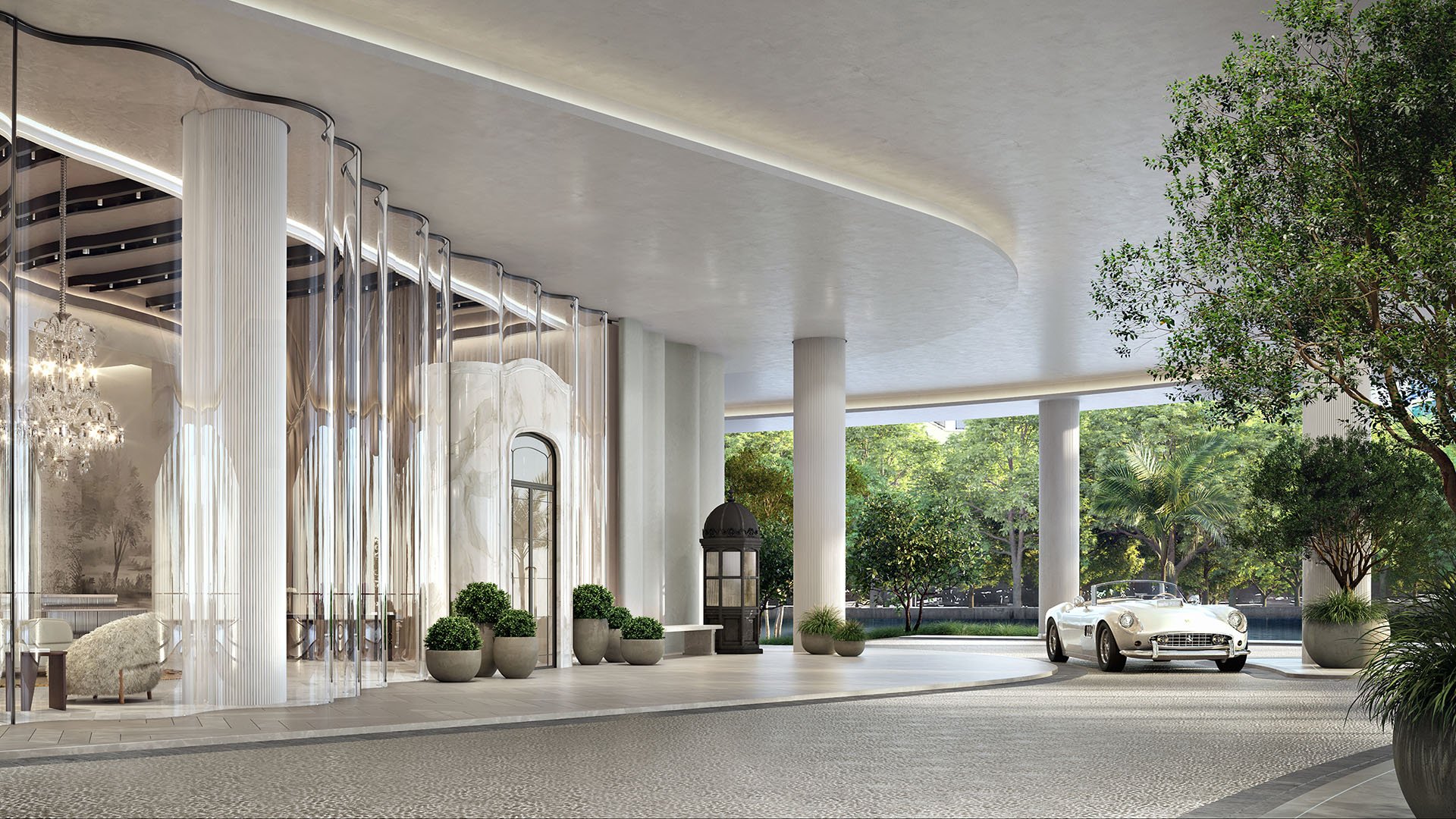
Valet is often treated as a convenience, but in Brickell it is also a security and privacy mechanism. A poorly managed arrival court creates friction: cars queue awkwardly, guests linger, residents remain visible for too long, and staff must solve too many problems in public view. A refined valet operation does the opposite. It shortens exposure, reduces confusion, and allows the arrival to feel calm even as the neighborhood moves quickly around it.
Buyers should study the porte cochère as carefully as they study the kitchen. Is there enough space for simultaneous arrivals and departures? Can a private car, rideshare, delivery vehicle, and resident vehicle be managed without forcing everyone into the same pinch point? Is there a clear distinction between a guest drop-off and a service movement? These questions are practical, but they affect how a building feels every day.
The most successful valet programs feel neither hurried nor conspicuous. Staff should recognize patterns, protect discretion, and avoid turning the entry into a social stage. For families, executives, public figures, and owners who travel frequently, this matters as much as ceiling height or terrace depth.
In a tower like St. Regis® Residences Brickell, the buyer’s expectation naturally extends to service polish. That expectation should include not only courtesy, but also control: who handles the vehicle, where keys are managed, how guests are identified, and how the transition from car to residence is protected.
Elevator privacy is one of the clearest tests of a luxury tower. Once a resident leaves the lobby, the building should become progressively more private, not less. The elevator bank is the threshold where access control either holds or dissolves.
Private or semi-private elevator access is prized because it reduces unwanted overlap. Even when a building does not offer fully private elevators, thoughtful programming can still improve discretion through controlled floor access, separated service elevators, and clear staff protocols. The buyer’s task is to understand not only what is promised, but how it functions in daily use.
Consider peak moments: dinner arrivals, school mornings, housekeeping schedules, package surges, weekend guests, and event nights. A tower may feel serene during a private tour and very different when multiple households are receiving guests. Elevator logic, staff discipline, and resident culture all shape the outcome.
For buyers evaluating Una Residences Brickell, the conversation should include the emotional texture of vertical privacy. Does the elevator ride feel like part of a private residence, or like an extension of a busy lobby? In high-rise living, that distinction is central.
Security should be evaluated through lived scenarios rather than generic features. Imagine arriving after a late flight. Imagine a guest arriving before you. Imagine a contractor scheduled while you are away. Imagine a high-profile dinner reservation, a school pickup, or a visiting family member unfamiliar with the building. The building’s systems should make each moment simple.
A serious buyer should ask about staffing coverage, guest clearance, valet procedures, service access, package handling, elevator control, and amenity access. The answers do not need to be dramatic. In fact, the best answers often sound measured and operational. Luxury security is less about spectacle than consistency.
It is also worth observing the building at different times of day. Morning departures reveal one kind of pressure. Evening arrivals reveal another. Weekend valet activity can be especially instructive. How staff respond when several things happen at once tells a buyer more than a polished tour ever can.
The most compelling Brickell residences make the city feel close, but not intrusive. They preserve the pleasure of urban living while protecting the resident’s interior life. That balance is the essence of modern luxury.
The future of Brickell luxury will be measured by how intelligently buildings manage density. Views, amenities, and design language will continue to matter, but the premium buyer is increasingly sensitive to the moments between them: the handoff at the curb, the greeting at the desk, the elevator ride, the transition into the residence.
Security, at its best, is not a barrier. It is a form of hospitality. It allows residents to feel known without feeling watched, protected without feeling constrained, and connected to Brickell without surrendering privacy.
For buyers, the advice is simple: tour for beauty, but question for operations. A tower can impress in photographs and still fall short in the daily choreography of access, valet, and vertical privacy. The residences that endure will be the ones where every threshold feels considered.
Why is security especially important in Brickell luxury towers? Brickell is a dense urban district, so the best towers create a calm residential layer between the city and the private home.
What should buyers look for in access control? Look for layered control across lobby entry, guest approval, amenity access, service routes, package areas, and elevators.
Is a staffed lobby enough for a luxury building? Not by itself. Staffing should be supported by clear protocols, thoughtful circulation, and consistent control of resident and guest movement.
Why does valet flow affect privacy? Valet is often the first point of exposure, so a smooth arrival court reduces waiting, confusion, and unnecessary visibility.
Should buyers visit at different times of day? Yes. Morning departures, evening arrivals, and weekend activity reveal how well the building performs under normal pressure.
Are private elevators always necessary? Not always, but controlled floor access, separated service movement, and disciplined staff protocols are important privacy indicators.
How should guests be handled in a luxury tower? Guests should be pre-cleared, received with discretion, and guided without gaining unnecessary access to residential areas.
What role does service circulation play? Service routes help separate vendors, deliveries, and maintenance from resident pathways, preserving privacy and flow.
Can security feel luxurious rather than restrictive? Yes. The most refined systems feel calm and hospitable, with protection operating quietly in the background.
What is the main takeaway for Brickell buyers? Evaluate the daily journey from curb to residence, because true luxury depends on how seamlessly privacy is protected.
If you'd like a private walkthrough and a curated shortlist, connect with MILLION.
If branded residences are on your mind — as a home or as an allocation — we would be glad to share what we are seeing, privately.
Begin a quiet conversation