A buyer-focused editorial on how security, discretion, and private arrival shape the next generation of Brickell luxury residences.
For the most selective Brickell buyer, luxury is no longer defined only by a panoramic view, a high floor, or a polished amenity deck. Those elements still matter, but they now sit within a larger question: how well does the residence protect the owner’s time, privacy, and sense of control from the moment of arrival?
This is the new test for the neighborhood’s most discerning purchasers. Security must be present without feeling theatrical. Discretion must be designed, not improvised. Private arrival must be more than a pleasant porte cochere. It must function as a complete sequence, from vehicle approach to lobby transition, elevator movement, residence entry, guest authorization, and service access.
In Brickell, where vertical living defines much of the residential experience, the path home carries unusual weight. A buyer may tour a spectacular residence and still hesitate if the arrival feels exposed, the lobby too public, the elevator bank too ambiguous, or the valet choreography too dependent on timing. The finest homes are increasingly judged by what happens before the front door opens.
The strongest residential security is not necessarily the most visible. For high-net-worth owners, executives, family offices, public figures, and international buyers, the ideal is layered protection that preserves ease. The experience should feel natural to residents and difficult for outsiders to read.
A well-conceived building separates the ceremonial from the operational. Residents should understand where guests are greeted, where deliveries are handled, how vendors are screened, and how access is controlled after hours. The most successful environments do this without turning the home into a fortress. The goal is quiet assurance.
Buyers should look closely at the transitions. Is there a clear distinction between resident circulation and visitor circulation? Are staff and service routes planned with dignity but separation? Can a resident move from car to home with minimal unnecessary exposure? These are not minor operational details. They shape daily comfort and long-term confidence.
When comparing residences such as St. Regis® Residences Brickell, the right questions are not limited to finishes and views. They should include the rhythm of access, the tone of staffing, the privacy of elevator movement, and the way the building handles peak arrival moments without compromising calm.
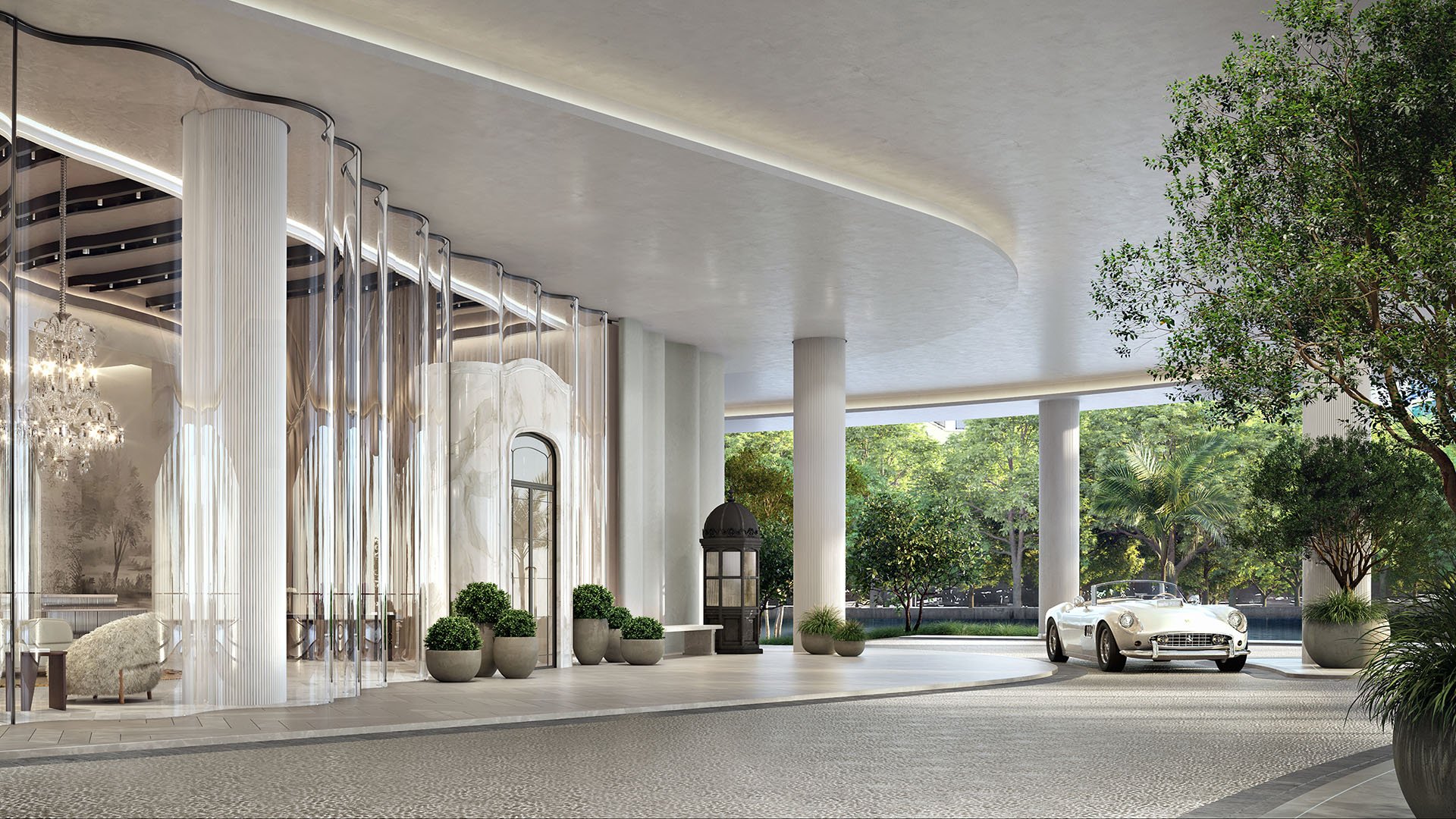
Private arrival is one of the most revealing features in a luxury residential building because it compresses architecture, service, security, and psychology into a few minutes. It is the moment when the city gives way to the private realm.
For some buyers, that may mean an understated entry that limits visibility from the street. For others, it may mean direct access to a controlled elevator sequence, discreet valet handling, or a lobby environment that avoids congestion. The exact solution can vary, but the intention should be unmistakable: the resident should never feel processed.
A private arrival should also work for real life. Families need predictable school-morning movement. Owners who entertain need guest arrival that feels elegant but controlled. Seasonal residents may need luggage and staff coordination without unnecessary exposure. Investors considering long-term value should recognize that these practical details often become decisive when a future buyer compares one building with another.
In conversations around Cipriani Residences Brickell, Baccarat Residences Brickell, and other branded or design-forward addresses, purchasers should resist focusing only on the name at the door. The better lens is operational: how does the building make arrival feel composed, private, and repeatable every day?
Discretion is often discussed as a service attribute, but in the best residences it begins with planning. A discreet building anticipates movement. It understands that not every resident wants the same degree of visibility, that not every guest should pass through the same threshold, and that not every delivery belongs near the primary residential experience.
This is where floor plate, elevator strategy, parking arrangement, lobby scale, and staff training intersect. A beautiful lobby can still fail a privacy-minded buyer if circulation is too exposed. A dramatic entry can lose its appeal if it creates unnecessary attention. The most refined buildings do not ask owners to choose between elegance and privacy.
For new-construction buyers, this is especially important during the evaluation stage. Renderings can communicate atmosphere, but they do not always reveal daily choreography. Buyers should ask how residents enter during busy periods, how guests are identified, whether service access is separated, how deliveries are staged, and how elevator access is controlled.
At residences such as The Residences at 1428 Brickell, the meaningful diligence is less about a single headline feature and more about the total privacy ecosystem. The question is whether the building’s design supports a life that feels both connected to Brickell and protected from unnecessary attention.
In a high-rise residence, the elevator is not merely transportation. It is part of the private domain. Buyers should treat elevator planning as a central privacy issue, especially when evaluating larger buildings or residences with significant amenity programming.
The best elevator experience is intuitive. Residents should not have to navigate uncertainty, prolonged waits, or overly public transitions. Access control should be clear. Guest movement should be managed without making visitors feel interrogated. Service movement should avoid creating friction with residents.
For some buyers, private or semi-private elevator access may be a priority. For others, the essential factor is controlled destination access and a refined lobby-to-residence sequence. Either way, the question is not simply how fast the elevator is. It is who can access it, when, and under what conditions.
This is also where high-floor and water-view preferences meet privacy expectations. A striking view may draw the eye, but the daily experience is shaped by the route to that view. The most desirable residence is one where the journey upward feels as considered as the home itself.
A serious Brickell purchase should include a privacy and arrival review alongside the usual analysis of layout, exposure, terrace, amenities, and finish quality. The following questions help clarify whether a building’s promise aligns with a buyer’s lifestyle.
How visible is the arrival from the street? How are vehicles handled during overlapping resident and guest arrivals? Are there separate paths for residents, visitors, deliveries, and staff? How does the building verify guests? How are after-hours arrivals handled? Can a resident move from car to elevator without unnecessary public exposure? Are service protocols consistent with the level of the building?
Buyers should also consider social privacy. Some owners enjoy a lively residential lobby. Others prefer anonymity. Neither preference is wrong, but the building must match the owner. A residence can be architecturally impressive and still be too public for a privacy-first buyer.
This is where Brickell differs from a gated-community or exclusive-area estate environment. The neighborhood’s appeal is its vertical energy, but that energy must be curated at the threshold of home. The best buildings create a private world within an urban setting, allowing owners to engage with the city on their own terms.
Privacy is not a trend. It is a durable luxury preference because it responds to a permanent need: the desire to control access to one’s personal life. As buyers become more sophisticated, they are less impressed by isolated amenities and more attentive to the total residential experience.
A building that handles security and arrival gracefully can feel calmer, more exclusive, and more livable over time. That can influence buyer confidence, owner satisfaction, and resale perception. In the luxury tier, small operational differences often become meaningful distinctions.
For Brickell buyers, the best advice is simple: tour the residence, but also tour the sequence. Arrive as you would on a normal day. Watch how the building receives you. Study who sees you, who greets you, where you wait, how you move, and how quickly the public world recedes. The answer may reveal more than the view.
Why is private arrival so important for Brickell buyers? It sets the tone for daily life, balancing convenience, discretion, and security before a resident reaches the home.
Does stronger security have to feel restrictive? No. The best security is layered and calm, supporting ease of movement while controlling access intelligently.
What should buyers evaluate beyond the residence itself? They should study the arrival sequence, lobby flow, elevator access, guest protocol, parking, and service routes.
Are private elevators always necessary? Not always. Controlled access, clear circulation, and a refined transition can matter as much as full private elevator service.
How should guests be handled in a discreet building? Guest access should feel gracious but structured, with verification that does not disrupt the residential atmosphere.
Why do service routes matter? They protect the resident experience by keeping deliveries, vendors, and operational movement from overlapping unnecessarily with private living areas.
Can a highly amenitized building still feel private? Yes, if the amenity, lobby, elevator, and service systems are planned to preserve separation and calm.
What should new-construction buyers ask early? They should ask how access control, resident arrival, guest movement, and back-of-house operations will work in daily practice.
Is discretion more important than views? It is not an either-or decision. The strongest luxury residences combine visual appeal with a private, controlled way of living.
What is the best way to shortlist comparable options for touring? Start with location fit, delivery status, and daily lifestyle priorities, then compare stacks and elevations to validate views and privacy.
If you'd like a private walkthrough and a curated shortlist, connect with MILLION.
If branded residences are on your mind — as a home or as an allocation — we would be glad to share what we are seeing, privately.
Begin a quiet conversation