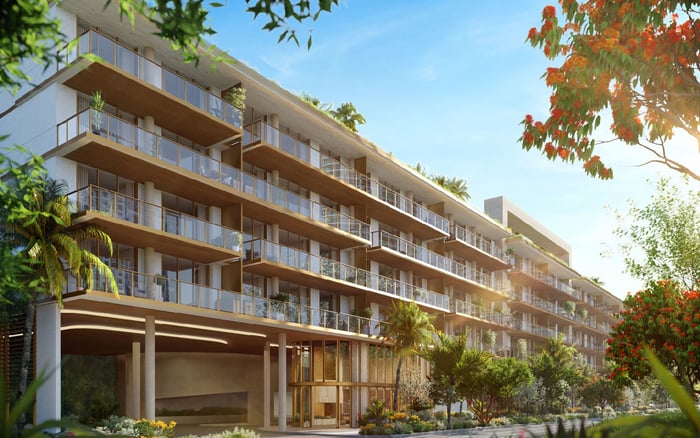
A refined buyer’s guide to evaluating Brickell and Downtown Miami through the practical lens of school-day timing, household staff movement, privacy, terraces, and everyday family flow.

For families considering Brickell and Downtown Miami, the most sophisticated purchase is rarely defined by skyline drama alone. It is defined by the quiet choreography of a weekday morning: children leaving on time, caregivers arriving without friction, household staff moving discreetly, and parents moving from private residence to professional obligation without turning the home into a corridor.
Brickell and Downtown offer two distinct interpretations of urban convenience. One leans into a polished residential and business rhythm, where errands, appointments, dining, fitness, and services can feel close at hand. The other can appeal to buyers who want cultural energy, larger-scale city movement, and a more metropolitan sense of arrival. Neither is automatically better for a family. The right choice depends on how the household actually functions between 6:30 a.m. and 9:00 p.m.
For a high-net-worth buyer, the relevant question is not simply where to live. It is where the family’s private life can remain intact while the public life of the city continues around it.
Brickell often attracts families who want urban proximity without surrendering daily order. The appeal is not only proximity to offices, restaurants, fitness, and services. It is the ability to compress the family schedule so fewer decisions require a car, a long transfer, or a complicated handoff.
For school-day convenience, buyers should study how the building performs under morning pressure. A beautiful lobby is secondary to the sequence from residence to elevator, elevator to valet or parking, and building exit to street. If that chain is congested, the address may feel less convenient than it appears on paper.
The best Brickell purchase for a family often has a calm internal plan. Bedrooms should be separated from entertainment zones. A secondary entrance, service vestibule, or staff-friendly circulation path can make a significant difference. If the residence has a terrace, the question is not just size, but whether the outdoor space feels usable for family life without sacrificing discretion.
Downtown can suit buyers who value city texture, visual openness, and a more dramatic expression of Miami’s urban identity. For some families, the appeal is living close to civic, cultural, and waterfront energy while still creating a protected domestic environment above it.
The Downtown buyer should be especially disciplined about the building threshold. In an energetic district, the transition from public street to private residence matters. Look for a sequence that feels composed: clear arrival, attentive access control, efficient vertical movement, and a residence plan that does not expose family life the moment the elevator opens.
Water views can be particularly meaningful in this context because they soften the urban experience. But a view should not distract from functional concerns. The highest-value residence is the one where bedrooms feel quiet, daily storage is generous, and family members can retreat without crossing entertaining areas or staff work zones.
In many South Florida residences, staff circulation is treated as an operational detail. For a serious family buyer, it is a luxury feature. The movement of nannies, drivers, housekeepers, chefs, tutors, security personnel, and visiting specialists shapes how private a home feels.
A strong residence allows service to happen without making service visible at every moment. That can mean a practical laundry relationship, a kitchen that supports preparation without disrupting family dining, storage that is not dependent on bedroom closets, and a powder room or secondary bath that prevents staff and vendors from moving through intimate zones.
Elevator logic matters as much as floor plan logic. Buyers should ask how deliveries arrive, how staff check in, where a driver waits, how groceries reach the residence, and whether a child’s morning exit intersects with housekeeping or maintenance activity. These questions may feel unglamorous, but they are exactly where comfort is won or lost.
Privacy is not measured only by size. A large residence can feel exposed if the entry opens directly into living space, if bedrooms share walls with entertaining areas, or if terraces face directly into neighboring towers. Conversely, a more restrained residence can feel exceptionally private if its plan creates a graceful progression from public to personal.
For families, privacy has three layers. The first is arrival privacy: how visible the family is when entering and leaving. The second is internal privacy: whether children, parents, guests, and staff can occupy the home without constant overlap. The third is exterior privacy: how the residence relates to adjacent buildings, water, sky, and neighboring balconies.
This is where Brickell and Downtown should be compared residence by residence rather than neighborhood by neighborhood. A lesser-known plan with superior circulation may outperform a more recognizable address. A lower floor with better setbacks may live more discreetly than a higher floor with intrusive sightlines.
A family should walk through the residence as if it were a real weekday. Where do backpacks land? Where does a tutor wait? Can a chef work while children eat casually? Can one parent host guests while another keeps the family wing quiet? Is there a protected place for luggage after travel? Does the elevator arrival feel ceremonial, exposed, or practical?
For buyers balancing private-school logistics with urban living, the building must do more than photograph well. It must absorb repetition. A home that functions gracefully on an ordinary Tuesday is more valuable than one that only impresses during a showing.
New construction can offer modern systems and contemporary amenity thinking, but it still requires scrutiny. The buyer vocabulary is precise: Brickell, Downtown, private-school, new-construction, terrace, and waterview priorities should be considered together, not in isolation.
The most compelling family residences in Brickell and Downtown are not necessarily the loudest or most theatrical. They are the ones that protect time. They reduce unnecessary crossings between public and private life. They allow staff to be effective without becoming central to the family’s visual field. They give children ease while preserving adult composure.
Brickell may be the more intuitive choice for buyers who prize efficient daily compression. Downtown may resonate with buyers who want a broader urban backdrop and can identify a building with a truly private residential sequence. In both cases, the winning property is the one that makes the school day feel less negotiated and the family home feel more sovereign.
Is Brickell better than Downtown for families? It depends on the family’s routine. Brickell may feel more streamlined for some households, while Downtown may appeal to buyers seeking broader urban energy.
What should families prioritize first when comparing residences? Start with daily movement. Elevator timing, parking access, staff entry, storage, and bedroom separation often matter more than headline amenities.
How important is staff circulation in a luxury condo? It is essential for households with regular support. Good staff circulation preserves privacy and keeps daily operations from interrupting family life.
Should buyers choose views or privacy first? Privacy should lead the decision. A beautiful view is most valuable when the residence also feels protected, quiet, and well organized.
Can a smaller residence live better than a larger one? Yes. A thoughtful plan with clear zones can feel more luxurious than a larger home with awkward circulation or exposed family areas.
What makes a residence school-day friendly? A school-day friendly home supports fast departures, easy returns, organized storage, and minimal friction between children, parents, and staff.
Are terraces always useful for families? Not always. A terrace should feel private, safe, and connected to the way the family actually lives rather than functioning only as a visual feature.
How should buyers evaluate a building lobby? Look beyond finishes. The important questions are how arrival feels, how access is controlled, and whether the building handles busy moments gracefully.
Does Downtown offer enough privacy for family living? It can, if the building and residence plan create a strong private threshold. The details of entry, sightlines, and elevator exposure are decisive.
What is the final test before making an offer? Imagine a full weekday in the home from morning departure to evening wind-down. If the residence reduces friction, it is worth serious consideration.
If you'd like a private walkthrough and a curated shortlist, connect with MILLION.
If branded residences are on your mind — as a home or as an allocation — we would be glad to share what we are seeing, privately.
Begin a quiet conversation