A discreet underwriting guide for buyers comparing Banyan Tree Residences West Palm Beach with Continuum on South Beach through culinary design, service circulation, and private dining utility.
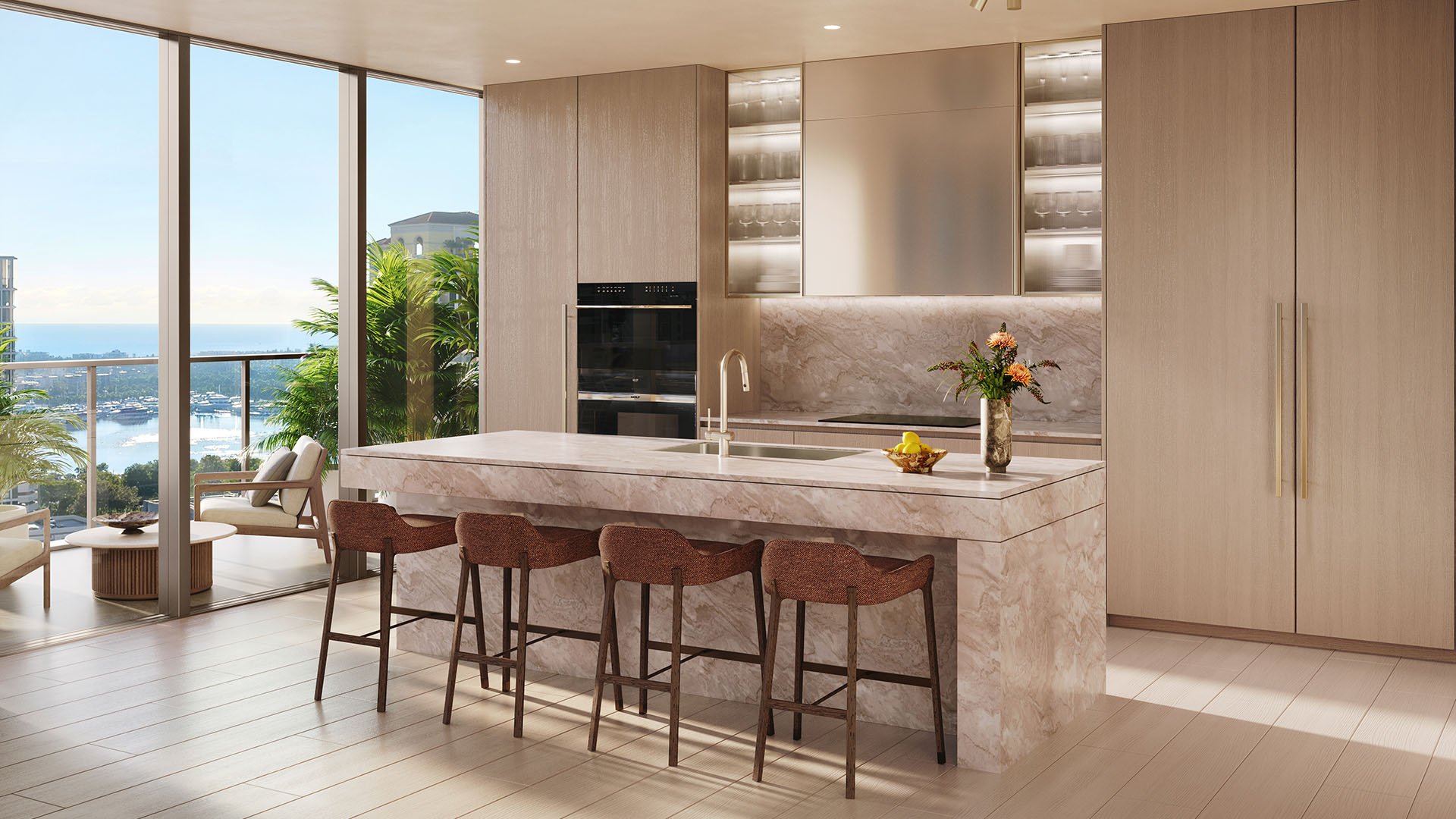
In ultra-prime South Florida, the kitchen is no longer judged by finishes alone. Buyers comparing Banyan Tree Residences West Palm Beach with Continuum on South Beach should underwrite culinary space as a complete hospitality system: how food arrives, where staff stages, how residents entertain, and whether the private realm remains private while service is underway.
Continuum on South Beach is the clearest South Beach comparison set for this culinary question. Banyan Tree Residences West Palm Beach, by contrast, calls for plan-level verification before any buyer assigns premium value to chef-ready kitchens, catering flow, private dining rooms, or the operating model behind them. That does not weaken the comparison. It sharpens it. The strongest purchasers in this tier separate lifestyle language from spaces that can genuinely perform during a dinner, fundraiser, family weekend, or chef-led tasting.
A chef-ready kitchen is best understood through function. The central questions are practical: can two or three people work without blocking one another, is there sufficient prep surface, does appliance placement support sequence, and can hot, cold, dry, and service storage be managed without visual clutter?
In a private residence, the test is more delicate than in a restaurant. Owners want professional service capability without living inside a commercial kitchen. That requires hidden utility, quiet ventilation, resilient surfaces, sensible waste movement, and enough separation between cooking and entertaining. A spectacular island loses value if it becomes the only landing zone for groceries, plating, flowers, barware, and guest conversation.
For New-construction buyers, underwriting should begin with dimensioned plans, not renderings. For Pre-construction buyers, the issue is even more important because substitutions, appliance packages, and final millwork details can change the way a kitchen performs. The correct question is not whether the kitchen photographs well. It is whether a chef can enter, work, plate, clean, and leave without turning the residence into a back-of-house corridor.
Catering flow is one of the most overlooked value signals in large residences. It determines whether an owner can host beautifully without sacrificing privacy. Study the path from elevator or service entry to kitchen, pantry, bar, dining area, terrace, powder room, and waste removal. Every crossing point matters.
At the South Beach end of the comparison, Continuum on South Beach belongs in the underwriting conversation because buyers use it as a serious benchmark for culinary amenity expectations. In West Palm Beach, purchasers looking across the broader luxury field may also compare the positioning of Alba West Palm Beach and Mr. C Residences West Palm Beach when calibrating how residential hospitality is being packaged across the market.
The key is to avoid assuming that a service elevator, if present, solves the entire problem. The better question is what happens after service arrives. Is there a staging surface outside the main kitchen? Is there a secondary pantry? Can florists, servers, and private chefs operate without passing through the owner’s bedroom wing? Can a breakfast for four and a catered evening for forty use the same infrastructure without friction? These details are not cosmetic. They shape the lived ownership experience.
Private dining rooms can be seductive in sales language, but they deserve disciplined underwriting. The room should have a clear purpose. Is it for resident-only dinners, building-hosted programming, wine service, chef collaborations, board-style meetings, family celebrations, or overflow entertaining? Each use requires different acoustics, adjacencies, privacy, and management.
The most valuable private dining environments feel residential, not banquet-like. They protect discretion, support excellent service, and avoid competing with the owner’s own dining room. If the room requires complicated reservations, high staffing costs, or awkward access, its value may be lower than its brochure prominence suggests. If it is elegantly managed, close to catering support, and scaled for real resident use, it can become a meaningful amenity rather than an occasional showpiece.
Investment analysis should also consider scarcity and behavior. Some owners entertain frequently and will pay for privacy outside the unit. Others prefer to use their own residence and treat shared dining spaces as backup. The underwriting conclusion changes with the buyer’s lifestyle, not merely the amenity count.
The West Palm Beach side of the equation is often about privacy, cultural rhythm, and a quieter style of entertaining. Buyers may care deeply about guest arrival, valet choreography, dining after philanthropic events, and the ability to host without theatrical exposure. The South Beach comparison carries a different energy, with established expectations around waterfront prestige, resort-like service, and high-visibility entertaining.
That distinction matters when comparing Banyan Tree Residences West Palm Beach with Continuum on South Beach. A culinary program that feels ideal in South Beach may not be the right model for West Palm Beach, and the reverse is also true. The better lens is fit. Does the residence support the way the owner will actually live, entertain, staff, and secure the home?
Buyers who also study branded or hospitality-inflected offerings in Brickell, such as ORA by Casa Tua Brickell, will recognize how strongly food and beverage identity can influence perception. Yet in a primary or second-home residence, identity must still translate into privacy, control, and daily usability.
Before assigning a premium to culinary amenities, buyers should ask for the details that determine performance. Request appliance specifications, exhaust strategy, pantry dimensions, back-of-house routes, reservation rules for private dining, staffing assumptions, guest policies, and maintenance responsibilities. If a catering kitchen or prep room is described, confirm whether it is in-unit, shared, or amenity-based.
The same discipline applies to acoustics and odor control. A private dining room loses appeal if sound carries into adjacent lounges. A chef-ready kitchen loses prestige if ventilation is inadequate. A catering corridor loses value if it intersects with resident leisure areas at precisely the wrong moment.
The final underwriting question is simple: does the culinary program reduce effort for the owner? True luxury is not a longer amenity list. It is fewer points of friction when the home is being used at its highest level.
Should buyers assume Banyan Tree Residences West Palm Beach has specific chef-ready kitchen features? No. Banyan-specific culinary details should be confirmed at plan and contract level before a buyer assigns value to them.
Why is Continuum on South Beach relevant in this comparison? It serves as the South Beach comparison set for evaluating how culinary amenity expectations may be underwritten.
What is the first thing to review in a chef-ready kitchen? Start with workflow, clearances, storage, ventilation, and prep space rather than finishes alone.
Is a private dining room always a value-add? Not always. It adds value when it is private, well-serviced, easy to reserve, and suited to resident behavior.
What does catering flow mean in a luxury residence? It is the path food, staff, supplies, and waste follow before, during, and after an event.
Should buyers compare West Palm Beach and South Beach the same way? No. Each market has a different entertaining culture, privacy expectation, and service rhythm.
Can beautiful renderings prove kitchen performance? No. Dimensioned plans, specifications, and circulation diagrams are more useful for underwriting.
Why does Investment analysis include amenity operations? Because staffing, access, reservation rules, and maintenance can affect usability and long-term appeal.
How should buyers treat New-construction culinary promises? They should verify what is included, what may change, and what will be governed by building rules.
What is the best way to shortlist comparable options for touring? Start with location fit, delivery status, and daily lifestyle priorities, then compare stacks and elevations to validate views and privacy.
For a confidential assessment and a building-by-building shortlist, connect with MILLION.
If branded residences are on your mind — as a home or as an allocation — we would be glad to share what we are seeing, privately.
Begin a quiet conversation