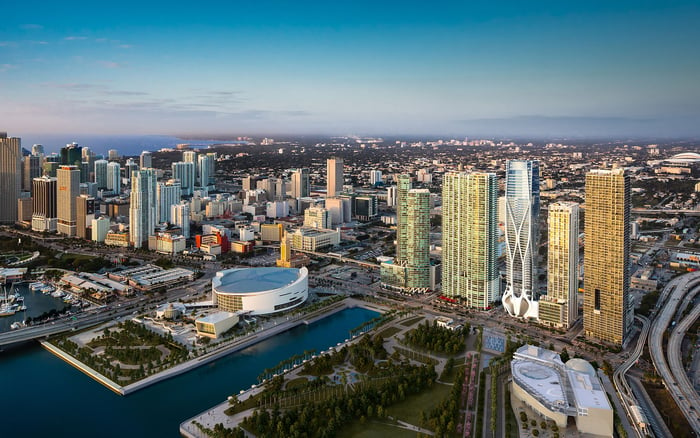
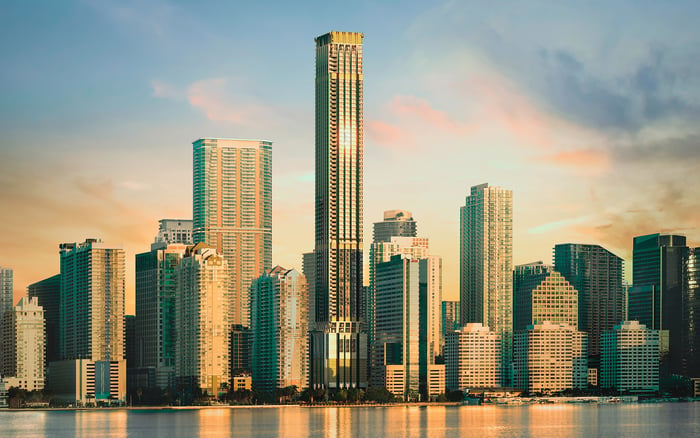
Paramount Miami Worldcenter’s skyport concept remains one of downtown Miami’s most visible symbols of future air mobility. Yet the near-term investment case is less about imminent passenger service and more about branding, optionality, and positioning within a premium urban district. For luxury buyers, the central question is not whether aerial mobility is imaginable, but whether regulation, economics, infrastructure, and real demand are mature enough to make it a dependable amenity in South Florida.
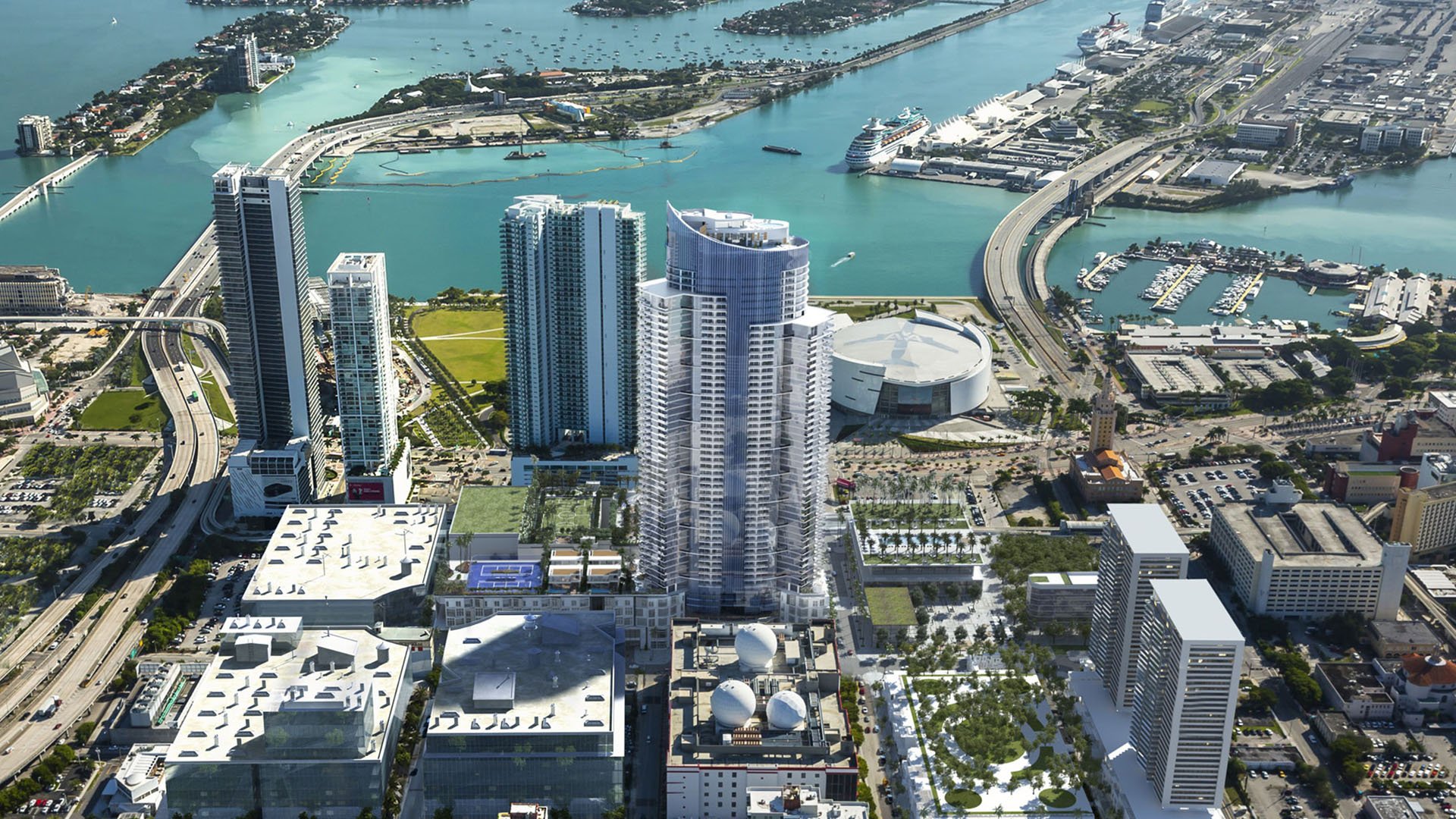
Paramount Miami Worldcenter is part of the broader Miami Worldcenter district, one of downtown Miami’s defining mixed-use developments, with residential, retail, hospitality, and commercial components. Within that setting, its rooftop skyport concept has long drawn attention because it reflects the city’s appetite for architectural spectacle and next-generation mobility.
For buyers, the more disciplined interpretation is also the more useful one. Today, the skyport is best understood less as an operating transportation amenity and more as a future-readiness feature. It signals ambition, design intent, and a willingness to anticipate emerging forms of urban access. That carries weight in a competitive luxury market, particularly in Downtown, where differentiation increasingly rests on vision as much as finishes.
For MILLION Luxury readers, the central question is not whether air taxis are conceivable from a rooftop in Miami. They are. The question is whether the full stack required to make them routine, safe, insurable, economically rational, and locally useful is sufficiently mature. At present, the answer remains cautious.
South Florida is unusually receptive to the idea of premium point-to-point aerial travel. Congestion is a genuine friction point for affluent residents, executives, and second-home owners moving between airports, core business districts, and coastal neighborhoods. In theory, future air mobility could ease the burden of peak-hour surface travel and create a high-value alternative for time-sensitive trips.
That logic becomes especially compelling when viewed against the region’s luxury development landscape. A buyer considering downtown product such as Waldorf Astoria Residences Downtown Miami or waterfront inventory like Aston Martin Residences Downtown Miami already thinks in terms of convenience, access, and symbolic advantage. Future air mobility fits naturally within that mindset.
The challenge is that attractive logic is not the same as viable service. Current eVTOL aircraft concepts are generally suited to short urban or regional trips, not broad mass transportation. That makes the likely first market narrow and rarefied: airport transfers, executive hops, and premium mobility for travelers willing to pay materially more for time saved.
Any serious assessment of viability begins with regulation. In the United States, federal oversight remains the primary gatekeeper for advanced air mobility operations. That means local enthusiasm, developer vision, and rooftop infrastructure cannot by themselves create a functioning air-taxi market.
Routine service still depends on a broader framework: aircraft certification, operational approvals, airspace integration, pilot or autonomy rules, and infrastructure standards. Those pieces are advancing, but they are not yet mature enough to support the kind of normalized, airline-like urban service many renderings suggest.
There is also the practical reality of the vertiport itself. A rooftop takeoff-and-landing area is not simply a glamorous amenity deck with a new name. It must account for noise, safety buffers, emergency procedures, passenger flow, and integration into a dense urban environment. Those demands complicate everything from design and staffing to building operations and neighborhood acceptance.
For Miami specifically, there is an additional reason for restraint. The city does not yet stand out as one of the strongest documented federal demonstration markets in this category. That does not rule out future progress, but it does suggest investors should separate imagination from evidence.
One of the more important realities for luxury buyers is the timing mismatch. Several prominent aircraft developers remain in certification and commercialization mode rather than operating mature scheduled passenger networks. As a result, a building can carry future air-mobility branding long before a dependable local service ecosystem exists.
That gap is not necessarily a flaw. In luxury real estate, perceived future relevance has value. A residence can benefit from association with innovation, particularly in districts competing for global attention. The same dynamic is visible in other high-concept developments, from Mercedes-Benz Places Miami in Brickell to Casa Bella by B&B Italia Downtown Miami, where lifestyle positioning helps define market identity before every operational promise is fully realized.
Still, there is a difference between a compelling brand narrative and a dependable mobility service. Buyers should value the distinction accordingly. A skyport concept may enhance prestige, conversation value, and long-term optionality. It should not yet be underwritten as though it were equivalent to a private marina, staffed club floor, or proven chauffeur program.
The business case also supports a measured outlook. Early eVTOL economics are expected to favor premium pricing before scale and technology improvements lower costs. Estimated first-generation ride economics suggest a service model better suited to affluent users than to everyday city commuting.
That has two implications. First, the concept is directionally compatible with the upper tier of South Florida real estate, where buyers already pay for privacy, time savings, and convenience. Second, it is unlikely to function as broad mobility infrastructure in the near term. In other words, a skyport at Paramount makes more sense as a future luxury transport node than as a mass-market transit breakthrough.
That distinction matters when comparing downtown aspirations with surrounding submarkets. Buyers in Brickell may view air mobility through the lens of executive access and airport convenience, while those in Edgewater communities such as Aria Reserve Miami may see the idea as part of a broader waterfront-luxury narrative rather than an everyday commuting tool. In both cases, the likely early user is selective, not universal.
Aircraft technology is moving quickly, particularly around battery performance. Better energy density later this decade could materially improve range and economics, which is encouraging for the broader category. But rapid technical change creates a subtle real-estate risk: fixed infrastructure may be designed around assumptions that evolve before service fully scales.
For a developer or condominium association, that means flexibility matters. The ideal rooftop mobility asset may not be the most specialized, but the one that can adapt as aircraft capability, charging needs, and operational models mature.
Liability is another underappreciated variable. Insurance and risk allocation for advanced aerial mobility remain developing areas. For a residential tower, uncertainty around underwriting, responsibility, and operational exposure can slow adoption even if aircraft technology progresses faster than expected.
The prudent conclusion is neither cynical nor breathless. Paramount Miami Worldcenter’s skyport concept is credible as a statement of future intent, and Miami’s congestion profile gives the broader idea of premium air mobility real strategic logic. But there is no scheduled commercial drone taxi or eVTOL passenger service operating in Miami today, and the local market has not yet demonstrated stable demand, route utility, or pricing tolerance in real-world use.
That leaves the concept in an interesting luxury real-estate category: valuable as identity, potentially valuable as optional infrastructure, but not yet equivalent to a functioning transportation amenity. In Downtown, that may still matter. Buyers often pay for proximity to the future, especially in projects and neighborhoods that signal cultural momentum.
For now, the most sophisticated lens is to treat future air mobility as a long-duration option embedded in the property’s narrative. It may become meaningful. It may eventually complement the lifestyle logic of Downtown, New-construction, and Investment-minded ownership. But until regulation, operating history, and economics align, it remains a premium concept with speculative timing rather than a present-day reason to buy.
Is Paramount Miami Worldcenter’s skyport an active air-taxi service today? No. It is better understood today as a future-readiness concept rather than a currently usable transportation amenity.
Are drone taxis already operating in Miami or South Florida? No scheduled commercial passenger service is operating locally at this time.
Why does the idea still attract attention from luxury buyers? Because South Florida congestion makes premium time-saving travel highly appealing for airport runs, business trips, and selective urban transfers.
Would early air taxis be mass-market transportation? Probably not. Early service is more likely to target affluent users and premium point-to-point trips.
What is the biggest hurdle to viability? Federal approvals remain central, including aircraft certification, operations, and airspace integration.
Does a rooftop skyport automatically mean service will launch soon? No. Real estate infrastructure can be in place before a proven local operator ecosystem exists.
What operational issues make vertiports complex? Noise, safety, emergency procedures, passenger handling, and dense urban integration all need to be resolved.
Could battery advances improve the outlook? Yes. Better battery performance could improve range and economics, though it also creates planning risk for fixed infrastructure.
How should buyers value the skyport today? As a branding and future-optionality feature, not as a guaranteed transportation utility.
Who is the most likely early customer for this kind of service? A high-income resident or traveler seeking faster airport or downtown point-to-point movement.
For a tailored shortlist and next-step guidance, connect with MILLION Luxury.
If branded residences are on your mind — as a home or as an allocation — we would be glad to share what we are seeing, privately.
Begin a quiet conversation