A buyer-oriented look at valet throughput, arrival choreography, staffing cues, and resident privacy expectations at two marquee Sunny Isles addresses, with practical ways to evaluate service performance before closing.
In Sunny Isles, a building’s curbside is where luxury becomes measurable. Valet logistics shape how quickly you move from arrival to residence, how discreetly guests are received, and how reliably daily routines stay friction-free. For many owners, the true “amenity” isn’t a signature scent or a sculptural desk-it’s the absence of waiting, noise, and unnecessary interaction.
When buyers compare Armani Casa Sunny Isles Beach and St. Regis® Residences Sunny Isles, the instinct is to focus on architecture, interiors, and brand halo. Yet valet performance often becomes the deciding variable for households that travel frequently, entertain on weekends, or keep multiple vehicles in rotation. The aim isn’t speed alone; it’s predictable throughput delivered with a sense of calm.
This editorial treats valet efficiency as a system-design, staffing, and etiquette working together. Even without seeing every shift at both properties, you can evaluate the same signals and stress points to understand which service style aligns with your lifestyle.
At ultra-premium residences, efficiency is best measured by four outcomes:
Low variance: a consistent experience across weekdays, weekends, and season.
Discrete handling: minimal exposure of residents, guests, and vehicles to casual observation.
Conflict avoidance: residents, visitors, and service providers aren’t competing for the same curb space.
Fast recovery: when the system is stressed, it returns to normal quickly.
A building can feel “fast” during a quiet mid-day window and still underperform when it matters. True efficiency shows up at the edges: school drop-offs, dinner arrivals, rainy nights, holiday traffic, and move-in periods.
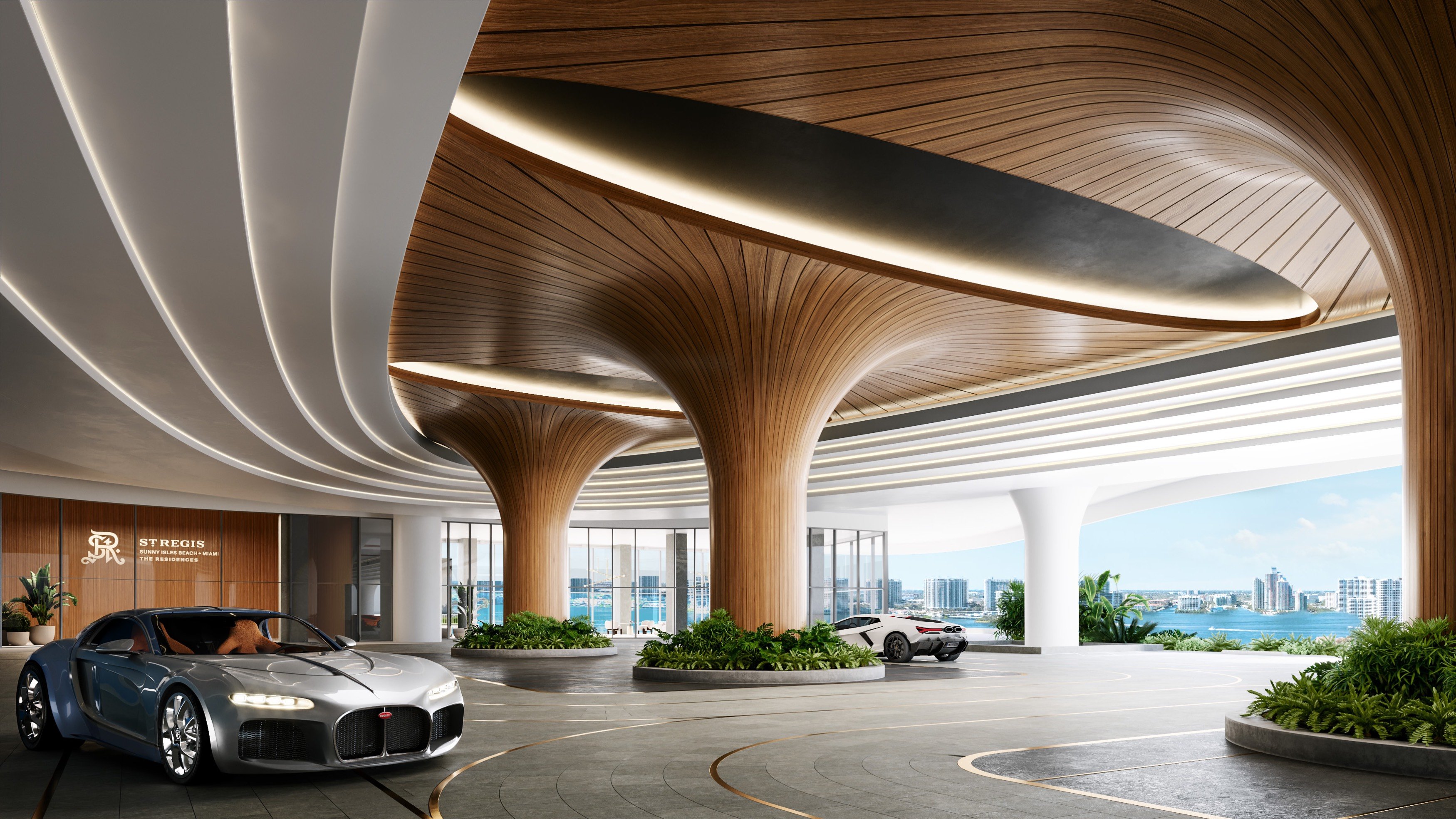
Valet operations begin with geometry. The strongest systems are quietly legible: vehicles can stack without blocking the drive, pedestrian paths are intuitive, and the door-to-elevator transition feels direct.
When assessing Armani Casa versus St. Regis, focus on:
Arrival sequence clarity: Is there one obvious point to stop, unload, and hand off keys-without awkward reversals or confusing signage?
Staging depth: Can multiple cars queue without spilling into the street? Even a generous driveway can underperform if the staging pattern forces vehicles to pinch near the porte cochere.
Pedestrian separation: Do residents and guests cross active vehicle paths, or can they move along a protected edge?
Elevator adjacency: The shorter and more direct the walk from curb to private elevators, the less the lobby becomes a bottleneck.
In branded luxury, “arrival theater” is a double-edged sword. A visually dramatic drop-off can encourage lingering and photo moments, slowing turnover. An efficient residence keeps the choreography elegant-and moving.
Armani Casa and St. Regis carry distinct reputations in how they express hospitality. That distinction matters because valet isn’t just parking-it’s the first point of human contact, and often the first service to be tested.
At Armani Casa Sunny Isles Beach, buyers often expect a fashion-house sensibility: polished, minimal, and controlled. In valet terms, that typically reads as clean handoffs and a quieter lobby rhythm. At its best, this approach reduces unnecessary conversation and keeps movement steady through subtle cues.
At St. Regis® Residences Sunny Isles, expectations skew more hospitality-led, with anticipatory service and a sense of ceremony. Done well, it can feel effortless even at peak volume. The trade-off is that a more “hotel-like” cadence must be actively managed so it doesn’t invite crowding at the threshold.
Neither style is inherently better. The question is which type of calm fits your routine: minimalist precision or highly attentive hospitality.
Valet performance becomes most revealing when you mirror real life. During tours or return visits, try to observe at least one of these scenarios:
Friday and Saturday evenings: high guest arrivals, rideshares, and delivery overlap.
Morning surge: multiple households leaving within the same 30 to 45 minute window.
Bad weather: umbrellas appear, doors stay open longer, and curb congestion rises.
Ask simple, practical questions without making it adversarial: How are rideshares staged? How are delivery drivers directed? Where do guests wait if their car isn’t yet pulled up? The quality of the answers-and how quickly staff points to a clear plan-often matters as much as the plan itself.
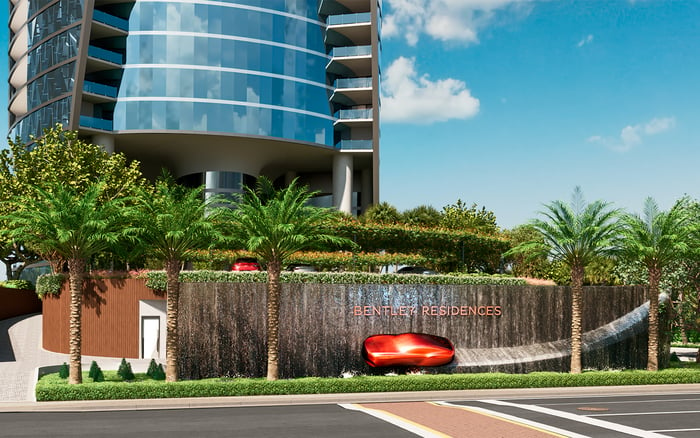
If you want an external benchmark for arrival throughput, spend ten minutes watching curbside flow at another Sunny Isles tower known for high-activity weekends, such as Bentley Residences Sunny Isles. Not to compare amenities, but to calibrate what “busy but controlled” looks like in practice.
The most efficient properties treat traffic as three distinct categories:
Residents: repeat users who value speed and privacy.
Guests: intermittent users who need guidance and a welcoming pause.
Service and deliveries: essential users who shouldn’t compete with either of the above.
Operationally, a building wins when these flows rarely intersect. Look for separate entry points-or at minimum, separate holding zones: a place for deliveries to be processed, a designated rideshare drop, and a clearly defined valet handoff for residents.
If the curb becomes the universal “everything zone,” efficiency collapses quickly. This is how even beautifully finished lobbies can start to feel chaotic.
For buyers who split time across multiple South Florida residences, it can be useful to compare how other high-design oceanfront buildings handle separation. A quick visit to a boutique-feel property like Arte Surfside can underscore how smaller-scale operations often rely on sharper separation and more disciplined staging to maintain discretion.
Two identical driveways can perform very differently based on staffing rhythm and internal communication. Watch for these cues:
Role clarity: Is one person dedicated to greeting and ticketing while others stage vehicles, or does everyone do everything?
Radio discipline: Efficient teams communicate in short, standardized messages. Disorderly teams talk constantly but resolve slowly.
Pull-ahead planning: Strong valets pre-stage vehicles when they sense a resident is about to depart, rather than waiting for a request at the last minute.
Escalation behavior: When the curb stacks up, does a supervisor step in and re-route traffic-or does the line simply grow?
You don’t need to press for staffing levels or schedules. You can observe whether the team moves as one. In luxury, synchronization reads as serenity.
The curb is only half the story. The garage is where delays compound. Ask to understand, at a high level, how the building handles:
Guest parking protocol: Is it seamless, or does it require multiple approvals?
Oversize vehicles: Is there a defined solution, or is it improvised?
Access control: Are there clear rules for residents who drive themselves versus those who use valet exclusively?
Wayfinding: Confusing turns and tight pinch points slow retrieval even with strong staff.
If you own in other neighborhoods, note how different districts shape expectations. Brickell, for example, often carries heavier rideshare pressure than oceanfront residential zones. Watching how a high-traffic building maintains curb order in Brickell-such as 2200 Brickell-can sharpen your eye for the operational details that matter even more in season.
Luxury buyers can-and should-ask for clarity on service standards without turning the conversation into a performance review. Consider requesting:
Valet hours and holidays coverage, including how late-night returns are handled.
Guest policy basics: whether guest parking is generally accommodated and how validation works.
Move-in and renovation logistics: service elevator scheduling, loading rules, and delivery windows.
Preferred practices for large events: what the building expects when you host.
The objective is alignment. If you entertain frequently, you’ll want a system that allows for welcoming pauses without clogging the curb. If you prioritize rapid departures and minimal interaction, you’ll want a system designed to keep the lobby from becoming a social intersection.
If the question is simply “which is more efficient,” the answer depends on what you mean by efficient.
If efficiency means quiet speed with minimal ceremony, Armani Casa tends to suit buyers who want a streamlined arrival and an understated social footprint.
If efficiency means high-touch arrival with strong guest handling, St. Regis tends to attract owners who want hospitality-forward service that can absorb visitor volume without feeling abrupt.
Both models can be executed brilliantly-or poorly. The advantage for buyers is that valet logistics are visible in real time. Ten minutes at the curb can reveal more than an hour with renderings.
Is valet efficiency mostly about curb length? Curb length helps, but traffic separation and staff coordination usually matter more.
What’s the single clearest sign of a well-run valet? Low variance: similar wait times and calm behavior even when arrivals spike.
Should I expect different valet behavior in Sunny-isles during season? Yes. Higher visitor volume makes peak-hour discipline and staging far more important.
How can I test retrieval speed without being intrusive? Observe discreetly at a busy time and note whether vehicles appear pre-staged or purely reactive.
Do branded residences typically run valet like a hotel? Often, but the best residential operations still prioritize resident privacy and repeat flow.
What questions should I ask about guest parking? Ask how guests are handled on weekends and where overflow is directed when the building is full.
Are rideshares a real operational problem? They can be. Without a defined staging spot, rideshares quickly block valet lanes.
Does the garage layout matter as much as the lobby? Yes. Tight turns, unclear zones, or access-control friction slows every retrieval.
Is it better to have valet-only or self-park options? It depends on your routine; flexibility is valuable if policies stay clear and consistent.
What should I look for if I host frequently? A system that guides guests smoothly without forcing them to wait in the main lobby.
When you're ready to tour or underwrite the options, connect with MILLION Luxury.
If branded residences are on your mind — as a home or as an allocation — we would be glad to share what we are seeing, privately.
Begin a quiet conversation