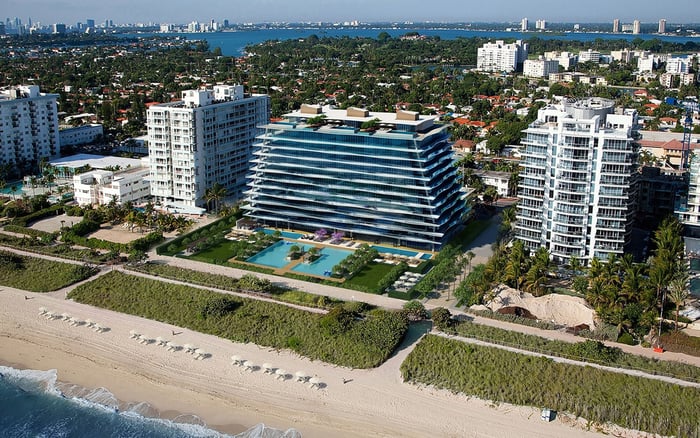
A buyer-focused look at Arte Surfside for South Florida owners who want a refined coastal base, boating access planning, and less day-to-day estate upkeep.

Arte Surfside is most compelling for a very specific South Florida buyer: someone who wants a refined coastal residence, regular access to boating, and a cleaner ownership profile than a large waterfront estate typically requires. This is not the buyer who needs to walk from breakfast to a private dock behind the house each morning. It is the buyer who wants the sea close, the boat managed intelligently, and the home itself protected from the constant maintenance obligations that often define estate living.
That distinction matters. At the upper end of the market, boating access is often reduced to a single phrase, when in practice it can mean several different lifestyles. Some owners require a private dock. Others need a marina relationship, a captain, a tender plan, club access, or storage for a vessel used seasonally. A buyer considering Arte Surfside should begin by defining that boating rhythm before comparing residences.
For those moving from a single-family waterfront home, the appeal may be less about giving something up and more about outsourcing complexity. Landscaping, exterior repair, pool maintenance, staff coordination, storm preparation, and ongoing grounds oversight can turn an estate into a second operating company. A well-selected condominium can reduce that burden while preserving the coastal identity that drew the buyer to South Florida in the first place.
Surfside has long appealed to buyers who want Miami Beach proximity without the constant visibility of larger resort corridors. The lifestyle is quieter, more residential, and often more discreet. That makes it relevant for owners who split time among multiple homes, travel frequently, or prefer a lock-and-leave residence that still feels connected to the water.
The keywords are not incidental: Arte Surfside, Surfside, boutique scale, oceanfront expectations, marina planning, and boat-slip due diligence each describe a different part of the purchase decision. A buyer may be drawn first to architecture or design, but the practical question is whether the property supports the way they arrive, leave, host, and get onto the water.
This is where condominium living can be persuasive. A buyer who keeps a boat at a separate slip, works with a captain, or uses a managed boating arrangement may not need the cost or exposure of a private waterfront home. Instead, the priorities become a calm residential setting, efficient car logistics, disciplined service, privacy, and the ability to move between home and water without making the property itself responsible for the vessel.
A waterfront estate offers autonomy, but autonomy has a price. The dock, seawall, exterior envelope, outdoor systems, pool, gardens, lighting, irrigation, gates, roofs, generators, and storm readiness all require attention. Even with a capable house manager, the owner remains responsible for decisions, approvals, vendors, schedules, and unexpected repairs.
For many ultra-premium buyers, the question is no longer whether they can manage an estate. They can. The question is whether they want that level of operational weight attached to a residence they may use intermittently. A condominium can be attractive because it shifts many exterior concerns into a collective structure and lets the owner focus on the private interior, lifestyle, and access strategy.
That does not make the decision simple. A condominium buyer must accept association governance, building rules, shared amenities, and limits on customization. The point is not that condo ownership is frictionless. The point is that its frictions are usually different, more structured, and often easier to anticipate than the open-ended upkeep of a private waterfront property.
Before touring Arte Surfside, the buyer should answer a few practical questions. How often will the boat be used? Is the vessel already owned, or is the buyer planning a purchase after closing? Will usage be spontaneous, scheduled, captain-led, family-oriented, or centered on entertaining? Does the owner need quick access for short evening runs, or is the vessel primarily for weekends and holidays?
The answers determine whether a condo base is enough. A buyer who wants a large yacht immediately behind the residence may still be better served by an estate or a dedicated yacht-club residential model. A buyer who is comfortable with nearby storage, captain coordination, and planned departures may find that a condominium delivers the better daily lifestyle.
This is also where valet, loading, guest arrival, service elevator protocols, and building privacy become part of the boating conversation. The route from residence to car matters. The ability to move bags, provisions, coolers, and guests without friction matters. A residence can be beautiful and still fail the boating-owner test if the logistics are awkward.
For buyers considering Arte Surfside, the strongest due diligence is behavioral, not decorative. Floor plan, exposure, terrace usability, ceiling height, finishes, and views are important, but they should be studied alongside service patterns. How does the building handle arrivals? How private is the entry sequence? How easily can a captain, driver, or assistant coordinate with the owner without disrupting the day?
Storage is another quiet priority. Boating owners travel with gear. Even when the vessel is stored elsewhere, the residence needs a plan for luggage, water toys, seasonal items, beach equipment, and guest provisions. In luxury condominium living, insufficient storage can become the detail that turns elegance into inconvenience.
Storm planning should also be discussed early. Estate owners are accustomed to managing shutters, outdoor furniture, landscaping, vessel movement, dock preparation, and post-storm inspections. A condominium may reduce some of those tasks, but it does not remove the need to understand protocols, insurance, building preparation, and the owner’s responsibilities before leaving town.
The ideal buyer for Arte Surfside in this context is not trying to replicate an estate. They are trying to refine the lifestyle. They want a coastal home that supports boating without letting the boat dominate the real estate decision. They value privacy, design, service, and efficiency. They may already own or charter vessels, but they do not necessarily want their primary South Florida residence to function as a marina facility.
This buyer often has a broader portfolio: perhaps a primary residence elsewhere, a mountain home, a New York apartment, or a Caribbean habit. South Florida becomes a strategic base, not a project. The residence should be ready, secure, well located, and easy to return to after weeks away. Maintenance should be visible enough to trust, but not so consuming that it shapes the owner’s calendar.
There is also an emotional component. Many estate owners eventually realize that privacy and control are not identical. A large home may offer control, but it can also create exposure through staff, vendors, contractors, and constant oversight. A more discreet condominium can offer another form of privacy: fewer moving parts, fewer interruptions, and a simpler perimeter around daily life.
The cleanest comparison is not price per square foot. It is lifestyle per hour. How many hours does the owner spend managing the property versus enjoying the water, the beach, family, dining, travel, and quiet? For some buyers, the estate will always win because the dock is essential and the land is irreplaceable. For others, the condominium wins because it removes the parts of ownership they no longer wish to carry.
A thoughtful comparison should include insurance posture, maintenance reserves, staff needs, transportation time to the boat, privacy during arrival and departure, guest handling, and resale appeal among similar lifestyle buyers. It should also include the intangible value of simplicity. In the luxury market, the most elegant decision is often the one that removes the most unnecessary administration.
Arte Surfside should be considered through that lens. It is a potential answer for the buyer who wants proximity to the coastal life and a more contained ownership structure. It is not a universal substitute for a dockside estate, and it should not be evaluated as one. Its relevance lies in the buyer who wants water, design, discretion, and operational restraint in the same sentence.
Is Arte Surfside suitable for a buyer who owns a boat? It can be suitable if the buyer is comfortable coordinating boating through a separate access, storage, captain, or marina plan rather than relying on a private dock at home.
Does Arte Surfside replace the need for a waterfront estate? Not for buyers who require a private dock at the residence. It is better understood as a lower-maintenance coastal base for buyers who can separate the home from the vessel.
What should boating buyers confirm before purchasing? They should confirm preferred storage, departure, captain, guest, loading, and storm procedures before treating the residence as a functional boating base.
Why might a condominium appeal to former estate owners? It can reduce exterior maintenance, vendor coordination, landscaping responsibilities, and the constant operational oversight common to large waterfront properties.
Is Surfside a practical location for this lifestyle? Surfside can appeal to buyers who want a quieter coastal setting with access to broader Miami-area boating, dining, and private-service infrastructure.
Should buyers prioritize views or logistics? Both matter, but boating-oriented buyers should not let views overshadow arrival sequence, storage, service access, and day-to-day ease.
What is the biggest misconception about boating access? Many buyers treat it as a yes-or-no feature, when the real question is whether the access model matches the owner’s exact boating habits.
Can a lock-and-leave residence work for active boaters? Yes, if the boat is professionally managed and the residence supports quick, private, and organized movement between home and departure point.
What type of buyer may still prefer an estate? A buyer who wants a vessel directly behind the home, maximum autonomy, and land-based privacy will usually continue to prefer a waterfront estate.
How should buyers approach resale considerations? They should focus on enduring fundamentals: privacy, service, condition, floor plan, location, and whether the lifestyle logic remains clear to future buyers.
For a confidential assessment and a building-by-building shortlist, connect with MILLION.
If branded residences are on your mind — as a home or as an allocation — we would be glad to share what we are seeing, privately.
Begin a quiet conversation