For Miami penthouse buyers, art-scale walls are becoming a serious due-diligence issue. The question is no longer whether a residence can look dramatic, but whether it can support, protect, light, service, and insure major works without compromise.

In Miami’s uppermost residences, a wall is rarely just a wall. For the buyer considering a penthouse with art-scale ambitions, it is a structural surface, a lighting field, a climate boundary, an insurance concern, a privacy issue, and an eventual resale signal. By 2026, the due-diligence question has become more exacting: can the residence truly support the art life the buyer intends to live?
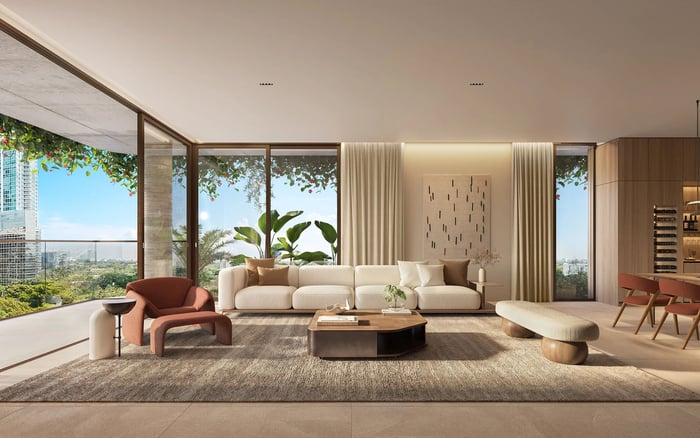
This is not simply about hanging large canvases. It is about determining whether the architecture can accommodate works of unusual scale, weight, sensitivity, and value without improvisation. A dramatic foyer, double-height salon, or uninterrupted gallery wall may photograph beautifully, but the serious buyer looks beyond the image. What sits behind the finished surface? How does light move across it? Can an installation crew reach it safely? Does the building permit the work required to make the space collection-ready?
Large volumes can seduce quickly, especially in Brickell, Miami Beach, Sunny Isles, and other vertical luxury markets where water, skyline, and glass define the mood. Yet art can complicate the very qualities that make a penthouse compelling. Sunlight is beautiful until it becomes exposure. Glass is cinematic until it reduces display walls. A sweeping staircase is sculptural until it constricts the delivery path.
The first buyer question should be direct: where will the most important works actually live? From there, diligence becomes practical. Review wall continuity, ceiling height, fixture locations, electrical pathways, and the relationship between display areas and direct light. A residence does not need to resemble a museum, but it does need to make intentional placement possible. The best homes create a calm dialogue between architecture and collection rather than forcing one to dominate the other.
The visible finish is only the beginning. For heavier works, sculptural installations, or oversized framed pieces, the substrate matters. Buyers should understand whether key walls are concrete, framed partitions, specialty panels, or areas interrupted by mechanical systems. That distinction can determine whether a wall can accept reinforcement, concealed blocking, or specialized hanging systems.
This is where elegant design and disciplined inspection meet. An art-scale wall should be evaluated before closing, not after the decorator has begun procurement. If reinforcement is needed, the buyer should know whether it is feasible, whether approvals are required, and whether the work can be completed without disturbing neighboring residences. In a completed building, the cleanest solution is often the one planned earliest.
Miami light gives interiors their glamour, but it also demands control. Oceanfront residences, in particular, can create strong contrasts between view-driven rooms and art-friendly rooms. Buyers should study how natural light enters the space at different times of day, then consider shades, glazing, art lighting, and fixture heat.
The ideal display strategy is layered. Ambient light should flatter the residence, while art lighting should be precise, adjustable, and serviceable. Recessed fixtures, track systems, wall washers, and discreet picture lighting each create a different experience. The serious collector should also consider humidity, air movement, and proximity to terraces or operable doors. Terrace living is part of the Miami promise, but the threshold between indoor display space and outdoor entertainment space should be managed with care.
A penthouse may have the perfect wall and still present a delivery problem. Before committing to a residence around large works, buyers should test the complete path of travel: loading area, service corridor, elevator dimensions, turn radii, ceiling clearances, door widths, and protection protocols. If a work cannot reach the intended wall safely, the wall is theoretical.
This is especially relevant in buildings where privacy and security are part of the appeal. Controlled access, discreet staff circulation, and limited service windows can be advantages, but they must align with installation needs. Buyers should also ask how often building management permits specialized crews, what insurance certificates are required, and whether after-hours installation is possible. The experience should feel invisible to guests, but the planning behind it is highly specific.
Art-scale living also intersects with association rules and risk management. Buyers should review alteration policies, noise limits, contractor requirements, and any restrictions affecting wall penetrations, lighting changes, or reinforced installations. A seemingly minor display decision can involve approvals if it touches common systems or exterior-facing conditions.
Insurance deserves equal attention. A serious collection may require documentation, appraisals, security planning, climate consistency, and careful coordination between homeowner coverage and fine-art coverage. The residence itself becomes part of the collection strategy. For an investment-minded buyer, that discipline can support future marketability. A home that accommodates art gracefully appeals not only to collectors, but also to buyers who value architectural seriousness, flexibility, and restraint.
The strongest Miami penthouses will not simply offer a big wall. They will offer a believable art environment: proportion, control, access, discretion, and technical readiness. Balcony views, entertainment terraces, and dramatic rooms still matter, but they should not compromise the buyer’s ability to live with important works.
The due-diligence question is therefore broader than design preference. It asks whether the residence can support a private cultural life at scale. In 2026, that may be one of the quietest ways to distinguish a true trophy home from a merely photogenic one.
What is an art-scale wall in a Miami penthouse? It is a wall intended to display unusually large, heavy, or valuable works with proper structure, lighting, access, and environmental control.
Should buyers inspect walls before closing? Yes. The ideal time to evaluate reinforcement, substrate, lighting, and installation feasibility is before the purchase is finalized.
Does a larger room automatically work better for art? Not always. Proportion, light control, wall continuity, and delivery access can matter more than square footage alone.
Why is sunlight a due-diligence issue? Strong natural light can affect placement choices, viewing comfort, and conservation planning, especially near expansive glass.
Can a penthouse wall usually be reinforced later? Sometimes, but feasibility depends on construction, building rules, existing systems, and the approvals required for alterations.
What access details should be checked? Buyers should review loading areas, elevators, corridors, ceiling heights, door widths, and the path from arrival to final placement.
Do building rules affect art installation? They can. Rules may govern contractors, work hours, wall penetrations, insurance certificates, and protection of common areas.
Is fine-art insurance separate from home insurance? It often requires specialized attention, including documentation, valuation, security considerations, and climate expectations.
Can art-ready planning help resale? Yes. A residence with flexible, well-considered display conditions can appeal to sophisticated buyers beyond the current owner.
What is the most important question to ask in 2026? Ask whether the residence can support the intended collection without compromising architecture, privacy, comfort, or future flexibility.
When you're ready to tour or underwrite the options, connect with MILLION.
If branded residences are on your mind — as a home or as an allocation — we would be glad to share what we are seeing, privately.
Begin a quiet conversation