A buyer-focused comparison of Edgewater’s two marquee new-construction towers, looking beyond branding to the details that shape daily life: terraces, ceiling height, layouts, interiors, and amenity posture.
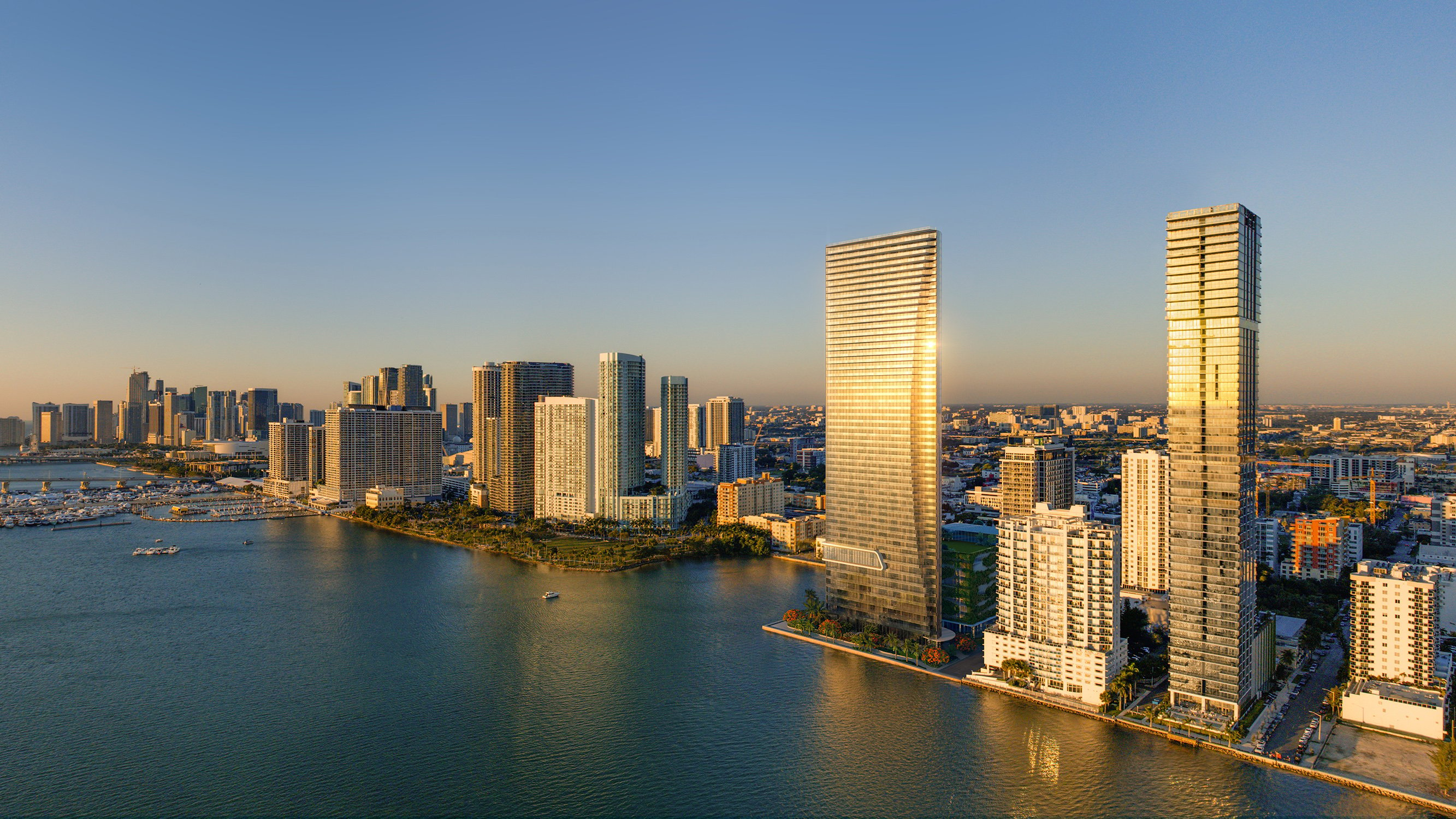
Edgewater has become a decisive test case for ultra-modern waterfront living in Miami-where the product is defined not only by square footage, but by how a residence breathes. In this bayfront corridor, outdoor rooms are no longer optional. They’re where sunrise coffee, sunset cocktails, and quiet work calls happen-often in the same day.
Two projects, in particular, crystallize these priorities. Aria Reserve Miami is conceived as a large-scale, twin-tower waterfront community with a bold glass expression. EDITION Edgewater arrives with a hotel-branded sensibility, a tighter residence count, and an atmosphere of restrained composure.
Both speak fluent Miami: views, light, and the insistence that a terrace is not an accessory-it’s an extension of the interior architecture.
Aria Reserve is planned as a pair of 62-story waterfront towers designed by Arquitectonica, with an exterior language defined by a zigzag, chevron-style pattern across the glass. The intent reads immediately from the bay: this is not a quiet building. It’s a skyline statement designed to register.
Inside, the narrative is about circulation and width. Residences are marketed with “flow-through” layouts and expansive terraces, aiming for cross-unit openness and daylong natural light. Many residences are positioned with standard 10-foot ceilings, while upper-tier product types-including Skyview and penthouse offerings-are described with higher ceilings.
Aria Reserve also leans into flexibility. It is marketed as integrating office or den space into every residence, a meaningful detail for buyers who want work-from-home capability without sacrificing entertaining scale.
EDITION Residences Miami Edgewater is a 55-story, hotel-branded residential tower aligned with EDITION and the Marriott ecosystem. The proposition is less about being the largest presence on the bay and more about being the most discreetly serviced.
A key differentiator is its boutique positioning, with 185 residences. In a neighborhood where many towers can feel populous, the lower unit count becomes part of the luxury equation: fewer neighbors, fewer competing schedules, and an experience that can read closer to private-club living.
Interiors are designed by Studio Munge with a restrained palette engineered for calm. The materials language highlights low-sheen, riff-cut white oak, light plaster tones, and natural stone. The mood is intentionally view-forward: when the bay is the artwork, the interior becomes the frame.
Ceiling height is marketed as variable, often cited around 10 to 14 feet depending on residence type. The kitchen story is equally specific: Sub-Zero and Wolf appliance packages are part of the offering, paired with white-oak cabinetry and natural stone countertops. EDITION’s “custom finish options” messaging also signals a clearer path to personalization than the typical fixed-finish condominium.
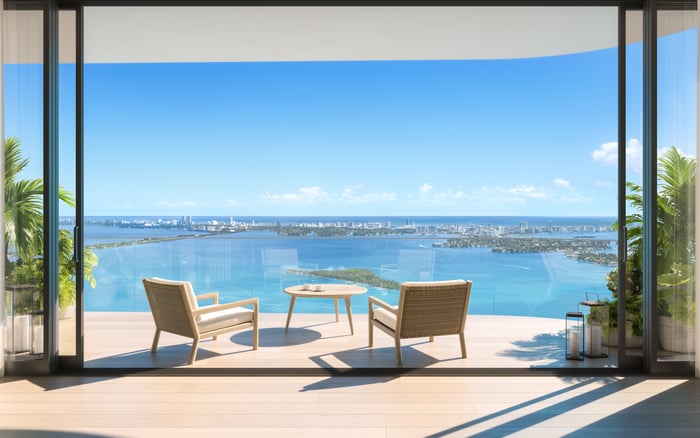
In Edgewater, terrace depth isn’t a vanity metric. It determines whether the outdoor space performs as a true room-or merely a scenic ledge.
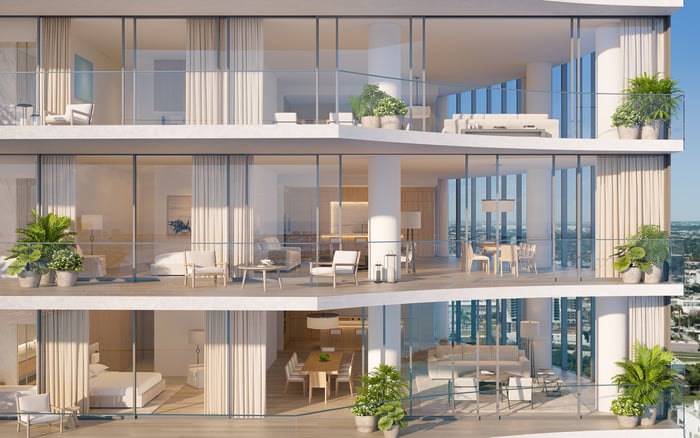
Aria Reserve markets terraces up to roughly 11 feet deep, designed to support meaningful outdoor living. The emphasis aligns with the project’s overall positioning: the terrace becomes a lifestyle platform, not simply an accessory for listing photos.
EDITION similarly highlights terraces up to roughly 12 feet deep, with layouts varying by residence type. For buyers, the nuance is proportion: the right depth supports a real dining table, lounge seating, and circulation without feeling compressed. If you’re deciding between the two, insist on reviewing the specific stack and terrace geometry rather than relying on published maximums.
The deeper point is philosophical. Aria Reserve treats the terrace as part of a resort ecosystem; EDITION treats it as an extension of a private suite. Both approaches can be right-depending on how you intend to live.
Luxury is often experienced at eye level, but remembered in volume. Ceiling height changes how art reads, how daylight falls, and how a home feels at night when lamps replace sun.
Aria Reserve lists 10-foot ceilings for many residences, with higher ceilings described in its upper product tiers. In practice, this tends to create a consistent baseline of openness across the building’s typical floor plates.
EDITION’s marketing emphasizes a broader range, often cited as roughly 10 to 14 feet depending on residence type. That variability can be a strategic advantage for buyers who want something more loft-like without necessarily moving into a penthouse category. The tradeoff is precision: you must confirm which residence types deliver which volumes.
For collectors and design-forward owners, the differences are tangible. A 10-foot ceiling paired with a deep terrace can read expansive and airy. A taller volume with a minimal interior palette can feel gallery-like-especially when the view is treated as the focal plane.
Both towers arrive with a defined interior point of view, but they speak to different temperaments.
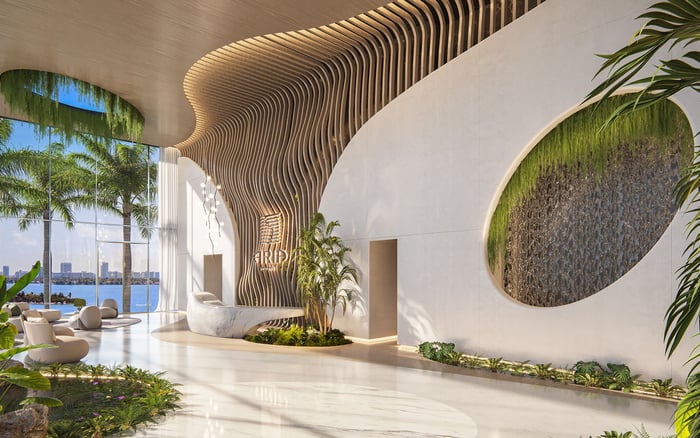
Aria Reserve commissioned MORADA Haute Furniture Boutique for interior design, with a nature-forward, biophilic-inspired luxury look. The project’s materials and finish positioning includes designer cabinetry, premium appliances, and high-end bath finishes as presented in its public-facing materials. The overall effect is meant to feel resort-adjacent: warm, textural, and lifestyle-led.
EDITION, by contrast, is calibrated for quiet. Studio Munge’s palette of white oak, light plaster tones, and natural stone is designed to remain calm across seasons and trends. The interior language also reinforces the idea that personalization can be part of the purchase, via the project’s “custom finish options” messaging.
If your home is a social stage, Aria Reserve’s sensibility may read as more expressive. If your home is a sanctuary, EDITION’s restraint may feel like an advantage.
Edgewater buyers increasingly evaluate towers the way they evaluate clubs: not only what’s offered, but how it will feel at peak usage.
Aria Reserve’s amenities are planned around a large recreation deck with multiple wellness and social spaces, organized to support a resort-and-community lifestyle. The scale suggests daylong programming-pools, recreation, and spaces meant to accommodate both families and entertaining.
EDITION’s branded-residence positioning implies hospitality-style services and owner benefits typical of branded living. The difference is experiential: branded residences tend to prioritize consistency, discretion, and service choreography. For many owners, that translates into a residential rhythm that feels more like living above a world-class hotel than inside a resort campus.
Neither is categorically better. The right fit depends on whether you want your building to feel like a destination-or like a private address with hotel-grade support.
Aria Reserve tends to appeal to buyers who want a full-spectrum lifestyle within the building: a larger community, larger amenities, and an architectural identity that announces itself from the water. The “flow-through” layout language and integrated den space also speaks to owners who expect the residence to flex between hosting and working.
EDITION tends to appeal to buyers who want fewer residences, a calm interior baseline, and the reassurance of a branded ecosystem. If you travel frequently or value service consistency, the branded framework can feel like an operational luxury.
For buyers comparing Edgewater to other elite pockets, it can be helpful to benchmark the vibe. Coconut Grove often reads as more residential and village-like, with projects such as Park Grove Coconut Grove. Brickell is typically more vertical and financial-district driven, with signature new construction like 2200 Brickell. Edgewater sits in between: bayfront, design-forward, and increasingly terrace-defined.
First, decide how you use outdoor space. If the terrace is a daily room, evaluate depth, wind exposure, and furniture planning. Both projects market deep terraces, but the stack-by-stack reality matters.
Second, prioritize volume. If ceiling height is central to your sense of luxury, verify the specific residence type’s listed height and how it pairs with glazing and terrace overhang.
Third, define your interior appetite. Aria Reserve’s biophilic warmth and EDITION’s quiet restraint are fundamentally different long-term companions.
Fourth, choose your amenity energy. Aria Reserve’s resort-scale deck implies a more animated social field. EDITION’s boutique count suggests a more discreet cadence.
Fifth, consider resale psychology. Some buyers will always pay for brand affiliation and the service promise. Others will pay for scale, signature architecture, and a resort lifestyle. Your ideal buyer on exit may not be identical to you.
Which is more boutique: Aria Reserve or EDITION Residences Edgewater? EDITION is positioned as a boutique product with 185 residences, while Aria Reserve is planned as a large twin-tower community.
Do both buildings emphasize outdoor living? Yes. Both market expansive terraces, with Aria Reserve noting depths up to about 11 feet and EDITION marketing terraces up to about 12 feet.
What does “flow-through” mean at Aria Reserve? It refers to layouts marketed to promote openness and cross-residence light, typically paired with expansive terraces.
Are ceiling heights similar in both projects? Both highlight 10-foot ceilings in many residences, while EDITION also markets higher ceilings in certain residence types.
Who designed Aria Reserve’s towers? Aria Reserve is designed by Arquitectonica and is planned as two 62-story waterfront towers.
Who designed the interiors at EDITION Residences? EDITION Residences interiors were designed by Studio Munge, with a restrained palette of white oak, plaster tones, and natural stone.
What is Aria Reserve’s interior design direction? Aria Reserve commissioned MORADA Haute Furniture Boutique, emphasizing a nature-forward, biophilic-inspired luxury look.
What appliance brands are highlighted for EDITION kitchens? EDITION marketing highlights Sub-Zero and Wolf appliance packages, with configurations varying by residence.
Does Aria Reserve include work-from-home space? It is marketed as integrating office or den space into every residence for flexible live-work planning.
How should I choose between these two Edgewater towers? Focus on terrace usability, ceiling height by residence type, interior mood, and whether you prefer resort-scale amenities or branded service cadence.
If you'd like a private walkthrough and a curated shortlist, connect with MILLION Luxury.
If branded residences are on your mind — as a home or as an allocation — we would be glad to share what we are seeing, privately.
Begin a quiet conversation