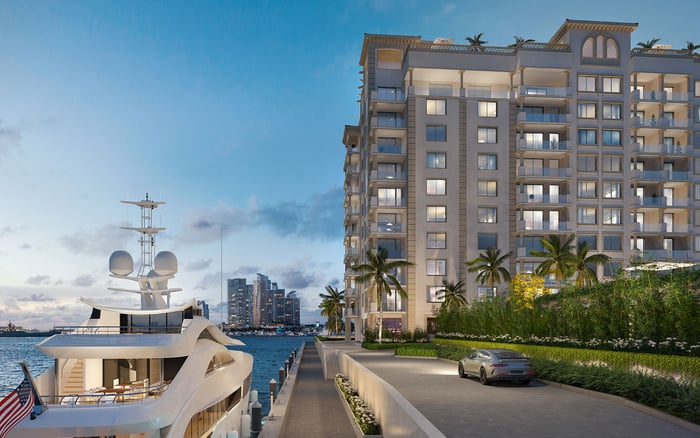
The Perigon’s oceanfront lifestyle is clearly articulated. Its home-office connectivity requires a separate conversation, with written confirmation of bandwidth, carrier independence, and emergency-power coverage before a buyer relies on the residence for business continuity.

At 5333 Collins Avenue, on Millionaires’ Row in Mid-Beach, The Perigon Miami Beach offers oceanfront living in a distinctly private setting. The development comprises 73 residences, with an advertised amenity program centered on hospitality, wellness, entertainment, and beachfront access.
For a buyer whose residence must also accommodate confidential calls, substantial file transfers, or a demanding executive schedule, another specification deserves equal attention: the connection between the office desk and the outside world. Home-office readiness warrants an assessment independent of the lifestyle offering.
Guaranteed bandwidth, independent telecom routes, and generator-backed resident connectivity remain unconfirmed. That is a disclosure boundary, not evidence that these capabilities are absent. The next step is a written, residence-specific technical brief-not an assumption in either direction.
The advertised program includes an oceanfront restaurant and speakeasy exclusively for residents and their guests, alongside a beachside swimming pool, outdoor spa, and dedicated beach access. Pool and beachside food-and-beverage service extend the hospitality offering. Wellness facilities, a screening room, salon, wine room, guest suites, and resident services round out the program.
These amenities speak to how a resident might spend the day, but they do not establish how reliably that resident can conduct business. A dedicated business center or professionally equipped coworking suite remains unconfirmed. Buyers should verify any shared-workplace provision directly and assess the intended in-residence office on its own merits.
An attractive room is only the starting point. Before finalizing the office layout, request confirmation of the telecom panel, conduit routes, cabling to the proposed desk location, and rules governing networking equipment.
Fiber-to-the-unit service, enterprise-grade internet, symmetrical upload and download speeds, and guaranteed bandwidth remain unconfirmed at The Perigon. A primary telecommunications provider, provider contract, and telecom service-level agreement have not been identified.
The buyer’s request should be precise: which carriers can serve the selected residence, what download and upload speeds are available, what service obligations apply, and what installation charges accompany the chosen service? Confirm whether the proposed modem or optical network terminal, often called an ONT, and router configuration are permitted.
A buyer also considering 57 Ocean Miami Beach should apply the same residence-level questions to both properties, without treating either address as evidence of technical capability. The comparison should rest on written answers, not amenity language.
Have the buyer’s IT consultant define the household’s working requirements first. Then request a service configuration that meets those requirements, including upload capacity, rather than accepting a headline download figure as the complete specification.
Dual internet carriers, physically independent broadband paths, and automatic telecom failover remain unconfirmed at The Perigon. Telecommunications demarcation locations, riser design, structured cabling, and residents’ ability to contract with multiple carriers are also undisclosed.
The essential diligence question is not simply whether a second subscription is available. It is whether the proposed connections use separate building entrances, separate risers, and independent upstream routes. Two subscriptions do not establish proven redundancy without that confirmation.
Ask the technical team to document each route and identify any shared infrastructure. Separately, confirm whether automatic failover is available, which equipment would perform it, and whether that equipment is permitted within the residence.
Cellular backup deserves its own inquiry. In-unit cellular coverage, rooftop telecommunications arrangements, and Wi-Fi 6E or Wi-Fi 7 infrastructure remain unconfirmed. Before relying on a secondary connection, have the consultant test reception at the actual office location and verify the rules governing antennas and related equipment.
Generator-backed connectivity requires more than a general assurance about building emergency power. At The Perigon, it remains unconfirmed whether telecom rooms, internet equipment, security, access control, or building-management systems receive generator-backed power. Emergency-power coverage for in-unit receptacles and office circuits is likewise unspecified.
Generator capacity, fuel type, fuel-storage duration, transfer-switch configuration, testing schedule, and supported loads remain unidentified. Buyers should treat those specifications as unresolved until written documentation establishes them.
Request the electrical one-line diagram, emergency-power load schedule, generator specifications, and available maintenance and testing records. Pair that request with the low-voltage drawings so the buyer’s consultant can examine the proposed connectivity arrangement alongside its power requirements.
The inquiry should trace the proposed service from the building’s telecom equipment to the residence’s network equipment and office circuits. Ask the technical team to identify which components would remain powered, which would not, and what remains unconfirmed. Do not translate a building-level emergency-power provision into a promise of uninterrupted resident internet service.
Whether the home is a principal residence or a seasonal base, acceptance criteria should be clear before closing. Have the buyer’s IT consultant verify unit-level carrier availability, wired throughput and latency, cellular reception, and failover behavior. Coordinate any emergency-power testing with building management.
Where a test cannot yet be completed, keep it as an unresolved verification item rather than treating a proposed specification as observed performance. The written brief should distinguish what is available, what is permitted, what has been installed, and what has actually been tested.
For a buyer weighing Faena House Miami Beach alongside The Perigon, the same brief provides a consistent basis for comparison. It presumes neither technical equivalence nor superiority. It gives the buyer a disciplined way to assess office requirements separately from the residential experience.
The Perigon’s hospitality and beachfront amenities establish a compelling lifestyle proposition. They do not, by themselves, resolve the operational requirements of a private office. Those requirements deserve a separate review: unit-level service terms, documented route independence, and an emergency-power schedule identifying the relevant equipment and circuits.
The most useful conclusion is neither a blanket endorsement nor a warning. It is a defined condition of confidence: obtain project-specific written confirmation, reconcile it with the selected residence, and arrange appropriate testing before relying on the home for business continuity.
For a discreet conversation about matching Miami Beach residences to your lifestyle and working requirements, connect with MILLION.
If branded residences are on your mind — as a home or as an allocation — we would be glad to share what we are seeing, privately.
Begin a quiet conversationThe Perigon is an oceanfront residential development at 5333 Collins Avenue, on Millionaires’ Row in Miami Beach’s Mid-Beach neighborhood.
The development comprises 73 residences.
The available project materials do not confirm fiber-to-the-unit service. Buyers should request written confirmation for their selected residence.
Neither symmetrical upload and download speeds nor guaranteed bandwidth is confirmed in the available materials. Request the available service tiers and obligations in writing.
The available materials do not identify a primary telecommunications provider, provider contract, or telecom service-level agreement.
Dual carriers, physically independent broadband paths, and automatic failover are not confirmed. Two subscriptions alone should not be treated as proof of independent routes.
The available information does not establish generator-backed power for telecom rooms or internet equipment. In-unit receptacles and office circuits also require written confirmation.
Request the electrical one-line diagram, emergency-power load schedule, generator specifications, and available maintenance and testing records. Low-voltage drawings should accompany the review.
The available amenity materials do not describe a dedicated business center or professionally equipped coworking suite. This does not establish that such a provision is unavailable.
Verify unit-level carrier availability, wired throughput and latency, cellular reception, and failover behavior. Any emergency-power testing should be coordinated with building management.