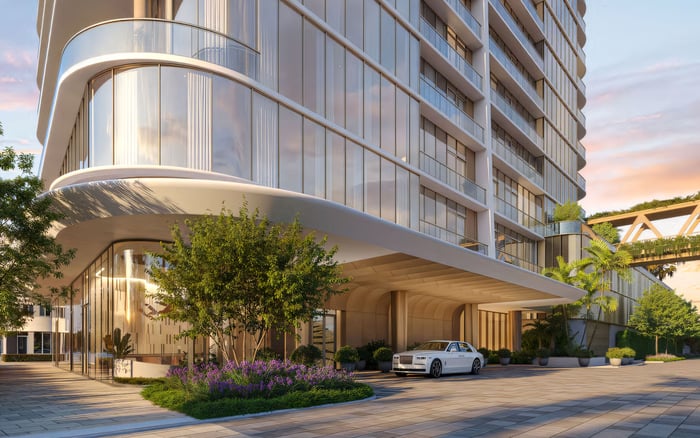
A discreet 2026 buyer framework for comparing 619 Residences by Foster + Partners + Nobu Hospitality with Aston Martin Residences Downtown Miami, emphasizing completion risk, reserve exposure, insurance structure, liquidity, and the value of an already delivered ultra-luxury building.

For ultra-prime buyers in Miami, the question is no longer simply which building offers the strongest brand language, the most seductive amenity narrative, or the most dramatic skyline presence. The more serious 2026 question is how much uncertainty a buyer is willing to absorb before closing. That is why the comparison between 619 Residences by Foster + Partners + Nobu Hospitality and Aston Martin Residences Downtown Miami is best understood as a test of reserve exposure, insurance structure, and completed-building certainty.
Aston Martin Residences Downtown Miami occupies the established-building side of this comparison. It is the completed ultra-luxury condominium option, and for buyers prioritizing lower completion risk, it becomes the relevant Downtown benchmark. The other side of the decision is the appeal of a branded preconstruction tower, where a buyer may be drawn to design pedigree, hospitality alignment, and the possibility of development upside.
The distinction is not about which narrative is more glamorous. It is about what a sophisticated buyer can verify today, what must be projected, and which risks remain outside the buyer’s control.
Completed-building certainty is a luxury in itself. In a finished tower, a buyer can evaluate the building as it exists, not as it is promised to become. The arrival experience, amenity operations, vertical circulation, acoustic privacy, common-area condition, service culture, and resident composition can all be observed. That visibility matters when the purchase is not only a residence, but also a long-duration capital placement.
Aston Martin Residences Downtown Miami is therefore more than a name in this comparison. It is the known condition. The building is already delivered, which shifts diligence from construction timing to operating performance. A purchaser can focus on the association structure, current monthly carrying costs, insurance treatment, reserve posture, and the way the building functions under real resident use.
For buyers who value control, this is the essential advantage. Completion risk is not abstract when timelines, financing conditions, and construction variables can influence the eventual ownership experience. A completed tower may not offer the same pre-delivery pricing psychology as a future building, but it offers something many 2026 buyers now prize more: fewer unknowns.
Pre-construction can be compelling for the right buyer. A residence tied to internationally recognized design and hospitality names may offer the emotional force of being early, the ability to select from a cleaner inventory slate, and the satisfaction of entering a building before its long-term social and market identity is fully formed. In certain cycles, that early position can be meaningful.
But the buyer profile is different. The preconstruction buyer must be comfortable with time, evolving delivery conditions, and the possibility that the final ownership experience will be shaped by factors that cannot be fully inspected at contract signing. Renderings, brand associations, and promised lifestyle programming are important, but they are not substitutes for a functioning building.
This is where the 2026 decision becomes personal. A buyer with multiple residences, flexible timing, and a high tolerance for development risk may view a branded future tower as an elegant option on Miami’s continued growth. A buyer seeking immediate use, greater certainty, and a clearer view of building-level obligations may prefer the completed benchmark.
Reserve exposure should no longer sit at the end of due diligence. For luxury condominium buyers, it belongs at the beginning. A beautiful residence can still carry an unattractive ownership profile if the association’s long-term capital planning is opaque, underfunded, or dependent on future special assessments.
In a completed building, buyers have the benefit of reviewing the existing structure rather than estimating how it may operate after turnover and stabilization. The questions are direct: how are reserves being handled, what capital items are anticipated, what is the relationship between current maintenance levels and long-term building needs, and how transparent is the association’s financial posture?
In a future building, the exercise is more interpretive. Buyers can review the disclosed framework, but the lived financial rhythm of the building has not yet been tested in the same way. That does not make the opportunity inferior. It simply changes the nature of the risk. New-construction appeal and reserve clarity do not always mature at the same pace.
For high-net-worth buyers, the best approach is not to avoid reserve exposure. It is to price it correctly, negotiate with awareness, and understand whether the residence is being acquired for lifestyle, investment, long-term family use, or a combination of all three.
Insurance structure has become part of the luxury conversation because it affects both carrying cost and buyer confidence. In the past, many purchasers treated insurance as a background line item. In the current environment, it deserves equal billing with views, ceiling heights, terrace usability, and building services.
For a completed building such as Aston Martin Residences Downtown Miami, a buyer can ask sharper questions about the building’s current insurance structure, how premiums interact with monthly ownership costs, and whether coverage assumptions appear durable. The answers are not merely administrative. They influence liquidity, lending comfort, and the long-term appeal of the asset.
For a preconstruction residence, insurance analysis is necessarily more forward-looking. The buyer is evaluating a structure that will eventually enter the market with its own operating realities. That may be acceptable, but it requires discipline. A polished sales gallery should not replace a careful review of how the eventual condominium association is expected to carry and allocate risk.
In the ultra-luxury tier, discretion often means asking unglamorous questions early. The most sophisticated buyers do not separate architecture from operations. They understand that a building’s elegance must be supported by a resilient financial and insurance framework.
Downtown is no longer a speculative skyline conversation for luxury buyers. It is a maturing vertical residential market where completed towers, branded residences, and waterfront addresses compete for a buyer who may also be considering Miami Beach, Coconut Grove, Brickell, Sunny Isles, or Palm Beach. Within that wider field, certainty has become a defining differentiator.
Aston Martin Residences Downtown Miami is the established reference point in this particular comparison because it gives the buyer a completed ultra-luxury option in the same urban frame. The tower functions as the lower completion-risk alternative to a preconstruction branded tower, especially for purchasers who want to see, touch, and occupy before committing fully to the lifestyle.
Resale considerations also enter the conversation. A completed building has observable market behavior, visible resident adoption, and a clearer identity among brokers and buyers. A future building may offer a different trajectory, but its market proof arrives later. The premium buyer must decide whether the value lies in entering early or in buying what has already been delivered.
The choice should begin with use case. If the residence is intended for near-term occupancy, family use, or immediate Miami presence, the completed-building argument strengthens. If the purchase is part of a broader portfolio strategy and the buyer can wait, a preconstruction branded tower may remain attractive.
The second test is balance-sheet psychology. Some buyers are comfortable with deposits, future closings, and the staging of capital over time. Others prefer the clarity of transacting in a finished building, where the residence, building operations, and surrounding ownership environment can be assessed together.
The third test is emotional. The buyer who wants the first chapter of a new branded address may accept uncertainty as part of the privilege. The buyer who wants fewer variables may find the completed Aston Martin Residences Downtown Miami proposition more aligned with 2026 priorities.
Neither position is inherently more sophisticated. What matters is whether the buyer’s risk tolerance matches the building’s stage of life. In the current market, luxury is not only finish quality. It is also predictability.
Is Aston Martin Residences Downtown Miami completed? Yes. It is the completed ultra-luxury condominium option in this comparison.
Why is completed-building certainty important in 2026? It allows buyers to evaluate the actual residence, building operations, amenities, and ownership structure before committing.
Is 619 Residences by Foster + Partners + Nobu Hospitality treated as preconstruction here? It is discussed as the branded future-tower side of the comparison, focused on development upside versus certainty.
Which option has lower completion risk? Aston Martin Residences Downtown Miami is framed as the lower completion-risk alternative because it is already completed.
Should reserve exposure be reviewed before making an offer? Yes. Reserve posture can affect long-term carrying costs, special assessment risk, and overall ownership confidence.
Why does insurance structure matter for luxury condo buyers? Insurance can influence monthly costs, lending comfort, liquidity, and the perceived strength of the building’s operating model.
Is pre-construction always riskier than buying completed? It generally involves more unknowns, although the right buyer may accept those variables for design, selection, or timing advantages.
How should an investment buyer approach this comparison? The buyer should weigh development upside against carrying-cost visibility, exit liquidity, and tolerance for delayed market proof.
Does Downtown Miami favor completed luxury buildings? Downtown supports both completed and future branded residences, but completed buildings offer a clearer ownership picture today.
Is resale liquidity easier to evaluate in a completed building? Yes. A completed building provides more visible evidence of buyer response, resident adoption, and market identity.
For a confidential assessment and a building-by-building shortlist, connect with MILLION.
If branded residences are on your mind — as a home or as an allocation — we would be glad to share what we are seeing, privately.
Begin a quiet conversation