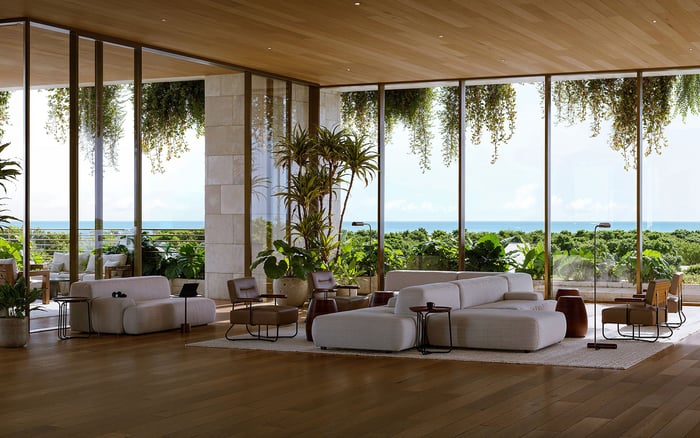
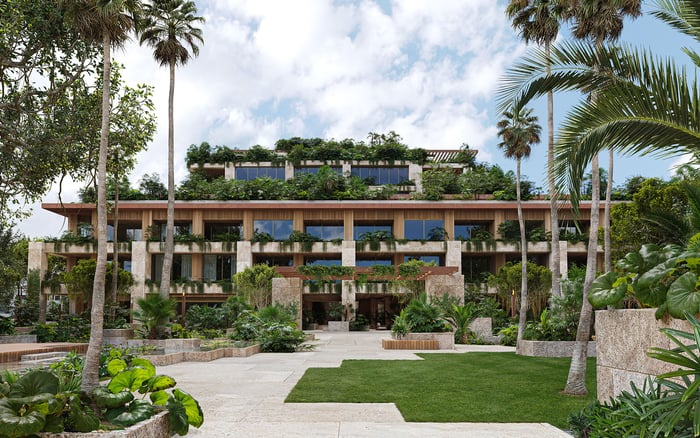
Ziggurat Coconut Grove stands apart in Miami luxury by rejecting tower scale in favor of stepped architecture, terraces, and a pedestrian-minded mixed-use vision that fits Coconut Grove’s village character. For architecture-conscious buyers, its appeal is rooted in scarcity, design pedigree, privacy, and a more intimate daily experience than the city’s conventional vertical condominium model.
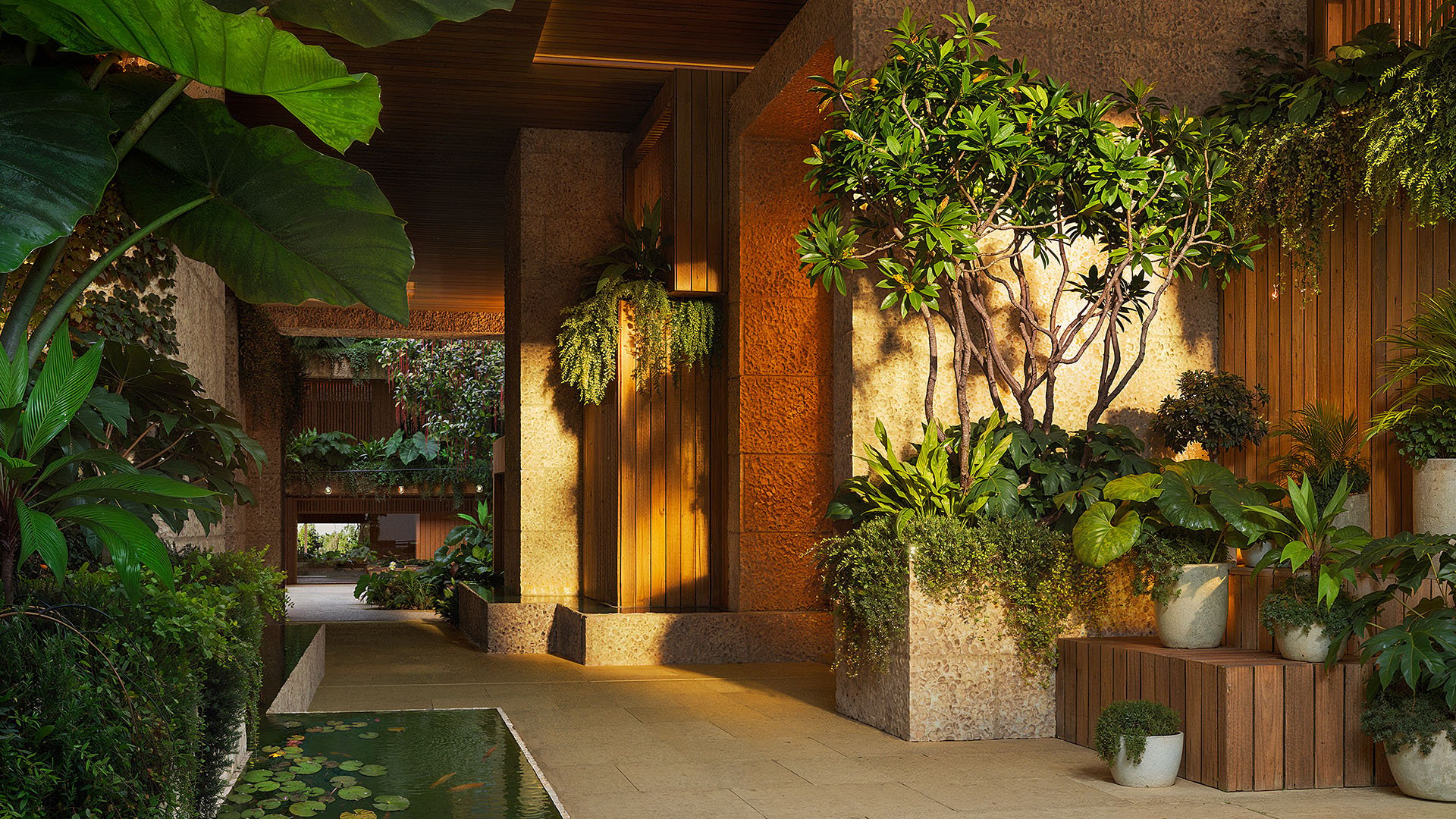
In South Florida, luxury residential marketing often revolves around altitude. The familiar pitch is higher floors, broader bay panoramas, dramatic arrivals, and the idea that prestige rises in direct proportion to verticality. Ziggurat Coconut Grove advances a different thesis. Rather than competing on tower scale, it is conceived as a design-led, stepped residential project by OKO Group with architecture by OMA / Rem Koolhaas, organized around terraces, lower-scaled massing, and a mixed-use ground plane.
That distinction matters because Coconut Grove is not Brickell, and many buyers drawn to the neighborhood are not necessarily seeking Brickell’s tempo. The Grove has long held a more layered identity within Miami: historic, tree-canopied, walkable, and culturally distinct, with a village rhythm that rewards time spent at street level. In that setting, a conventional monolithic tower can feel imported. Ziggurat Coconut Grove is compelling precisely because it is designed to belong.
For MILLION Luxury readers, the central question is not whether the project is taller, louder, or more theatrical than competing developments. It is whether the architecture creates a more refined way to live. Here, the answer lies in proportion, circulation, privacy, and the quality of outdoor space.
The most natural buyer for Ziggurat Coconut Grove is not chasing a purely skyline-driven purchase. This is a residence for someone who responds to architecture as a daily experience, not simply as a visual icon from afar. The stepped form signals that immediately. Instead of repeating a standard tower floor plate across dozens of levels, the project emphasizes spatial variation, layered terraces, and communal nodes that feel more curated than stacked.
That design language tends to resonate with architecture-conscious purchasers, collectors, and globally mobile buyers who have already experienced the conventional luxury tower formula in other cities. For this audience, scarcity and neighborhood fit can be more valuable than sheer height. A buyer comparing options in Coconut Grove may also consider Park Grove Coconut Grove, Mr. C Tigertail Coconut Grove, or Vita at Grove Isle, yet Ziggurat Coconut Grove speaks most directly to those who want a more architectural, more terraced, and less vertically standardized expression of luxury.
This is also where the project’s discretion becomes part of its appeal. Public pricing has not been broadly transparent, and current availability may require direct inquiry. In the upper tier of the market, that selective posture often reinforces the sense that the offering is intended for buyers seeking alignment, not mass visibility.
The strongest case for Ziggurat Coconut Grove is architectural, but not in an abstract sense. Its stepped ziggurat form is more than a signature silhouette. It changes how the building meets the neighborhood and how residents may experience the property day to day. Terracing softens the massing. Green roofs and layered outdoor spaces create a more gardened visual relationship with the Grove. The result is intended to feel less like an isolated residential object and more like a composition that participates in its surroundings.
That is especially relevant in Coconut Grove, where buyers often value shade, walkability, and a residential atmosphere that feels textured rather than overprogrammed. The project’s anti-tower position is not anti-luxury. It is anti-formula. Instead of relying on private-elevator theatrics or pure skyline dominance, it leans on design prestige, outdoor living, and neighborhood intimacy.
For some purchasers, that will be a stronger luxury signal than a higher floor count. The true premium here is not altitude. It is a sense of compression and release, of moving through terraces, semi-public moments, and more varied spaces. In a market full of superlatives, restraint can read as confidence.
A project like this works because Coconut Grove already has an identity robust enough to support it. The neighborhood’s appeal is not simply residential. It is experiential. Streets feel walkable. The tree canopy changes how scale is perceived. Daily life can include cafés, boutiques, dining, and informal gathering without the sense that everything is organized around a single high-rise lobby.
Ziggurat Coconut Grove extends that logic with a pedestrian-oriented ground plane and a mixed-use vision that includes retail, dining, and gathering spaces. This is an important distinction for sophisticated buyers. In many Miami projects, the base of the building is dominated by parking, drop-off choreography, and private residential separation. Here, the ambition is placemaking.
That does not mean a loss of privacy. It means privacy paired with urbanity rather than isolation. Buyers who are also considering Arbor Coconut Grove, The Well Coconut Grove, or Four Seasons Residences Coconut Grove may find that Ziggurat Coconut Grove occupies a distinct lane: less about hospitality expression, less about a conventional branded high-rise cadence, and more about architecture integrated with the neighborhood’s village mood.
The value proposition is easiest to understand when framed correctly. Buyers are not paying for the same qualities they would seek in a hyper-vertical address in Brickell or a pure oceanfront statement in Miami Beach. They are paying for design intent, scarcity, and a mode of living that feels more personal.
In practical terms, that means greater emphasis on terraces, outdoor rooms, varied massing, and a building profile that sits more comfortably within Coconut Grove’s established character. It also means a stronger connection between residence and neighborhood. For a buyer who wants to step outside into a place that feels inhabited rather than merely serviced, this matters.
There is also a broader market logic behind the appeal. Boutique, design-driven new development in established neighborhoods tends to command attention because it is difficult to replicate. Coconut Grove does not need another anonymous glass tower to validate its luxury credentials. If anything, the neighborhood’s prestige is sharpened by projects that understand scale and context.
Miami remains rich with vertical statements, and many are exceptional on their own terms. In Brickell, for example, projects such as 888 Brickell by Dolce & Gabbana exemplify a more overtly skyline-oriented, brand-forward sensibility. In Edgewater or Downtown, the appeal often centers on water views, dramatic height, and metropolitan energy.
Ziggurat Coconut Grove is pursuing nearly the opposite emotional register. It asks whether luxury can feel quieter, greener, and more embedded in neighborhood life without losing design authority. For many buyers, especially those who have already owned in traditional towers, that is not a compromise. It is the next refinement.
The project also reinforces a growing divide in the upper market between spectacle and subtlety. Spectacle still sells, especially when paired with waterfront exposure and global branding. Subtlety, however, can be harder to find and harder to imitate. A residence that privileges terraces over pure elevation and mixed-use placemaking over isolated monumentality offers a kind of sophistication that reveals itself more gradually.
The clearest reason to watch Ziggurat Coconut Grove is that it refuses to behave like a generic luxury condominium. Its stepped form, layered outdoor spaces, and pedestrian-minded base suggest a different definition of prestige, one more aligned with Coconut Grove itself. For buyers who want their residence to feel connected to a neighborhood rather than suspended above it, that difference is material.
It is also why the project may prove especially compelling to purchasers who care about authorship in architecture. OMA / Rem Koolhaas brings a level of design recognition that places the project in conversation with a more international standard of residential ambition. Yet the success of the concept will depend less on name recognition than on whether the final experience delivers what the renderings and narrative promise: privacy, terraces, spatial richness, and a true sense of village-scaled luxury.
For the right buyer, that may be more desirable than tower scale ever was.
What is Ziggurat Coconut Grove? It is a planned luxury residential project in Coconut Grove by OKO Group with architecture by OMA / Rem Koolhaas, conceived as a design-led alternative to the conventional condo tower.
Why is it called a ziggurat? The project centers on a stepped form, with layered massing and terraces rather than a singular vertical slab.
Who is the ideal buyer? It best suits architecture-conscious buyers who value privacy, outdoor space, and neighborhood character over maximum height.
How does it fit Coconut Grove? Its lower-scaled, terraced design aligns with the Grove’s walkable, tree-canopied, village-like identity.
Is it a mixed-use project? Yes. The vision includes retail, dining, and gathering spaces to create a more neighborhood-oriented daily experience.
What makes it different from Brickell towers? It is less focused on skyline spectacle and more focused on placemaking, terraces, and a more intimate residential feel.
Does the design include outdoor living spaces? Yes. Green roofs and layered terraces are central to the project narrative and to its softer relationship with the neighborhood.
Is pricing publicly clear? Pricing has been selectively presented, so current availability and pricing may require direct inquiry.
Why does scarcity matter here? Boutique, design-driven new development in Coconut Grove is relatively rare, which can elevate the appeal of a project with strong architectural identity.
Is this for buyers who want a classic Miami tower experience? Not primarily. It is better suited to those who prefer architectural nuance and village intimacy to pure tower scale.
For a confidential assessment and a building-by-building shortlist, connect with MILLION Luxury.
If branded residences are on your mind — as a home or as an allocation — we would be glad to share what we are seeing, privately.
Begin a quiet conversation