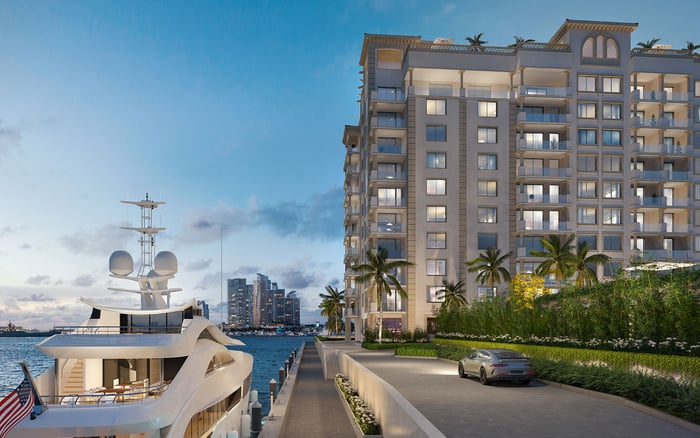
For yacht owners considering The Perigon Miami Beach, residential due diligence should extend well beyond the apartment. A disciplined review tests the vessel’s full route, dock compatibility, severe-weather plan, landside logistics, and privacy protocol before a purchase becomes binding.

For a yacht owner considering The Perigon Miami Beach, the most consequential questions may extend beyond the residence itself. A rigorous due-diligence brief should connect the vessel’s dimensions and operating profile to its intended berth, bridge exposure, storm strategy, crew movements, guest transfers, and the privacy of every arrival.
This is not simply a search for nearby water. It is an operational test of whether the owner’s preferred yachting pattern can coexist elegantly with daily life in Miami Beach. A captain, marine surveyor, insurance adviser, marina representative, and real-estate counsel should review their respective areas before contractual deadlines expire. A beautiful residence and a workable yacht plan are separate assets that must function together.
Begin with the yacht, not the map. Record length overall, beam, loaded draft, air draft, displacement, tender arrangement, fixed antennas, retractable equipment, and any operating limits established by the captain or manufacturer. Air draft should reflect the vessel in its actual arrival configuration, not a simplified specification sheet.
Then trace every plausible route between open water and the intended dock, fueling location, maintenance facility, and hurricane refuge. Review each bridge individually for posted clearance, relevant water level, opening schedule, communications procedure, and the effects of wind or current while waiting. Never treat nominal clearance as usable clearance without a safety margin accepted by the captain.
Test the route at realistic arrival times as well. Daylight, nighttime, weekend traffic, special events, and a bridge that fails to open can produce markedly different experiences. Buyers comparing The Ritz-Carlton Residences® Miami Beach should apply the same vessel-specific route analysis rather than infer access from a waterfront setting or map pin.
Dockage due diligence should extend beyond whether a slip is described as suitable. Confirm the maximum accepted length, beam, draft, displacement, and overhang, along with fendering, piling geometry, water depth at the berth and on approach, turning room, and restrictions on tenders or chase boats. If the yacht requires specific shore power, pumping, fueling, provisioning, or waste services, establish precisely where and how those needs will be met.
Operational rules matter just as much. Review guest access, crew credentials, vehicle parking, deliveries, contractor entry, work hours, overnight occupancy, pets, charter activity, and the transfer or cancellation terms attached to the berth. A boat-slip arrangement may be owned, leased, assigned, licensed, or separately contracted; those distinctions belong in legal review.
A buyer exploring Onda Bay Harbor as a residential alternative should still separate the home decision from the marina decision. Obtain current written terms from the relevant parties and make any essential dockage outcome part of the transaction strategy.
A named storm exposes weak assumptions quickly. The owner should know who makes the move decision, what trigger begins preparations, where the yacht will go, how long relocation takes, and which crew members must be present. The plan should anticipate that the preferred destination, haul-out provider, tow operator, or fuel source may be unavailable.
Review the marina agreement for evacuation requirements, deadlines, liability provisions, line and fender obligations, and restrictions on leaving a vessel in place. Align those terms with the yacht’s insurance conditions and the captain’s judgment. When timing or coverage depends on a third party, written confirmation is preferable.
The backup plan should include alternate berths or yards, vendor contacts, crew transport, access to keys and documents, and a post-storm inspection sequence. Even when considering a marine-oriented setting such as St. Regis® Residences Bahia Mar Fort Lauderdale, buyers should assess storm readiness independently rather than assume proximity to yachting infrastructure resolves the risk.
Arrival privacy is a chain, and its weakest link may be far from the residence. Walk through the entire sequence: approach, bridge waiting, marina entry, line handling, guest disembarkation, luggage transfer, vehicle staging, elevator access, and crew departure. Identify where the yacht, guests, or vehicles may be observed and where delays could create unwanted visibility.
Ask how visitor names are handled, who receives arrival notices, whether vendors use separate entrances, and how captains coordinate with residential staff. Digital discretion also belongs in the plan. Communications, shared itineraries, photographs, vessel-tracking practices, and guest posts should follow a protocol reviewed by the captain and appropriate advisers.
For buyers also weighing The Residences at Six Fisher Island, privacy should be evaluated as an operating procedure, not an architectural promise. The strongest protocol is calm, repeatable, and understood by household staff, crew, drivers, and guests.
Before closing, assemble a concise yacht-owner memorandum. It should contain the measured vessel profile, marked routes, bridge checks, dock terms, insurance requirements, storm contacts, privacy protocol, and unresolved contingencies. Dates and responsible parties should be clearly identified so assumptions do not pass silently from broker to captain or from captain to counsel.
The central question is practical: Can this specific yacht, under the owner’s actual operating preferences, be berthed, moved, protected, serviced, and received discreetly? If any answer depends on informal assurances, convert it into a document, a contingency, or a clearly accepted risk.
Is published bridge clearance enough for a purchase decision? No. The captain should compare route conditions with the yacht’s measured air draft and an appropriate safety margin.
Should retractable antennas be included in the air-draft review? Yes. Review both normal and reduced configurations, including the time and crew procedure required to change them.
What vessel dimensions should a marina receive? Provide length overall, beam, loaded draft, air draft, displacement, overhangs, and tender configuration.
Can a nearby berth be treated as part of the residence? Only if the governing documents and contracts establish that relationship. Counsel should verify ownership, assignment, transfer, and termination terms.
What dock utilities deserve confirmation? Confirm shore power, potable water, waste handling, fueling access, connectivity, and any adapters or operating limits.
Who should control the storm decision? The plan should name a decision-maker and align the captain’s authority with insurance and contractual obligations.
Why is a backup storm destination necessary? A preferred berth, yard, tow service, or haul-out option may not be available when demand rises.
How can owners improve arrival privacy? Coordinate marina, vehicle, luggage, guest, crew, and residential access through one rehearsed protocol.
Should yacht tracking be switched off for privacy? Any tracking decision must comply with applicable rules and safe-navigation requirements, with advice from the captain and counsel.
When should marine due diligence begin? Begin before contractual deadlines, allowing specialists time to inspect routes, documents, dockage, and contingency plans.
To compare the best-fit options with clarity, connect with MILLION.
If branded residences are on your mind — as a home or as an allocation — we would be glad to share what we are seeing, privately.
Begin a quiet conversation