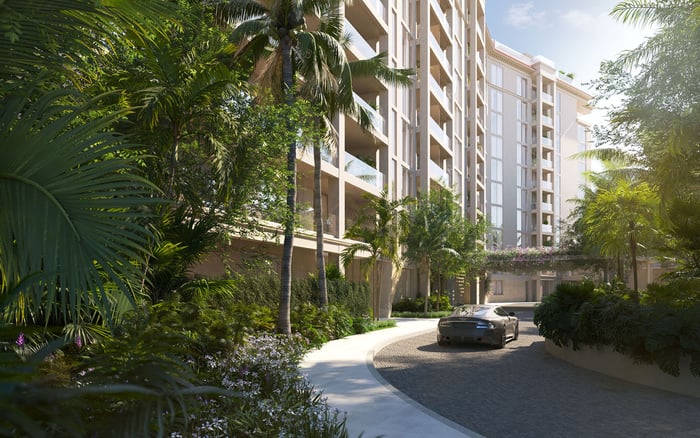
A buyer-focused guide to evaluating private elevator arrivals, guest circulation, and service access across selected branded residential addresses in Miami.
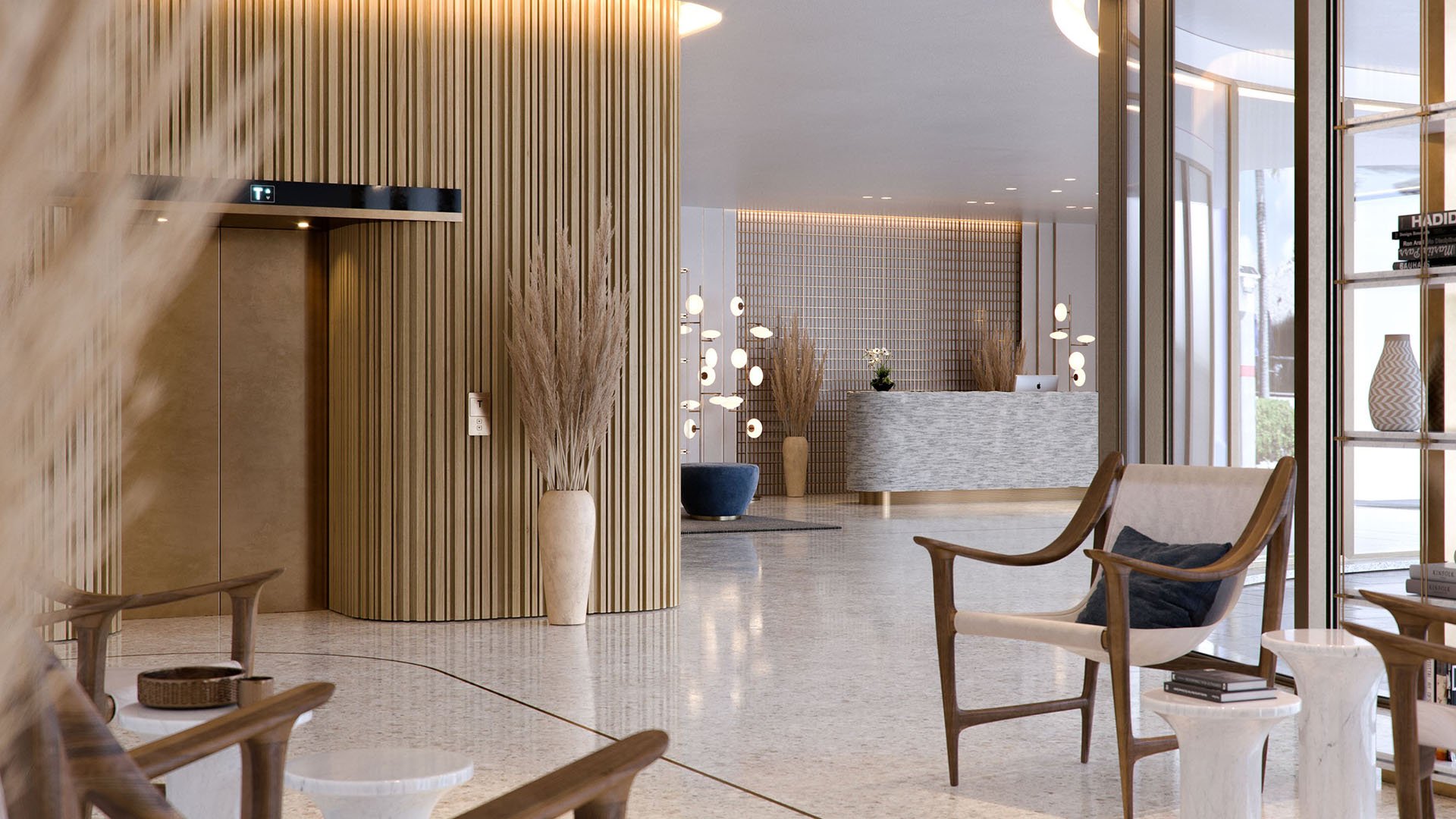
In Miami’s branded residences, privacy is not a single amenity. It is a sequence: the vehicle approach, entrance handoff, lobby exposure, elevator control, residential threshold, and the handling of guests, staff, and deliveries. A private elevator arrival can feel exceptional, but its value depends on how effectively the entire route limits unnecessary encounters.
For buyers who move between homes, host frequently, or maintain household staff, discreet access is also an operational concern. The strongest choice is not necessarily the address with the most dramatic elevator lobby. It is the residence whose circulation plan, staffing model, and access rules align with the owner’s actual routine. This assessment should trace a real arrival from curb to front door.
A useful shortlist spans distinct neighborhoods and residential formats. Each candidate should be treated as the start of due diligence, not confirmation that every residence shares the same elevator or access configuration.
In Brickell, The Residences at 1428 Brickell belongs in a focused comparison for buyers seeking an urban branded address. Request the precise route for residents, invited guests, vendors, and household employees. Ask whether elevator permissions are tied to a residence, floor, or temporary credential-and whether procedures change after hours.
For a Miami Beach search, Shore Club Private Collections Miami Beach offers another relevant point of comparison. The buyer’s review should distinguish the ceremonial arrival from the everyday one. Walk the route from vehicle drop-off to residence, then repeat it as a dinner guest and a service professional would experience it.
In Sunny Isles Beach, Bentley Residences Sunny Isles merits consideration from purchasers who place arrival design high on the brief. The essential questions concern control and continuity: who authorizes access, where visitors wait, what staff can see, and how the route functions if a primary elevator is unavailable.
For buyers considering island living, The Residences at Six Fisher Island can enter the conversation. The residence-level arrival should be assessed within the broader sequence of property access. Confirm every handoff rather than assuming that one controlled boundary resolves every privacy question.
A second Miami Beach reference, The Ritz-Carlton Residences® Miami Beach, gives buyers another branded model to evaluate. Compare not only finishes and hospitality, but also the separation of resident, guest, and service movement. The most discreet plan is often the one that resolves ordinary logistics without calling attention to them.
The phrase can describe several configurations. An elevator may open directly into a residence, a private vestibule, or a limited-access landing shared by very few homes. These are materially different experiences. Buyers should identify the precise condition for the residence under consideration and confirm whether access control is physical, digital, staffed, or layered.
The threshold deserves equal scrutiny. A direct opening can be elegant, yet it raises practical questions about package handling, guest verification, fire and life-safety procedures, and separation between the elevator and living space. A vestibule may provide a useful buffer, provided its ownership, maintenance, and permitted use are clear.
Privacy should also withstand routine disruption. Ask what happens during maintenance, peak arrival periods, and power or equipment interruptions. A beautifully designed primary route is less compelling if the backup path passes through a busy shared area or complicates access for family members and staff.
Guest access should feel gracious without becoming porous. The ideal protocol allows an owner to pre-authorize a visitor, gives staff clear instructions, and limits elevator permissions to the intended destination. Revocation should be equally straightforward. Buyers should request a demonstration rather than rely on a verbal overview.
Consider distinct guest profiles. A close friend arriving for dinner may follow one route, while a caterer, trainer, medical professional, or event vendor may require another. Ask where each person checks in, waits, and exits. Determine whether staff must escort them and whether service circulation intersects with resident spaces.
Digital convenience warrants scrutiny as well. Temporary credentials, mobile access, and remote authorization can reduce friction, but buyers should understand who administers the system, which records are retained, and how access is managed when a device fails. Privacy is strongest when technology, staffing, and physical design reinforce one another.
When possible, tour at more than one time of day. Observe the vehicle queue, lobby activity, elevator wait, and visibility from common areas. Stand where a guest would stand. Walk from parking or drop-off with a phone in one hand and luggage in the other. Small inconveniences often emerge only when the route is tested rather than admired.
Bring a concise list of scenarios: owner arrival, unaccompanied family member, overnight guest, household employee, delivery, private driver, and vendor. For each, ask who grants permission, which entrance is used, where waiting occurs, and what happens after hours. Request written clarification for any point that could affect daily life.
Finally, review governing documents, purchase materials, and current operating policies with qualified advisers. Elevator use, common-area rules, staffing practices, and technology can evolve. The objective is to distinguish design intent from enforceable rights and present-day operations.
Does a private elevator always open directly into the residence? No. Depending on the specific residence, it may open into a private vestibule, a limited-access landing, or the home itself.
Should buyers verify privacy features for a particular unit? Yes. Elevator and entry configurations can differ, so verify the exact residence rather than relying on a building-level description.
What is the first arrival route to test? Begin at the vehicle drop-off or parking space and continue to the residential threshold without skipping any handoff.
How should guest access be evaluated? Request a live demonstration covering pre-authorization, check-in, elevator permission, waiting areas, and credential expiration.
Why does service circulation matter? Deliveries and household operations shape daily privacy, particularly when service paths overlap with resident or guest routes.
What should happen when an elevator is unavailable? Ask the building to explain the alternate route and how privacy, accessibility, and authorization are maintained during the disruption.
Are app-based credentials enough on their own? Not necessarily. Digital access is most effective when supported by clear staffing protocols and controlled physical circulation.
Should household staff use the same entrance as owners? That depends on the owner’s preferences and building rules. Confirm permitted routes and after-hours procedures in advance.
Which documents deserve close review? Review governing documents, operating policies, and purchase materials for provisions concerning elevators, guests, and common areas.
What defines the best choice for a privacy-focused buyer? It is the residence whose design, access controls, staffing, and backup procedures work together for the buyer’s actual routine.
For a confidential assessment and a building-by-building shortlist, connect with MILLION.
If branded residences are on your mind — as a home or as an allocation — we would be glad to share what we are seeing, privately.
Begin a quiet conversation.jpg&width=700&height=438&fit=cover)