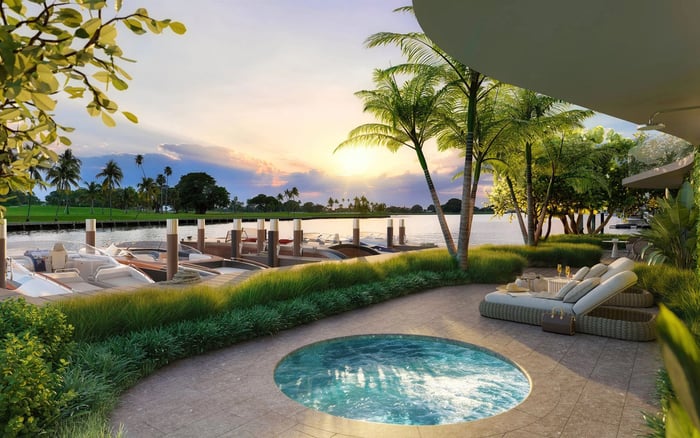
For many South Florida empty nesters, downsizing does not mean reducing a home to its bare minimum. The more sophisticated decision is often choosing a condo that preserves privacy, elegance, and operational simplicity while still accommodating grandchildren, adult children, caregivers, remote work, and longer guest stays. A family-floor-plan mindset is less about raising children again and more about buying flexibility, comfort, and resale depth in a market shaped by longevity and multigenerational living.
.jpg)
In South Florida, downsizing is rarely a purely arithmetic exercise. For many affluent buyers, the question is not simply whether to move from a large house into a condominium, but whether that condominium can support the life they are living now and the one they are likely to live five or ten years from now.
For many so-called empty nesters, the goal is not a minimalist retreat. It is a primary or near-primary residence that can accommodate visiting children, grandchildren, overnight guests, occasional caregiving, and at times a hybrid work schedule.
A family-floor-plan mindset, then, is not sentimental. It is strategic. It treats the second bedroom, den, or additional bath not as an indulgence, but as protection against future inconvenience.
One of the most common mistakes buyers make is assuming that because children no longer live at home full-time, a one-bedroom or tightly planned two-bedroom will be sufficient indefinitely. In practice, extra space often becomes more useful, not less. Grandchildren sleep over. Adult children visit for longer stretches. Friends arrive for holiday weekends. A spouse needs a quiet office. A caregiver may eventually require a proper sleeping area.
That is why resilient condo layouts often include at least one secondary bedroom or flexible den. That room can serve as a guest suite one month, a home office the next, and a grandchild sleeping space during school breaks. In a refined building such as 2200 Brickell, that kind of adaptability reflects how sophisticated buyers increasingly define livability: elegance paired with utility.
The same logic applies to bathrooms. More than one full bath reduces friction when multiple generations share the residence, even briefly. It preserves the privacy of the primary suite while allowing guests to feel accommodated rather than managed.
Luxury buyers often focus first on total interior area, ceiling height, views, and finishes. Those elements matter, but for empty nesters, layout often carries greater long-term value than size alone.
A well-executed split-bedroom plan is especially effective. It creates separation between the primary suite and secondary sleeping quarters, allowing owners to host adult children or grandchildren without compromising calm. Open living and dining areas also work best when balanced by genuinely private sleeping zones. The ideal result is a residence that feels expansive when entertaining and composed when occupied by several people at once.
This is one reason thoughtfully zoned plans continue to stand out in projects such as Una Residences Brickell and Aria Reserve Miami. In both cases, the appeal for this buyer profile is not simply prestige. It is the assurance that a home can remain graceful under changing patterns of use.
The phrase aging in place can sound utilitarian, but in the luxury condo market it is better understood as a design advantage. Step-free entry, wider circulation space, and an accessible bathroom configuration can make a residence easier to navigate over time while also improving the experience for visiting relatives of different ages and mobility levels.
The most sophisticated buyers understand that accessibility is not separate from luxury. It is part of it. Ease of movement, clear transitions, and intuitive everyday comfort create a residence that feels quietly resolved.
This is where a family-floor-plan mindset becomes especially important. If health needs evolve, or if a parent, relative, or caregiver spends more time in the unit, a rigid layout can force a second move. A flexible one may absorb those changes without major renovation. In boutique settings such as The Well Bay Harbor Islands, buyers are often drawn to precisely this balance of wellness-oriented living and practical future use.
In the upper tier of the market, buyers do not purchase only for lifestyle. They also purchase for optionality. A condo that works only for a couple seeking a pied-à-terre has a narrower audience than one that can also appeal to a remote executive, a multigenerational household, or a buyer planning for longer-term residence.
That broader functionality can support liquidity. A second bedroom that doubles as an office, a split plan that preserves privacy, or an accessible layout that broadens the future buyer pool all contribute to a more versatile asset. This is particularly relevant in South Florida, where buyers often intend to use their residences more fully than a purely seasonal pattern might suggest.
The smartest approach is to think in scenarios rather than categories. Instead of asking whether three bedrooms are necessary, ask how the home should perform when family visits for several nights, when one partner is working remotely, or when someone needs greater privacy or assistance.
A useful checklist includes:
A true second bedroom or enclosed den
At least two full bathrooms when possible
Separation between the primary suite and guest sleeping areas
Open entertaining space with defined private zones
Circulation that feels easy now and later
Storage that supports extended stays rather than weekend visits
In oceanfront settings, this approach can be especially compelling. A residence at 57 Ocean Miami Beach or The Ritz-Carlton Residences® Pompano Beach may satisfy the aesthetic expectations of a luxury buyer, but the more important question remains whether the floor plan is elegant only in photographs or genuinely capable in daily life.
South Florida has long been associated with reinvention, and that extends to the way affluent buyers define home. For today’s empty nester, success is not necessarily a dramatic reduction in space. It is a more intelligent allocation of it.
That may mean leaving behind the maintenance demands of a single-family property while retaining the social, familial, and practical functionality that made that house work for decades. In this market, right-sizing often means editing out waste, not surrendering flexibility.
The strongest condo choices for this group tend to combine privacy, adaptability, and a refined sense of ease. They acknowledge that family patterns rarely disappear entirely. They evolve. A buyer who understands that can choose a residence that feels impeccably suited to the present while remaining ready for the future.
Why would an empty nester need a family-style condo layout? Because extra rooms and better separation can accommodate grandchildren, adult children, guests, caregiving, and work without sacrificing privacy.
Is a second bedroom really necessary in a luxury condo? For many buyers, yes. It can function as a guest room, office, sleeping space for grandchildren, or a future caregiver suite.
What layout usually offers the most privacy? A split-bedroom plan is often preferred because it separates the primary suite from guest or family sleeping areas.
Do multiple bathrooms still matter after the kids move out? Yes. They make longer stays more comfortable and reduce friction when several people are using the home at once.
How does accessibility fit into luxury design? Thoughtful accessibility improves ease of living, supports aging in place, and can feel seamless rather than clinical when well executed.
Is downsizing to a one-bedroom too limiting? It can be, depending on family patterns and work habits. Buyers who host often or want flexibility may find a larger layout more practical.
Can a flexible floor plan help resale appeal? It can improve marketability because the home may appeal to a wider range of future buyers with different living needs.
Should empty nesters buy only for current needs? Usually not. A condo should reflect both present lifestyle and likely future changes in health, family visits, and work habits.
What features make a condo more future-ready? Privacy, multipurpose rooms, comfortable circulation, and adaptable bathrooms are among the most useful long-term features.
What is the key mindset shift for South Florida condo buyers? Think beyond simply choosing a smaller home and focus on whether the layout can gracefully handle real life over time.
For a confidential assessment and a building-by-building shortlist, connect with MILLION.
If branded residences are on your mind — as a home or as an allocation — we would be glad to share what we are seeing, privately.
Begin a quiet conversation