As South Florida luxury buyers gain more choice, many are looking past oversized amenity decks and focusing on quieter, cleaner, more discreet service circulation that protects privacy and daily ease.

For years, the visual hierarchy of new development was easy to read. A larger pool deck, another lounge, a more elaborate spa program, and a denser amenity offering all signaled ambition. In South Florida, that language still matters, but for the most discerning buyer, it no longer settles the question.
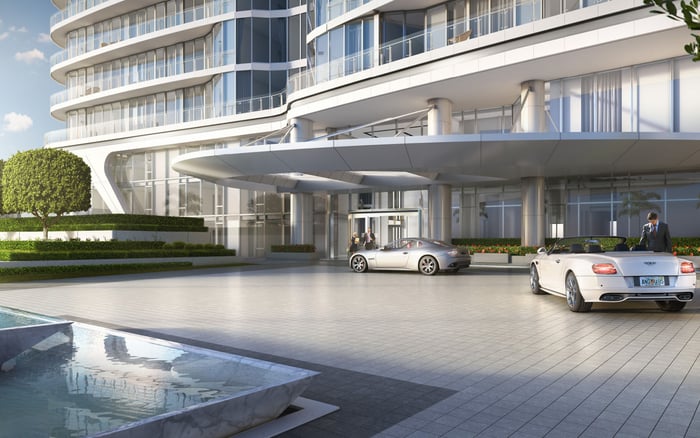
As upper-tier inventory has expanded and buyers have gained more leverage, attention has shifted to the mechanics of daily life inside a building. The question is no longer simply whether a tower offers a dramatic amenity deck. It is whether packages arrive without cluttering the lobby, whether housekeeping and vendors move discreetly, whether freight activity is separated from resident corridors, and whether the route from curb to residence feels calm rather than operational.
That shift is subtle, but consequential. In a more selective market, affluent buyers are increasingly judging a residence by the quality of its routines, not just the spectacle of its brochure.
Luxury product now competes in a landscape where many amenities are effectively baseline. A well-appointed fitness center, spa components, outdoor entertaining spaces, and polished common areas are expected in premier new construction. What differentiates one building from another is often less visible.
Service circulation is part of that differentiation. In practical terms, it includes loading docks, freight elevators, trash rooms, vendor access, housekeeping paths, and the operational routes that support daily living. When these paths are poorly planned, residents feel the consequences immediately: elevator crowding, visual clutter, noise bleed, odor near transitional areas, and an uncomfortable overlap between private life and back-of-house activity.
When they are well planned, the opposite happens. Staff movement becomes nearly invisible. Deliveries feel seamless. Arrival sequences remain polished. Privacy is preserved, and the building presents itself with consistency at 8 a.m., 2 p.m., and 8 p.m., not just during a perfectly timed tour.
That is especially relevant in dense vertical neighborhoods where resident drop-off, valet, moving activity, package volume, and service access may all be happening within a tight footprint. In places like The Residences at 1428 Brickell or St. Regis® Residences Brickell, the luxury promise is not merely design language. It is the expectation that operations support discretion.
Noise remains one of the most decisive forms of residential friction. Buyers may forgive a modest compromise in the amenity mix more readily than recurring sound from a loading area, a service elevator bank, a waste room, or a mechanical adjacency. Once a purchaser has lived in high-end multifamily property, these details become easy to identify and difficult to ignore.
The same is true of visual interruption. A glamorous lobby loses some of its impact if carts are staged nearby, if contractor access cuts through resident-facing space, or if the corridor outside a residence feels too close to active service movement. White-glove living depends on a degree of invisibility. The building should feel supported, not busy.
There is also the matter of privacy. In ultra-premium residences, buyers are not simply paying for finishes or square footage. They are paying for insulation from friction. Separate staff and service circulation helps reduce overlap between residents, movers, vendors, and housekeeping teams. That separation reinforces the sense that the building is composed around the owner rather than around its own logistical needs.
This is one reason sophisticated buyers touring waterfront product such as The Perigon Miami Beach or Rivage Bal Harbour increasingly ask questions that once felt almost too operational for a luxury conversation. Where is the loading entrance? Which elevator is freight? How close is the residence stack to the service core? Where do vendors queue? Those questions are no longer secondary. They are often the real test.
When momentum is strong and choice is limited, buyers may accept operational imperfections in exchange for location, branding, or views. But as supply rises and selection widens, tolerance narrows. A residence is compared not only with the building next door, but with several competing options offering similarly polished amenity packages.
In that environment, operational flaws can start to read like value discounts waiting to happen. A buyer may still love the apartment, but if they anticipate recurring freight congestion, service noise, or messy delivery patterns, they begin underwriting inconvenience into the purchase. Not always explicitly, and not always as a line item, but in the form of hesitation.
That hesitation matters in the condo segment, where presentation, day-to-day livability, and execution increasingly separate properties that maintain pricing power from those that require more negotiation. In practical terms, a larger amenity deck may no longer compensate for a building that feels too exposed to its own operations.
South Florida amplifies this issue because the service load is often intense. Luxury towers here regularly accommodate valet activity, substantial package flow, housekeeping, contractors, seasonal occupancy patterns, and high expectations around seamless hospitality. The more active the building, the more important it becomes to choreograph those movements elegantly.
In neighborhoods where land is constrained and arrival sequences are compressed, buildings that solve this well create a different emotional effect. They feel calmer. More expensive, even when the finish palette is similar. Better mannered.
A serious buyer should treat service circulation the way they treat view corridors, ceiling heights, and association budgets: as core due diligence.
Start with the arrival. Is resident drop-off clearly separated from loading and vendor activity? Does valet feel composed, or does it share too much territory with operational traffic? Then assess the elevator logic. A beautifully finished passenger cab is less persuasive if it is regularly burdened by service use.
Next, consider adjacency. Ask where trash rooms, freight elevators, and mechanical zones sit in relation to the specific residence stack under consideration. A premium line loses some of its premium if the corridor outside it becomes an informal service path.
Tour timing also matters. Midday can reveal more than a sunset showing. If possible, buyers should observe a building when packages are arriving, staff are active, and routine operations are underway. The question is not whether the property looks impressive. The question is whether it remains composed under normal use.
This lens is especially useful across varied product types, from the urban choreography of Una Residences Brickell to lower-density luxury expressions in places like Glass House Boca Raton. Different formats create different pressures, but the principle is the same: true luxury should absorb service demands without making residents feel them.
The market message is not that amenities no longer matter. They do. Buyers still expect generous wellness, entertaining, and outdoor programs. But those features are now judged against a more exacting standard of livability.
Developers who invest in cleaner back-of-house planning are effectively investing in the resident’s emotional experience of the building. They are protecting quiet, preserving privacy, improving tours, and reducing the odds that daily logistics will erode perception over time.
For sellers and agents, this also changes the narrative during showings. The strongest luxury presentation is not only about highlighting the obvious features. It is about demonstrating that the building runs beautifully. In the current market, invisible competence may be one of the most persuasive amenities of all.
Why are buyers focusing more on service routes now? More choice in the luxury market has made buyers more attentive to daily comfort, privacy, and friction inside the building.
What counts as a service route in a condo tower? It typically includes loading docks, freight elevators, trash rooms, housekeeping paths, and vendor access points.
Can service circulation really affect value? Yes. In a negotiated market, recurring noise, congestion, or visual disruption can weaken buyer confidence and pricing power.
Why do bigger amenity decks matter less than they used to? Many new luxury buildings already offer extensive amenity packages, so buyers look for differentiators that improve everyday living.
What is the biggest concern tied to poor service planning? Noise is often the first issue, followed closely by loss of privacy and the sense of operational clutter.
Does this matter more in South Florida than elsewhere? It can, because many luxury towers here handle heavy valet, delivery, staffing, and seasonal-use patterns.
How can a buyer evaluate this during a tour? Ask about freight access, observe elevator usage, and visit when the building is operating under normal daytime conditions.
Are service routes only a concern in very large towers? No. Even boutique buildings can suffer if loading, trash, or staff circulation is poorly separated from resident areas.
Is privacy part of this conversation? Absolutely. Separate service circulation helps reduce unnecessary overlap between residents, vendors, movers, and staff.
What does this trend mean for developers? It means operational planning has become part of the luxury product itself, not just a technical detail behind it.
For a discreet conversation and a curated building-by-building shortlist, connect with MILLION.
If branded residences are on your mind — as a home or as an allocation — we would be glad to share what we are seeing, privately.
Begin a quiet conversation