A discreet buyer’s guide to assessing whether a South Florida luxury residence can support multiple generations with privacy, legality, resilience, and future resale appeal, all while preserving the feel of a single refined home.

The most successful intergenerational residences do not present themselves as a compound. They read as a singular home with a gracious internal hierarchy: one primary residence, one or more highly functional private zones, and shared spaces that remain central to daily life. For South Florida buyers, that distinction matters aesthetically, operationally, and financially.
A property can be generous enough for parents, adult children, long-term guests, or live-in support without fragmenting into multiple equal-status dwellings. The evaluation begins with a simple lens: does the home feel like one estate with layered privacy, or like two houses negotiating the same lot?
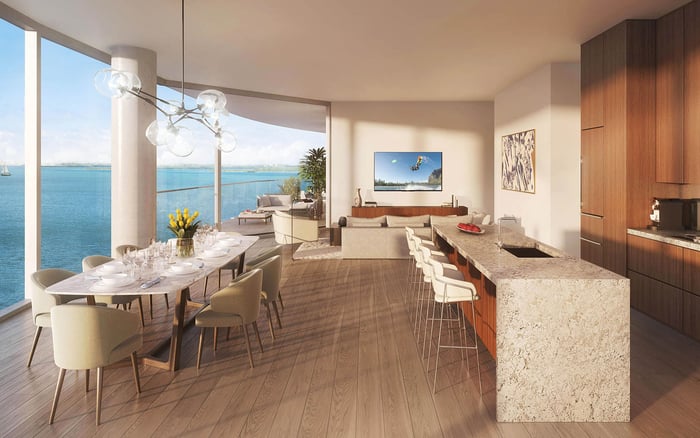
That is why the strongest candidates tend to feature attached guest wings, discreet secondary entrances, and separate sitting areas rather than detached structures that compete with the main residence. In the condominium world, the same principle translates into floor plans with split-bedroom layouts, den suites, private elevator foyers, and enough separation to support autonomy without sacrificing a unified household experience. Residences at 2200 Brickell or The Well Coconut Grove naturally invite this conversation because buyers often want wellness, privacy, and family practicality without sacrificing design coherence.
In South Florida, zoning is the first pass, not the last. Miami-Dade allows accessory dwelling units on qualifying single-family lots, but the secondary structure generally cannot exceed 750 square feet or 40 percent of the principal dwelling’s floor area. That alone can quickly tell a buyer whether a proposed multigenerational solution is genuinely feasible or merely aspirational.
Just as important, county rules are not a universal answer for every municipality. Guest-house standards, ADU rules, and permitting requirements vary by city, and deed restrictions or HOA rules may further limit occupancy, the number of kitchens, or the way a secondary suite can be used. In gated communities and tightly managed luxury enclaves, legal review should sit alongside architectural review from the outset.
Buyers should also verify whether any guest wing, garage conversion, staff quarters, or cabana suite was properly permitted. Separate utility infrastructure may improve privacy and practicality, but only if those additions are lawful and recognized. If the family’s long-term plan includes semi-independent occupancy, an attorney should review title, leasing, and use restrictions early rather than after closing.
The fastest way for a luxury residence to start feeling like a compound is to overstate separation. Two gates, duplicated driveways, mirrored kitchens, and fenced outdoor zones may solve privacy on paper, but they often leave the property feeling divided rather than elegant.
A better standard is layered independence. Private entrances are useful. Separate living areas are useful. A partial kitchen or kitchenette can be useful. But the strongest layouts stop short of creating a second obvious house. They provide retreat without detachment.
When touring a home, pay close attention to circulation. Can parents reach their suite from the main entrance without crossing a children’s media space? Can an adult child come and go without passing directly through the formal living room? Does garage access create unwanted daily overlap? Even in a large residence, poor circulation can make family life feel crowded.
Outdoor planning matters just as much. Unified estates usually have one principal pool, one major outdoor lounge, and one wellness or entertaining core. Landscaping, courtyards, and terraces can create degrees of privacy far more elegantly than walls and duplicated amenities. In a boutique setting such as Ocean House Surfside or Rivage Bal Harbour, that same principle appears in residences that preserve intimacy while still feeling expansive enough for extended family stays.
Many intergenerational purchases begin with today’s needs and overlook tomorrow’s. That is shortsighted in a market where owners expect homes to remain both beautiful and adaptable.
A residence is easier to live in across generations when it already incorporates a first-floor bedroom or easily accessible sleeping suite, no-step entries where possible, wider hallways, and bathrooms that can accommodate changing mobility without looking clinical. These details are not concessions to age. In a refined home, they are signs of intelligent planning.
For condominium buyers, this can mean evaluating whether guest suites are near the main living area without being exposed to it, whether elevators open into private foyers, and whether service access can support household help or multigenerational logistics discreetly. Consider how projects such as Alina Residences Boca Raton or St. Regis® Residences Brickell appeal to buyers who value polish and function in equal measure.
A multigenerational home must work not only on a perfect Saturday, but also during storm season. More residents under one roof means more complexity during evacuation, greater dependence on functioning systems, and less tolerance for lower-level flooding or prolonged repair disruptions.
That makes resilience part of the buying thesis. Evaluate where mechanical systems are located, whether utilities are elevated appropriately, and how the residence would function if ground-level areas were compromised. In coastal settings especially, construction quality and flood-aware planning are inseparable from multigenerational practicality.
This is one reason buyers should resist being seduced by square footage alone. A larger home with vulnerable lower-level systems may be less functional than a slightly more compact property with stronger resilience planning. In high-service buildings such as The Surf Club Four Seasons Surfside, the conversation often extends beyond aesthetics to continuity, access, and how a residence performs when conditions are less forgiving.
The final test is whether the residence can evolve. A family arrangement that works beautifully for seven years may be irrelevant in twelve. If the secondary suite can later function as guest accommodation, staff quarters, a library wing, a gym-and-office combination, or an extension of the primary suite, the home becomes far more defensible as a luxury asset.
Over-customization is where many buyers lose the plot. Multiple full kitchens, aggressively segmented outdoor areas, or separate identities for each wing may make the current arrangement convenient, but they can narrow the future buyer pool. South Florida’s strongest luxury homes retain broad single-family appeal even when they are exceptionally good at accommodating multiple generations.
In practical terms, the residence should feel easy to reprogram. Ask whether the so-called in-law suite would still read as premium guest space. Ask whether a private lounge could become a media room or office. Ask whether the floor plan’s elegance survives once the current family configuration changes.
The goal is not to buy a family compound and disguise it. The goal is to choose a residence refined enough to absorb complex family life without ever losing composure.
What is the first thing to check in an intergenerational luxury purchase? Start with zoning, municipal rules, HOA restrictions, and permit history before treating any guest suite or ADU as usable value.
Is a detached guest house always better for privacy? Not necessarily. Attached or closely integrated suites often preserve a more elegant single-residence feel while still allowing autonomy.
What layout features matter most for multigenerational living? Private entrances, separate sitting areas, thoughtful circulation, and a secondary food-prep area are usually more useful than total duplication.
How can a home avoid feeling like a compound? Keep amenities centralized, use landscaping for privacy, and avoid duplicated driveways, fenced-off zones, and competing household identities.
What accessibility features should luxury buyers prioritize? A first-floor bedroom option, no-step access where possible, wider passages, and adaptable bathrooms help the home age gracefully.
Why do permits matter so much with guest suites? Unpermitted additions can create legal and valuation issues, even when the space appears beautifully finished and fully functional.
Should condo buyers think differently than single-family buyers? Yes. Condo buyers should focus on suite separation, elevator access, service flow, and household privacy within one floor plan.
Do separate utilities add value? They can improve day-to-day privacy and practicality, but only if the infrastructure and any related additions were properly approved.
How important is storm resilience in a multigenerational home? It is essential in South Florida because a residence serving more people is harder to evacuate, repair, and operate after flooding or system loss.
What protects resale value in this category? Flexibility. The best homes can shift from family suite use to guest, staff, office, or wellness space without major redesign.
For a tailored shortlist and next-step guidance, connect with MILLION.
If branded residences are on your mind — as a home or as an allocation — we would be glad to share what we are seeing, privately.
Begin a quiet conversation