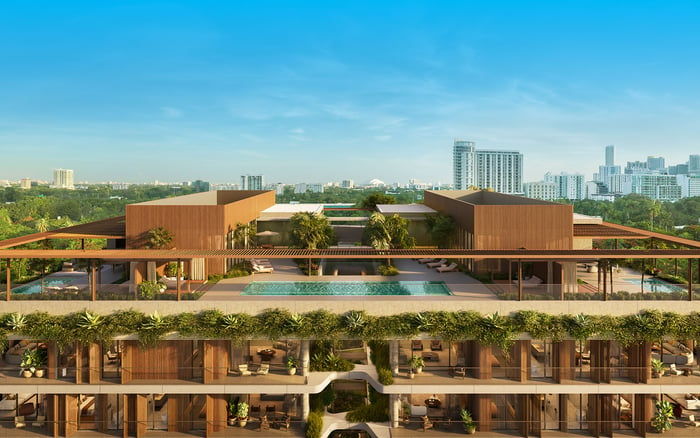
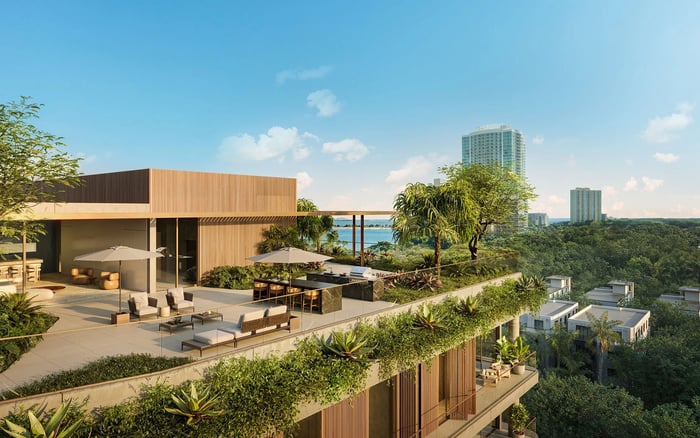
Outdoor recovery terraces are becoming a defining luxury for full-time South Florida owners because they support daily wellness, privacy, climate comfort, and long-term livability in a way occasional-use balconies rarely can.
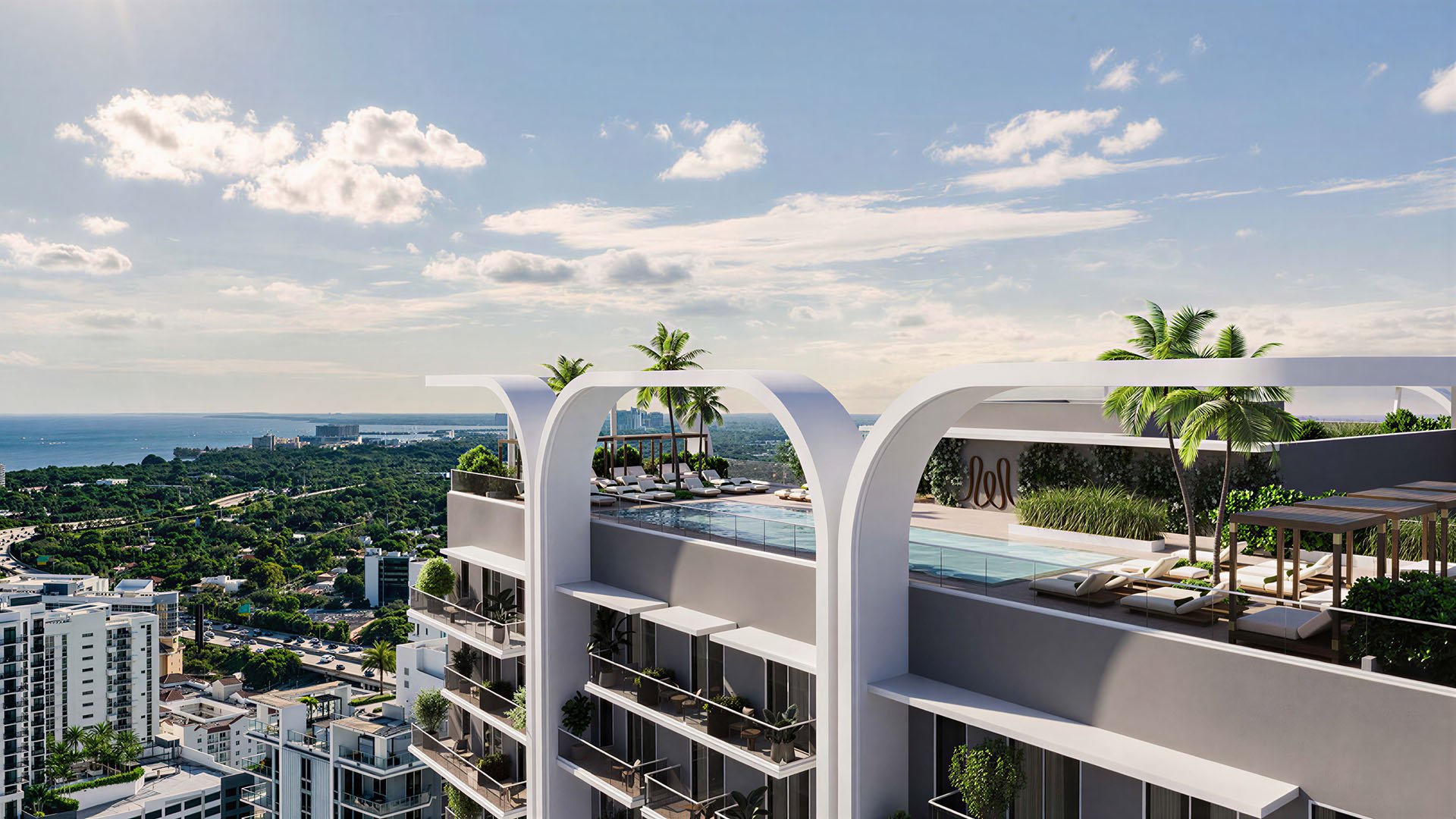
For the full-time South Florida owner, outdoor space is no longer a decorative amenity or an occasional sunset perch. It is part of the operating system of the home. A well-composed recovery terrace can support the quiet rituals that make a residence livable every day: morning air after training, shaded reading after calls, decompression before dinner, or a private pause between family obligations.
Seasonal guests often evaluate outdoor space through a simpler lens. They want a view, a breeze, a place to serve lunch, and perhaps a memorable setting for friends. Full-time owners ask a more exacting question: will this terrace still feel useful in August, on a weekday, after a long drive, during a private phone call, or when the household needs multiple zones at once?
That difference is why recovery terraces matter. They turn outdoor space from a picture into a practice.
The most sophisticated owners increasingly treat the terrace as an extension of the wellness suite. The idea is not necessarily formal therapy, nor does it require a dramatic spa program. It can be as precise as a shaded chaise positioned away from glare, a dining ledge that preserves circulation, or a planting strategy that softens reflected heat.
A seasonal guest may spend a week admiring the skyline. A full-time resident lives with the sun angle, the privacy exposure, the evening noise, and the ease of moving between interior and exterior spaces. In this sense, the outdoor room becomes a daily regulator. It provides light without confinement, air without leaving home, and a subtle separation from the more performative areas of the residence.
Recovery is also psychological. In high-rise living, especially in dense coastal and urban settings, the private outdoor room offers a rare sense of control. It lets an owner step outside without entering a lobby, pool deck, beach club, or restaurant. That autonomy is especially valuable for those who live in the home year-round rather than arriving for a curated holiday interval.
A balcony can be beautiful, but a recovery terrace requires more intention. Depth, privacy, shade, furniture planning, and access points all matter. The difference is often felt rather than announced. Can two people use the space without constantly moving chairs? Is there a place for a quiet breakfast separate from a lounge setting? Does the threshold from the primary suite make sense? Can the owner use the space without feeling exposed to neighboring lines of sight?
For full-time owners, these details compound. Small inconveniences become daily irritants. A terrace that is too narrow, too hot, too windy, or too visible may photograph well but fail in practice. A more resolved terrace, by contrast, can create a secondary living room that changes the emotional size of the home.
This is especially relevant in Brickell, Coconut Grove, and Miami Beach, where buyers often weigh the energy of the location against the need for personal retreat. In the most successful residences, outdoor recovery space does not compete with the neighborhood. It balances it.
South Florida outdoor living is often described in glamorous terms, but owners know the real standard is usability. A terrace that works only in ideal conditions is a seasonal feature. A terrace that works across more of the year becomes part of the home’s value proposition.
Shade is central. So is airflow. Material choices matter because surfaces that look elegant in a showroom can behave differently under strong sun. Planting can create softness and privacy, while overfurnishing can make a generous space feel restless. The best recovery terraces have restraint. They allow the owner to settle, not manage.
This is where the full-time resident has an advantage in judgment. The buyer who plans to live in the residence will notice whether the doors open naturally, whether the seating is protected, whether dining is practical, and whether the terrace can support quiet use without becoming another entertainment zone. The guest may remember the view. The owner remembers how the space feels at 7 a.m. and again at 9 p.m.
Luxury buyers often speak about amenities, but full-time owners tend to value discretion more than spectacle. A resident who uses wellness spaces daily may prefer a private terrace to a shared deck, even when the shared deck is beautifully designed. The reason is simple: recovery requires repetition, and repetition favors privacy.
A recovery terrace can also protect the home’s social rhythm. It gives residents a place to be outside without hosting, dressing for public areas, or navigating building activity. For families, it can be a decompression zone between school, work, sport, and evening plans. For couples, it can be a quiet neutral room. For solo owners, it can be the most personal space in the residence.
The pool may still matter, as do fitness rooms, lounges, and beach access where available. Yet the private terrace is the amenity that belongs only to the owner. It is always reserved, always immediate, and always shaped by the household’s own rituals.
While outdoor recovery is an emotional concept, it also has practical implications. Buyers increasingly understand that livability is not measured only in interior square footage. Usable private exterior space can make a residence feel more complete, particularly when it functions as a true room rather than a narrow edge.
For future resale, a terrace with credible daily utility can help a home stand apart from residences that rely solely on view language. The most compelling examples are not necessarily the largest. They are the most resolved: easy to furnish, comfortable to inhabit, connected to the right rooms, and private enough to be used without hesitation.
Full-time owners should therefore evaluate terrace quality with the same seriousness they bring to kitchens, primary suites, and storage. Is the outdoor space a lifestyle promise, or does it support a lifestyle already in motion? The distinction is meaningful.
Begin with access. The best recovery terraces connect naturally to the rooms where decompression actually happens: the primary suite, living room, den, or breakfast area. Next, consider exposure. Morning light may feel restorative, while harsh afternoon conditions may require more protection. Then study privacy from neighboring residences, common areas, and public viewpoints.
Furniture planning should be tested before closing, not improvised after move-in. If a terrace cannot comfortably hold the intended seating, dining, or quiet wellness arrangement, it may not perform as expected. Also consider sound. Some owners enjoy urban energy, while others need stillness. Neither preference is universal, but the fit should be honest.
Finally, ask whether the terrace encourages daily use. If the answer is yes, it becomes more than outdoor space. It becomes a residential advantage.
What is an outdoor recovery terrace? It is a private outdoor space designed for restoration, comfort, and everyday use rather than only entertaining or view appreciation.
Why does it matter more for full-time owners? Full-time owners rely on the terrace repeatedly, so shade, privacy, access, and comfort affect daily life more than they do during short visits.
Is a recovery terrace different from a standard balcony? Yes. A standard balcony may offer outdoor exposure, while a recovery terrace is planned as a functional outdoor room with room to rest.
Should buyers prioritize size or usability? Usability should lead. A smaller, well-protected terrace can be more valuable in daily life than a larger space that is awkward or exposed.
What rooms should connect to the terrace? The strongest connections are usually to the living area, primary suite, den, or breakfast space, depending on the owner’s routine.
Does privacy matter as much as the view? For year-round residents, privacy can matter even more because it determines whether the terrace will be used comfortably every day.
How does climate affect terrace value? Shade, airflow, surface materials, and orientation influence whether the space feels inviting across more hours of the day.
Is this mainly a Miami Beach consideration? No. The same logic applies across South Florida, including Brickell, Coconut Grove, coastal enclaves, and quieter residential districts.
Can a terrace improve resale appeal? It can, particularly when it reads as a true outdoor room that expands livability rather than a decorative ledge.
What is the best way to shortlist comparable options for touring? Start with location fit, delivery status, and daily lifestyle priorities, then compare stacks and elevations to validate views and privacy.
When you're ready to tour or underwrite the options, connect with MILLION.
If branded residences are on your mind — as a home or as an allocation — we would be glad to share what we are seeing, privately.
Begin a quiet conversation