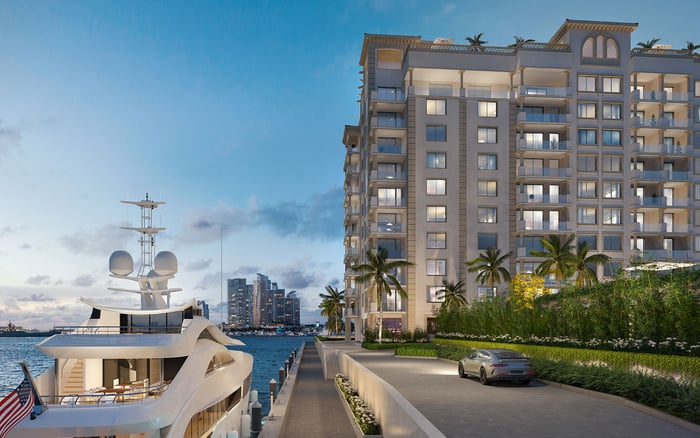
Opus Coconut Grove presents a refined case for buyers who want the Grove’s village-style convenience without the exposure of a denser urban condo setting.

For many high-net-worth buyers, walkability is no longer a convenience feature. It is a lifestyle filter. The ability to leave the car behind for dining, services, parks, waterfront access and daily errands has become one of the clearest measures of livability in Miami’s most mature neighborhoods. Yet those same walkable settings can bring what luxury buyers often resist: visibility, transient foot traffic, street noise and the sense of living along a public corridor.
That tension is precisely where Opus Coconut Grove earns attention. It is positioned for buyers who want pedestrian access to Coconut Grove amenities while preserving the discretion of a quieter residential environment. In a market where luxury often announces itself loudly, Opus makes a subtler argument: the best address may be the one that allows residents to engage with the neighborhood without feeling exposed to it.
Coconut Grove has long appealed to buyers who prefer a softer, more residential expression of Miami luxury. Its atmosphere is less entertainment-driven than districts shaped by nightlife or high-density commercial energy. The appeal is not simply being near restaurants or the waterfront. It is the ability to live within a layered neighborhood, where streets feel residential, tree cover matters and daily movement feels less transactional.
For a buyer comparing Coconut Grove with Brickell, Downtown Miami or Miami Beach, this distinction is meaningful. Walkability in the Grove is often about village rhythm rather than urban intensity. The buyer is not just asking whether a restaurant is nearby. The better question is whether the journey there feels calm, private and integrated into a residential day.
Opus Coconut Grove is framed around that idea. It is presented as close enough to the Grove’s village core for buyers who want dining, services, parks and waterfront access within a short walk, while still being set within the neighborhood’s quieter, tree-canopied residential fabric rather than on a major arterial or tourist-heavy corridor.
In luxury real estate, privacy is often discussed in terms of elevator access, residence layouts or security. Those details matter, but privacy begins earlier. It starts with how the building meets the street, how many people move around the property and whether the address feels like a destination for residents rather than passersby.
Opus Coconut Grove uses several privacy arguments that matter in a walkable setting. Its more boutique positioning can support a quieter residential experience than larger, more exposed condo environments. Controlled access and thoughtful street presence are part of the appeal for buyers who want a clearer separation between the residential realm and surrounding pedestrian activity.
This is the difference between convenience and exposure. A buyer can want to walk to dinner and still prefer a sense of arrival that feels quiet, composed and protected.
The word boutique can be overused, but in this context it serves a real purpose. Boutique scale can reduce the sense of volume that comes with larger residential towers: more cars, more guests, more deliveries, more lobby turnover and more visual activity around the entrance. For buyers seeking privacy, that reduction is not incidental. It is central to the experience.
Opus Coconut Grove is framed as a boutique-scale alternative to larger urban condo environments where exposure can become part of daily life. The point is not that bigger buildings lack luxury. Many deliver it exceptionally well. The point is that a smaller residential setting can create a different emotional register: less spectacle, more discretion.
For buyers comparing Grove addresses, that distinction can be useful. Arbor Coconut Grove, Mr. C Tigertail Coconut Grove and The Well Coconut Grove each sit within the broader conversation about how the Grove is evolving for luxury residents. Opus belongs in that conversation for buyers whose priority is the rare combination of walkability, boutique scale and a more protected residential feel.
The most natural Opus buyer is not trying to disappear from Miami. They want to participate selectively. They want restaurants nearby, services within reach, waterfront access in the orbit of daily life and perhaps proximity to schools, parks and marinas, while still maintaining personal discretion.
That profile is increasingly common among executives, founders, family-office principals and second-home buyers who do not want the constant visibility of denser condo districts. They may entertain, travel frequently and value service, but they do not necessarily want a building that feels like a stage. They want the lifestyle advantages of a walkable neighborhood without the transient quality that can accompany high-foot-traffic urban corridors.
The marina dimension is also part of the broader Grove draw. For some buyers, the waterfront is not only a view category, but a rhythm of living near boats, bay breezes and outdoor movement. Opus should be understood within that larger Coconut Grove lifestyle rather than judged only by conventional tower metrics.
A buyer choosing between the Grove and a denser Miami district is often choosing between two forms of convenience. In a high-rise urban setting, convenience may be vertical and immediate: restaurants below, major corridors nearby, energy at the doorstep. In Coconut Grove, convenience is more residential and textured: shaded streets, a village core and a lower-key pace.
Opus Coconut Grove leans into the second model. Its value proposition is not about maximum visibility or dramatic urban theater. It is about living close to what matters while preserving a sense of separation. For buyers who have already owned in major resort or city-center buildings, that quieter luxury can feel more sophisticated than another high-profile address.
This does not make Opus the answer for every buyer. Those who want direct spectacle, large-scale amenity volume or a more entertainment-led setting may prefer other markets. But for buyers who measure luxury by discretion, pedestrian access and emotional calm, Opus deserves a serious look.
The strongest reason to shortlist Opus is that it addresses a specific and difficult brief: walkable but not overexposed, connected but not crowded, close to amenities but still residential in tone. Many properties can deliver one side of that equation. Fewer can credibly argue for both.
It also benefits from Coconut Grove’s broader luxury momentum without needing to imitate the scale or posture of more vertical districts. Buyers looking across Grove options such as Four Seasons Residences Coconut Grove may find that Opus occupies a distinct lane: less about grandeur as a public statement, more about privacy as a daily experience.
For the right buyer, that is the point. Opus Coconut Grove is not merely a residence near walkable amenities. It is a case study in how village-style access and protected residential living can coexist when scale, access and street presence are handled with intention.
Is Opus Coconut Grove a good fit for buyers who prioritize walkability? Yes. It is positioned for buyers who want access to Coconut Grove dining, services, parks and waterfront amenities within a short walk.
Does walkability at Opus mean sacrificing privacy? No. Its appeal is the balance between pedestrian access and a quieter residential feel supported by boutique positioning and controlled access.
What makes the setting different from denser Miami condo districts? Opus is framed within Coconut Grove’s quieter, tree-canopied residential fabric rather than a major arterial or tourist-heavy corridor.
Who is the likely buyer for Opus Coconut Grove? It suits buyers who want neighborhood convenience, discretion and a lower-key luxury lifestyle close to daily amenities.
Is Opus considered a large urban condo environment? No. It is framed as a boutique-scale alternative to larger, more exposed condo settings.
What privacy themes matter most for this type of buyer? Buyers should focus on arrival experience, building scale, access control, street presence and how exposed daily routines feel from the public realm.
Is Coconut Grove more lifestyle-driven or entertainment-driven? The Grove supports a lower-key luxury lifestyle compared with more entertainment-driven Miami districts.
Should buyers verify exact project specifications? Yes. Buyers should confirm residence count, pricing, timing, square footage and amenity details before making decisions.
How should Opus be compared with other Grove residences? Compare it through the lens of walkability, privacy, scale and the daily feel of the surrounding residential streets.
What is the best way to shortlist comparable options for touring? Start with location fit, delivery status, and daily lifestyle priorities, then compare stacks and elevations to validate views and privacy.
For a confidential assessment and a building-by-building shortlist, connect with MILLION.
If branded residences are on your mind — as a home or as an allocation — we would be glad to share what we are seeing, privately.
Begin a quiet conversation