In South Florida, the insurance conversation has become a quiet but decisive force in luxury real estate. For actuaries, the preference for new construction towers is less about style and more about controllable risk: modern wind standards, updated life-safety systems, centralized maintenance, and clearer replacement-cost modeling. Historic oceanfront homes can be irreplaceable from an architectural standpoint, but they often introduce variables that are difficult to price with confidence, especially when proximity to salt air, legacy building practices, and bespoke materials collide with today’s underwriting discipline. This editorial explains the practical reasons actuaries often view new high-rise construction as a more predictable risk than older coastal single-family assets, and how sophisticated buyers can use that lens to shop smarter.

Luxury buyers in Miami Beach, Sunny Isles, and Palm Beach often talk about views, finish packages, and privacy. Insurance actuaries talk about variance. Their job is to estimate future loss with as little uncertainty as possible-and in coastal South Florida, uncertainty is the most expensive ingredient.
That is why new construction towers often register as a more predictable exposure than historic oceanfront homes. A tower is, in many ways, an engineered financial object: consistent construction assemblies repeated floor to floor, standardized fire and life-safety systems, documented maintenance programs, and a clear chain of responsibility through a condominium association. Even when premiums rise, the risk story remains legible.
A historic oceanfront home can be the inverse. It may be built with craftsmanship the market reveres, yet it often carries one-off details that are difficult to model, hard to replace, and expensive to repair. Actuaries do not discount beauty. They discount uncertainty.
Actuarial preference is not aesthetic. It is structural, operational, and statistical.
First, modern towers are generally designed around contemporary wind engineering, impact-protection expectations, and hardening details now assumed in coastal construction. When building systems are current, their performance characteristics are easier to anticipate. That directly influences how insurance is priced and how deductibles are structured.
Second, towers concentrate risk management. Maintenance is not optional when hundreds of owners share the same envelope. Elevators, generators, pumps, roof assemblies, glazing systems, and life-safety equipment are governed by scheduled service contracts, budgets, and, increasingly, a reserve-planning culture. From an underwriting standpoint, a building that must operate like an institution tends to produce cleaner, more consistent data than a single-family home that can be maintained impeccably-or deferred quietly.
Third, replacement-cost modeling is typically more straightforward. A tower’s components are often specified in ways that can be benchmarked: curtain wall systems, standardized mechanical equipment, repeatable unit build-outs. When losses occur, the repair pathway is more defined.
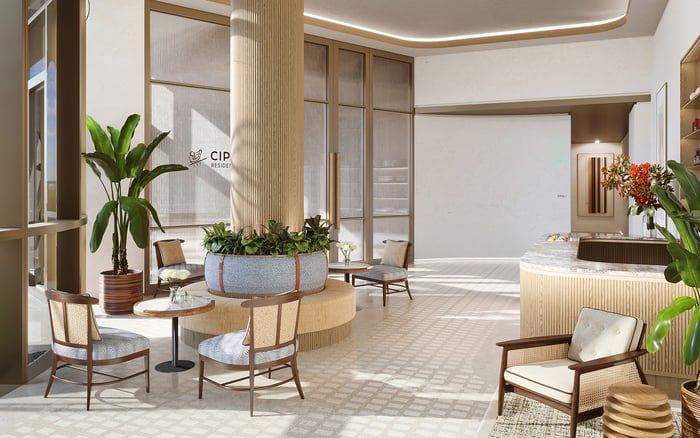
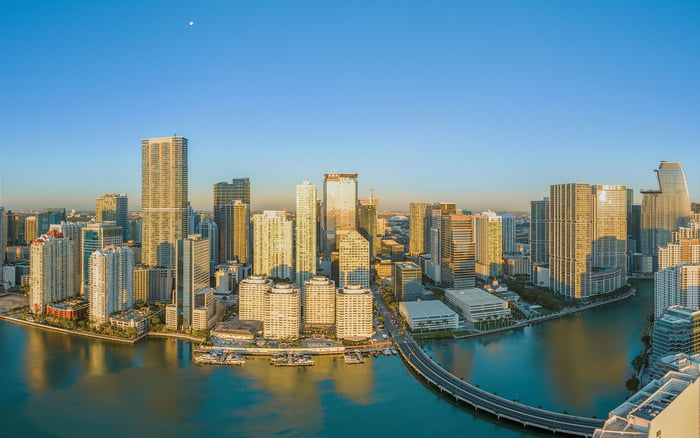
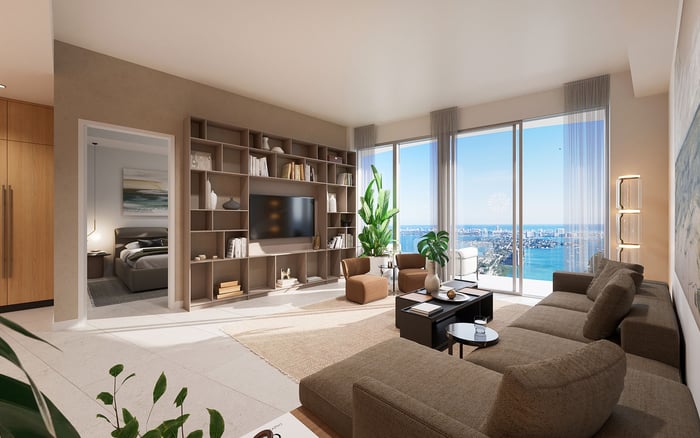
For buyers who want the modern coastal experience without operational ambiguity, a new Brickell address such as 2200 Brickell illustrates the category actuaries tend to understand: contemporary construction logic, professionally managed common elements, and a building narrative designed to be maintained.
Historic oceanfront homes are often described as “irreplaceable.” For insurance, that word can read like a warning label.
Salt-air intrusion, humidity cycles, and wind-driven rain can exploit the smallest legacy weakness. Older windows, roof interfaces, and wall assemblies may not perform like modern systems, even after thoughtful renovations. Retrofits help, but they can introduce their own uncertainty: mixed materials, layered construction stages, and a paper trail that is sometimes incomplete.
Then there is the nature of bespoke. A historic stair detail, custom millwork, specialty plaster, or rare stone may be central to the home’s value, but not easily replicated at scale. Replacement costs can become less predictable precisely where the home is most special.
Finally, single-family properties place resilience decisions on the owner. Generator capacity, roof upgrades, water-intrusion mitigation, and landscape drainage are not shared responsibilities. A meticulous owner can create a fortress. A distracted owner can create a claim.
In this context, actuaries often favor the building type where resilience is embedded in governance-not solely in personal discipline.
In ultra-prime South Florida, “condo” no longer means compromise. It can mean an operating system.
Associations, when well run, create enforceable standards for maintenance and capital planning. They can contract for building-wide inspections, schedule envelope renewals, and upgrade life-safety components with a level of coordination a single-family street rarely achieves. From an actuarial perspective, that coordination can dampen tail risk tied to catastrophic losses.
This is one reason newly delivered oceanfront and near-ocean towers can feel more financeable in the current environment. In Miami Beach, new development energy has gravitated toward buildings that signal modern performance and professional stewardship, like Five Park Miami Beach, where buyers often evaluate not just the residence, but the long-term operational posture.
None of this guarantees low premiums. It simply means the risk can be modeled with greater confidence-the condition under which insurers can actually price.
Oceanfront is an emotion. Insurance is geometry.
Historic homes on barrier islands and low-lying waterfront streets often sit close to grade, with expansive glazing and indoor-outdoor transitions that make them spectacular to live in-and expensive to harden. Their proximity to wind-driven debris and water-intrusion pathways is immediate.
Vertical living changes the exposure profile. Higher floors can reduce certain forms of water-related risk to interiors and concentrate mechanical vulnerability in protected, engineered locations. Common areas are designed for capacity: stairwells, fire suppression, and egress systems built for many occupants.
For buyers who crave true ocean adjacency but prefer a high-performance building envelope, Miami Beach options such as The Perigon Miami Beach reflect why towers can be attractive in underwriting terms: modern assemblies, documented specifications, and an address that reads as a single engineered asset rather than a one-off artifact.
Actuaries do not underwrite marble. They underwrite failure modes.
New construction tends to rely on current-generation waterproofing, glazing, fastening, and concrete practices with more established performance expectations. Mechanical, electrical, and plumbing systems are typically documented, standardized, and supported by readily available parts and service expertise.
Historic homes may have undergone multiple phases of renovation over decades. That can create a patchwork of old and new: upgraded kitchens tied into older supply lines, modern HVAC integrated with legacy ducting routes, and concealed conditions behind walls that only reveal themselves when stressed.
The issue is not that older is always worse. The issue is that older is less uniform. In actuarial language, non-uniformity increases dispersion-and dispersion pressures premiums.
A sophisticated buyer’s process in South Florida increasingly begins with insurability-not as an afterthought, but as a gating factor.
If you are comparing a historic oceanfront home to a new tower residence, treat insurance like you would treat architecture: request clarity early. Ask how the building is managed, how systems are maintained, and how upgrades are scheduled. In a condo, understand the association’s culture around reserves and major projects. In a single-family home, understand the timeline and documentation of prior improvements, and be prepared to invest further.
This is particularly relevant for buyers exploring newer coastal product in areas like Hallandale. A building such as 2000 Ocean Hallandale Beach sits within a market where buyers often balance ocean proximity with the appeal of contemporary construction and centralized stewardship.
The most elegant homes and the most beautiful towers can both be excellent choices. The difference is how you structure the decision.
For new construction towers:
Evaluate the building as an enterprise. Who manages it, and how transparent is the maintenance program?
Understand what is insured by the association versus what is insured by the unit owner.
Look for design decisions that reduce claim frequency: robust glazing, protected entries, and thoughtfully detailed terraces and balconies.
For historic oceanfront homes:
Treat renovation documentation as an asset. Permits, scopes of work, and system ages matter.
Budget for resilience upgrades even if the home is “move-in ready.” Coastal environments punish complacency.
Recognize that bespoke finishes may not be fully “valued” the way you value them. Plan for specialty coverage where appropriate.
For buyers who want the architectural allure of an older neighborhood feel but prefer a newer building profile, consider the hybrid appeal of boutique coastal condos like 57 Ocean Miami Beach, which can offer a more controlled risk narrative than many standalone historic oceanfront residences.
New construction towers tend to win actuarial favor because they reduce guesswork. They are built to modern expectations, run by formal governance, and composed of repeatable systems that can be priced with greater confidence.
Historic oceanfront homes remain the pinnacle for certain buyers, especially those who collect design and provenance. But that choice increasingly requires a second layer of sophistication: understanding that the insurance market is not judging the home’s romance. It is judging the volatility of its next decade.
Why do insurers often see new construction condos as lower risk? Modern systems and standardized assemblies are easier to model and maintain consistently.
Are high-rise units always cheaper to insure than oceanfront houses? Not always, but towers often present a more predictable exposure profile than one-off homes.
Does being on a higher floor change insurance considerations? It can, since some water-related risks to interiors may be reduced compared to low-lying homes.
Why do historic homes create underwriting uncertainty? Mixed-era renovations, legacy materials, and hidden conditions can make losses harder to predict.
Can a renovated historic oceanfront home become “insurance-friendly”? Yes, but it typically requires documented upgrades and ongoing resilience investment.
What should buyers ask a condo association before purchasing? Ask about maintenance cadence, reserve approach, and how major building systems are managed.
How do replacement costs differ between condos and single-family homes? Condo components are often standardized, while historic homes can involve bespoke, harder-to-price repairs.
Do luxury finishes increase insurance premiums? They can, especially when materials are rare or require specialized labor to repair or replace.
Is oceanfront living automatically hard to insure? It can be, but building type, systems, and governance often matter as much as location.
When should insurance be discussed in the buying process? Early, ideally alongside inspections and due diligence, before finalizing a purchase decision.
When you're ready to tour or underwrite the options, connect with MILLION Luxury.
If branded residences are on your mind — as a home or as an allocation — we would be glad to share what we are seeing, privately.
Begin a quiet conversation