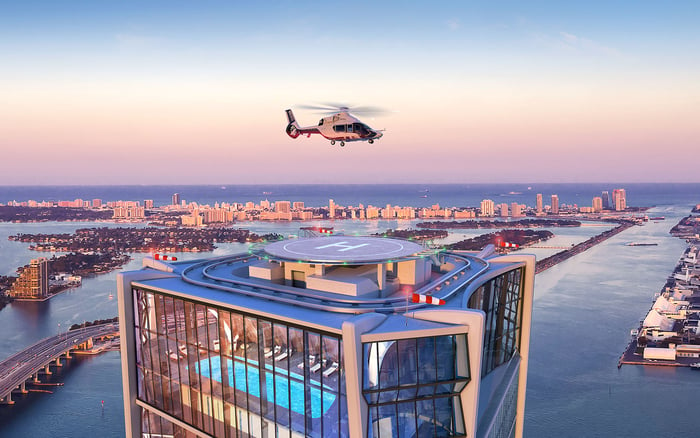
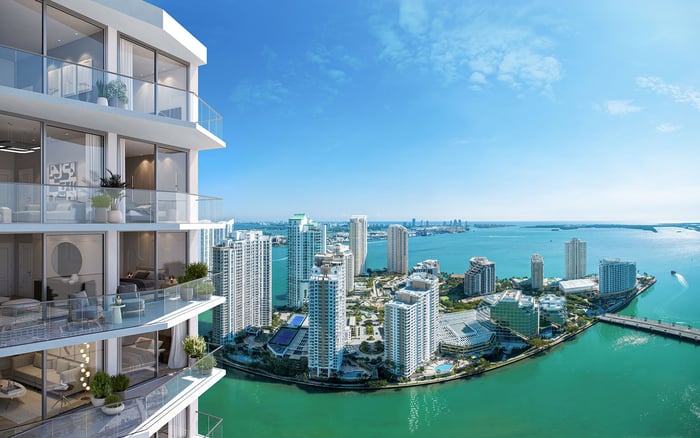
A discreet buyer’s guide to why former waterfront estate owners often find Downtown Miami condominium living compelling, from privacy and service to simplified ownership and elevated urban access.

For the owner of a waterfront estate, moving into a condominium is rarely a simple exercise in downsizing. It is a recalibration of daily life: privacy, service, maintenance, movement, and control. The question is not only how many bedrooms are required, or whether the residence offers enough storage. The deeper question is whether the next home can preserve ease, discretion, and command while removing the operational weight that often comes with a large waterfront property.
That is where Downtown Miami enters the conversation. For certain buyers, the neighborhood offers a vertical interpretation of estate living: controlled arrival, attended lobbies, curated amenities, elevated views, and immediate access to the city’s cultural and dining life. The appeal is not about abandoning a waterfront sensibility. It is about translating that sensibility into a more managed, lock-and-leave format.
A waterfront estate can be magnificent, but it is also a living system. Grounds, docks, pools, exterior maintenance, staffing, storm preparation, guest coordination, and security all require attention. Some owners enjoy that level of oversight. Others reach a point where they want the pleasure of a refined residence without the continual choreography behind it.
A well-chosen Downtown condo can answer that need. The experience is often more predictable: a staffed point of entry, private parking logistics, building security, amenity access, and professional management. For buyers accustomed to a high standard of living, the transition works best when the building feels composed rather than crowded, polished rather than theatrical, and private even within an urban setting.
This is why many estate owners study the building as carefully as the residence itself. The quality of arrival, elevator experience, floor plan, service culture, and resident profile can influence satisfaction as much as the view. Square footage still matters, but flow and function become decisive.
Buyers leaving a waterfront estate are often giving up horizontal space: lawns, private frontage, terraces, and the visual distance between home and city. A condominium has to compensate with proportion, light, and perspective. High ceilings, generous glazing, meaningful outdoor space, and thoughtful privacy can make a residence feel expansive, even when the footprint is more efficient.
The sense of arrival matters just as much. Estate owners are used to a sequence: gate, drive, landscape, front door, water beyond. In a condominium, that sequence becomes valet or private garage access, lobby, elevator, vestibule, and view. When each step feels calm and intentional, the move can feel like an upgrade in ease rather than a loss of ceremony.
In listing language, priorities often appear as High-floors, Waterview, New-construction, and Pool, but the best decisions go beyond keywords. A buyer should consider whether the residence feels restful at different times of day, whether terraces are genuinely usable, and whether the building’s shared spaces support the way they actually live.
One of the most persuasive arguments for condo living is the ability to retain service while reducing personal management. Former estate owners often value responsiveness: someone available at the door, a team that understands deliveries, a building that can support guests, and systems that continue functioning when the owner is away.
This is especially relevant for buyers who travel frequently or divide time among multiple homes. A condominium can make absence easier. There is less to supervise, fewer exterior variables, and a clearer chain of responsibility. The residence can be closed and reopened with less friction, one of the quiet luxuries many buyers begin to prize after years of estate ownership.
That said, not every luxury building will suit an estate owner. Some buyers want social energy and a full amenity calendar. Others want a building that feels almost residential in its restraint. The right fit depends on temperament. The most successful transitions happen when the buyer is honest about how much interaction, visibility, and activity they want around them.
The move from a waterfront estate into Downtown is also a shift in rhythm. Instead of driving for nearly every outing, owners can place themselves closer to restaurants, cultural venues, offices, marinas, private clubs, and neighboring districts. For some, that immediacy is the point. The city becomes part of the living experience, not an occasional destination.
Brickell may enter the same conversation, especially for buyers who want financial district energy and a polished high-rise environment. Downtown, however, can feel distinct because it offers a broader urban canvas and a sense of connection to the bay, the arts, and the evolving civic core. The buyer is not choosing only a condo. They are choosing a daily pattern.
That pattern can be compelling for owners who no longer want the responsibilities of a large property but still want scale in their surroundings. Instead of private acreage, the new luxury may be a skyline at dusk, a short ride to dinner, a building team that knows preferences, and a residence that feels secure whether occupied full-time or seasonally.
The most important exercise is to map existing estate habits against a potential condominium lifestyle. Where do guests stay? How often is entertaining formal versus casual? Is staff still needed? How much storage is required for art, wine, sports equipment, or seasonal wardrobes? Does the owner need a true family room, a service entry, or separate zones for visiting children and grandchildren?
Parking and arrival should be reviewed with particular care. A buyer leaving a private driveway may underestimate how much the building’s vehicular flow affects daily comfort. Elevator privacy, package handling, pet logistics, backup systems, and guest procedures also deserve attention.
Then there is the question of identity. Some owners are ready for a dramatic architectural statement. Others want a quieter residence that feels elegant without announcing itself. Downtown Miami can accommodate both instincts, but the buyer must be clear about whether the next home is meant to be a primary residence, a seasonal base, or a simplified urban pied-à-terre.
In an estate, space is often measured by land, frontage, garage capacity, and the separation between rooms. In a Downtown condo, space is measured differently. It is about volume, sightlines, terrace depth, privacy from neighboring towers, and the efficiency of the plan. A smaller residence can live beautifully if the primary suite is calm, the kitchen supports real use, and the living areas hold people comfortably without wasted circulation.
This is why the best condo searches are not purely numerical. A residence with less total area may feel more gracious than a larger one if the proportions are right. Conversely, a large condo can disappoint if the plan is chopped, the views are compromised, or the arrival lacks dignity.
For estate owners, the goal is not to replicate the old house in the sky. The goal is to preserve what mattered: privacy, beauty, service, comfort, and control. When those elements align, Downtown Miami becomes more than a practical compromise. It becomes a sophisticated next chapter.
Is moving from a waterfront estate to a Downtown Miami condo mainly about downsizing? Not necessarily. For many buyers, it is about simplifying ownership while preserving privacy, service, and a refined daily experience.
Can a condo feel private enough for someone used to an estate? It can, but the building’s arrival sequence, elevator design, resident culture, and floor height are critical to that feeling.
What should estate owners prioritize first in a condo search? They should begin with lifestyle requirements, including arrival, views, storage, staff needs, guest patterns, and comfort during travel.
Does Downtown Miami suit full-time residents or seasonal owners better? It can suit either, depending on the building, services, and how much access to city life the owner wants.
How important are amenities for former estate owners? Amenities matter when they replace private estate functions such as fitness, pool time, entertaining space, and guest support.
Should buyers focus only on square footage? No. Floor plan efficiency, ceiling height, light, privacy, and terrace usability can be more important than the total number.
Is Brickell comparable to Downtown for this type of move? Brickell can be comparable for buyers seeking a polished high-rise setting, though Downtown may offer a different civic and cultural rhythm.
What is the biggest adjustment after leaving an estate? The biggest adjustment is usually the shift from private control of every exterior element to shared building systems and protocols.
Can a Downtown condo still support entertaining? Yes, if the residence has the right flow, kitchen function, parking logistics, and building policies for guests.
What is the best way to shortlist comparable options for touring? Start with location fit, delivery status, and daily lifestyle priorities, then compare stacks and elevations to validate views and privacy.
For a discreet conversation and a curated building-by-building shortlist, connect with MILLION.
If branded residences are on your mind — as a home or as an allocation — we would be glad to share what we are seeing, privately.
Begin a quiet conversation