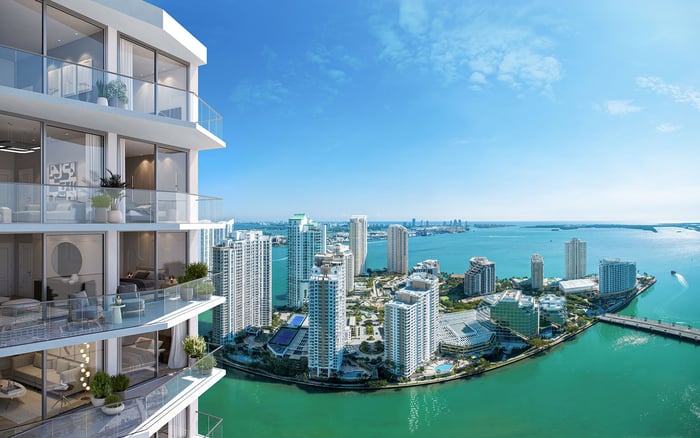
Miami condo buyers are beginning to weigh digital privacy as seriously as exposure, floor height, and amenity design. In a market defined by connected residences, smart-home cybersecurity can influence confidence, resale logic, and the feeling of true privacy.

For years, the Miami condo search has often started with the view: Biscayne Bay at sunrise, the Atlantic horizon, a glittering Brickell skyline, or the softened greens of a private island landscape. Exposure has long served as shorthand for prestige, and in many cases it still does. Yet the most discerning buyers are learning to ask a quieter question before they fall in love with the glass: how protected is the home behind it?
Smart-home cybersecurity is no longer a purely technical concern. In an ultra-premium residence, digital access shapes privacy, comfort, convenience, and control. A condominium may have cinematic water views, but if its connected systems feel improvised, outdated, or loosely managed, the home can lose some of the emotional assurance luxury buyers expect.
This does not mean the view has become irrelevant. It means the hierarchy is becoming more layered. A buyer considering Brickell, a Miami Beach retreat, a Sunny Isles tower, an oceanfront residence, a waterview pied-à-terre, or a new-construction address may now evaluate digital infrastructure with the same seriousness once reserved for ceiling heights, elevator access, and terrace depth.
The modern luxury condominium is a networked environment. Lighting, climate, motorized shades, entry controls, audio, cameras, appliances, wellness features, and building apps may all be connected in some form. The result can be elegant, almost invisible ease: a residence that welcomes its owner with the right temperature, the right light, the right music, and the right sense of arrival.
The complication is that every connected feature introduces a question of access. Who can control it? Who installed it? Who maintains it? What happens when ownership changes? Are passwords reset, permissions removed, and devices updated? Has the residence been treated as a bespoke digital environment, or merely as a collection of convenient gadgets?
Luxury buyers are accustomed to evaluating physical security. They notice staffed lobbies, private elevators, controlled garages, vestibules, and discreet service circulation. Smart-home cybersecurity extends that instinct into the invisible architecture of the home. The network becomes another layer of the floor plan. Password protocol becomes part of the closing checklist. The handover of digital control becomes as important as the handover of keys.
In South Florida’s upper tier, buyers often value discretion as much as spectacle. Many are purchasing second homes, relocating with family offices, or seeking a residence that can support a more fluid life between cities. For these owners, privacy is not an accessory. It is a design standard.
A home with impeccable stone, millwork, and lighting can feel incomplete if the digital environment is not equally refined. Buyers may want to know whether cameras are limited to appropriate areas, whether microphones are present in consumer devices, whether guest access can be segmented, and whether household staff, vendors, or previous owners retain any digital permissions.
The issue is less about fear than control. Luxury has always included the ability to choose what is visible and what is not. In a connected condo, that choice depends on the discipline of the systems behind the walls and inside the apps. Even the most beautiful view can be experienced less fully if the owner is uncertain about who else may have access to the home’s digital life.
A buyer’s concern today may become a resale question tomorrow. As connected residences become more common, sophisticated purchasers may increasingly distinguish between homes that are simply equipped with smart devices and homes that are intelligently managed.
This distinction matters because technology ages differently from marble, bronze, or oak. A well-chosen stone floor may improve with patina. A neglected network can become obsolete or vulnerable. Even when no problem exists, ambiguity can create hesitation. If a seller cannot explain how the smart-home system is administered, or if a buyer’s advisor cannot easily determine what is connected, the residence may feel less turnkey.
In the most competitive segment of the Miami market, confidence is a form of value. Buyers want homes that are elegant to live in and orderly to assume. A clean digital handoff, updated equipment, documented access, and a plan for ongoing maintenance can support that confidence. The goal is not to turn a condo showing into a technical audit. It is to ensure that the home’s invisible systems are worthy of its visible design.
The right questions are practical and direct. Buyers should ask what smart-home platform controls the residence, which devices are connected, and whether the system can be fully reset at closing. They should ask who has administrative access, whether guest networks are separated from owner networks, and whether building-level apps interact with in-unit systems.
It is also reasonable to ask how updates are handled. Some systems depend on ongoing support, while others may be managed locally by the owner’s preferred specialist. A buyer should understand whether the residence is locked into a vendor relationship, whether components can be upgraded, and whether the system has documentation clear enough for a new owner to operate confidently.
In a condominium, the inquiry should extend beyond the unit. Access control, package rooms, parking systems, elevators, amenity reservations, visitor registration, and building communications may all involve digital platforms. A polished residence inside a less disciplined building can still leave a buyer with unresolved questions. Conversely, a building with thoughtful digital governance can elevate even the most private in-unit experience.
Miami will always reward beauty. Light on water, uninterrupted exposure, and a balcony that frames the city’s theater remain powerful. But the definition of a trophy residence is expanding. It is no longer enough for a home to look extraordinary from the terrace. It must also feel secure from the inside.
For some buyers, the final decision may come down to a subtle tradeoff. One residence may offer a more dramatic vista, while another offers cleaner systems, stronger privacy, and a more coherent smart-home environment. The second option may feel less romantic at first glance, but more livable over time. That is where priorities are shifting.
The best luxury homes do not force a choice between beauty and control. They deliver both. Yet when buyers must choose, many may find that peace of mind has a longer shelf life than a postcard view. In a city where glass walls, connected amenities, and global ownership patterns converge, smart-home cybersecurity is becoming part of the language of modern Miami luxury.
Should cybersecurity really matter when buying a Miami condo? Yes. If a residence uses connected systems, cybersecurity helps protect privacy, access, and the feeling of control luxury buyers expect.
Does this mean the view is less important? Not necessarily. The view remains a major emotional and financial consideration, but digital confidence can influence how livable the home feels.
What smart-home features should buyers review first? Start with entry systems, cameras, Wi-Fi networks, lighting controls, climate controls, audio systems, and any building app tied to residence access.
Can smart-home systems be reset after closing? Many can be reset or reconfigured, but buyers should confirm this before closing and plan for a clean transfer of administrative control.
Who should evaluate a condo’s digital systems? Buyers may involve a trusted smart-home integrator, cybersecurity professional, or technology advisor familiar with residential systems.
Are older condos automatically riskier than new residences? Not automatically. A well-maintained older system may be clearer and safer than a newer system with poor documentation or weak access control.
Should building systems be part of due diligence? Yes. Elevators, visitor management, package rooms, amenity reservations, and parking access can all affect a resident’s digital privacy.
What is a clean digital handoff? It means passwords, owner accounts, vendor access, device permissions, and administrative controls are reviewed, reset, and transferred properly.
Can cybersecurity influence resale value? It can influence buyer confidence. A well-documented, well-managed system may make a residence feel more turnkey and easier to trust.
What is the simplest first step for buyers? Ask for a complete inventory of connected systems and confirm who controls each one before becoming attached to the view.
To compare the best-fit options with clarity, connect with MILLION.
If branded residences are on your mind — as a home or as an allocation — we would be glad to share what we are seeing, privately.
Begin a quiet conversation