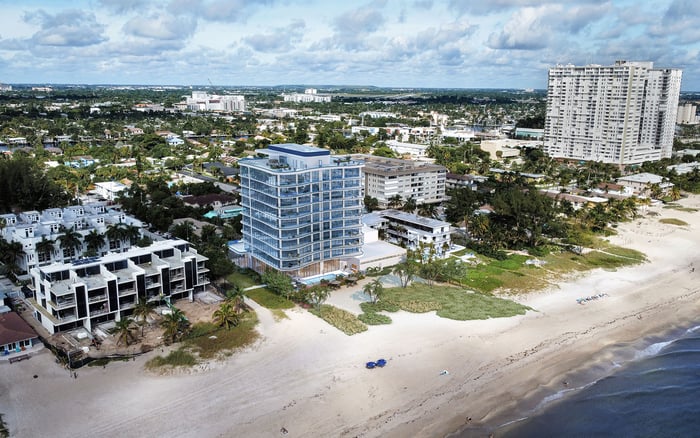
For yacht-owning buyers, waterfront proximity is not the same as legally secured dockage or a practical route to the ocean. The decisive review covers the nature and transferability of any slip right, the complete marina-to-inlet passage, vessel dimensions, and the documents governing long-term access.

Buyers comparing W Pompano Beach Hotel & Residences and Ocean 580 Pompano Beach should separate the appeal of a coastal residence from the legal and practical requirements of yacht access. A view, nearby water, or proximity to a marina does not by itself establish a right to use a particular berth.
The controlling documents should identify whether dockage is connected to the residence, offered under a separate arrangement, or obtained from an independent operator. Buyers should avoid treating marketing descriptions, informal assurances, or proximity alone as evidence of an enforceable boating right.
Waterfront proximity is a lifestyle advantage, but only documents establish boating rights.
The term “slip” can refer to different legal arrangements. A berth might be conveyed with real property, leased for a stated term, licensed under operating rules, or secured independently from a third-party marina. The applicable structure can affect control, duration, recurring costs, renewal, and resale.
A buyer’s attorney should trace any claimed right from the residence to the relevant marina or docking area. The review should cover the purchase agreement, declaration, exhibits, recorded instruments, permits, marina agreement, association rules, and amendments that may govern use.
If a berth is described as exclusive, the operative document should define that term. Buyers should confirm the assigned location, permitted vessel dimensions, term, renewal process, fees, insurance requirements, and the circumstances under which an operator or association may relocate the vessel or end the arrangement.
A dockage arrangement that works for the initial owner may not pass automatically to a future buyer. The documents should explain whether the right transfers with the residence, requires approval, involves a separate assignment, carries a fee, or terminates when the unit is sold.
This review is particularly important before a buyer becomes contractually committed. Counsel should compare every relevant agreement and request written clarification when provisions conflict, depend on future rules, or give another party broad discretion.
The same project-specific discipline applies when comparing nearby alternatives such as The Ritz-Carlton Residences® Pompano Beach and Armani Casa Residences Pompano Beach. Buyers should not assume that the boating arrangements associated with one Pompano Beach property apply to another.
A yacht-access review should examine the entire passage from the proposed berth to the intended inlet. The analysis begins with the vessel’s air draft, water draft, beam, and length, then considers each bridge, channel segment, turn, and navigational constraint along the route.
Movable bridges can still affect timing and passage. Opening procedures, operating schedules, tidal conditions, temporary restrictions, and construction activity may influence whether a route is practical for a particular vessel. Buyers should verify current conditions rather than rely on a general description or a single clearance figure.
The review should also consider whether an alternative route is necessary or feasible. A route that appears workable on a map may perform differently when tested with the intended yacht under actual operating conditions.
Bridge height is only one part of usable access. Water depth, tidal variation, beam, turning room, channel width, current, and berth configuration can determine whether a vessel can safely reach and occupy a space.
The physical berth should be evaluated together with the legal right. A buyer may have permission to use dockage that is unsuitable for the intended yacht, or a physically suitable berth governed by terms that provide limited continuity. Both issues should be resolved before the residence is treated as meeting the buyer’s boating needs.
A marine inspection, depth assessment, and route trial with qualified professionals can help test vessel fit. The review should cover the complete passage and proposed berth under conditions relevant to the yacht rather than stopping at a desktop analysis.
Commercial marina availability can be useful without becoming an attribute of residence ownership. If a buyer expects to rely on third-party dockage, the marina arrangement should be evaluated independently from the condominium purchase.
That review should address availability, term, renewal, cancellation, pricing, vessel limits, storm procedures, insurance, access hours, services, and travel between the residence and berth. The buyer should also consider what happens if the marina changes its rules or cannot continue accommodating the vessel.
For either featured project, the central question is not simply whether dockage may be found nearby. It is whether the buyer can document a durable arrangement that fits the vessel, ownership horizon, and intended pattern of use.
A disciplined file should address assignment, transfer, vessel-size limits, insurance, fees, maintenance, utilities, guest use, live-aboard restrictions, storm procedures, relocation, termination, and remedies if access is interrupted. It should identify who controls the rules and how those rules may change.
Legal review and marine review serve different purposes. Counsel can evaluate the nature and enforceability of the right, while marine professionals can assess the berth and route against the yacht’s dimensions and operating requirements. Neither review should substitute for the other.
The strongest purchase decision aligns three elements: an enforceable right, a physically suitable berth, and a navigable route appropriate for the intended vessel. Buyers considering Ocean 580 or W Pompano should verify all three before assigning boating value to the residence.
For discreet guidance on Pompano Beach residences and document-led comparisons, connect with MILLION.
If branded residences are on your mind — as a home or as an allocation — we would be glad to share what we are seeing, privately.
Begin a quiet conversationNo. Any dockage right should be confirmed in the controlling documents rather than inferred from location or proximity to the water.
Not without documentation. Third-party marina access is separate from ownership unless an enforceable instrument connects it to the residence.
Review the purchase agreement, declaration, exhibits, recorded instruments, permits, marina agreement, operating rules, and relevant amendments.
A slip may be conveyed with property, leased, licensed, or obtained independently from a third-party marina. The specific structure determines the buyer’s rights and obligations.
A dockage right may require approval, a separate assignment, or a transfer fee, or it may end when the residence is sold. Those terms can affect future use and resale.
No. Movable bridges, tides, depth, channel width, turns, schedules, and temporary restrictions may still affect passage.
The review should account for air draft, water draft, beam, and length. These dimensions should be tested against both the berth and the complete route.
Check bridges, opening procedures, vertical and horizontal clearance, depth, tides, channel width, turns, restrictions, and construction conditions.
A marine inspection, depth assessment, and full-route trial with qualified professionals can help evaluate practical vessel fit.
Review vessel limits, insurance, fees, assignment, renewal, relocation, termination, storm procedures, maintenance, utilities, and access rules.