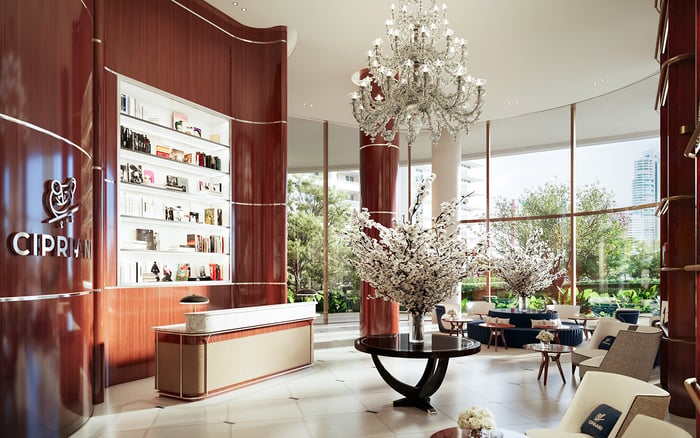
For hospitality-led residences, privacy depends on the complete journey from arrival to residence. Buyers should examine public-area access, elevator controls, guest procedures, service routes, event operations, and the documents governing them.

For buyers comparing Cipriani Residences Brickell and Villa Miami, privacy should be evaluated as a complete sequence rather than a feature at the front door. The relevant path may begin at the curb or garage and continue through reception, shared spaces, elevators, residential corridors, and service areas.
Hospitality-oriented programming can introduce movement by residents, invited guests, staff, vendors, and event attendees. Buyers should therefore determine which groups may enter each area, how access is authorized, and where different routes intersect.
The goal is not to assume that social programming compromises privacy. It is to understand whether the planned circulation and operating rules match the buyer's expectations for discretion, convenience, and control.
Request a clear explanation of how an owner enters from the street, valet area, or resident parking. Then map the separate journeys of an invited guest, delivery worker, service provider, and event attendee. Note every shared threshold, reception point, elevator, amenity level, and residential corridor.
A separate entrance does not by itself establish complete separation. Buyers should ask where routes merge, whether credentials are destination-specific, how visitors are announced, and whether access expires after an approved visit.
This framework can also help buyers compare other hospitality-oriented options such as ORA by Casa Tua Brickell. The purpose is not to assume that projects operate alike, but to evaluate each one through the same set of circulation questions.
Dining rooms, lounges, wellness facilities, pools, and event spaces can influence residential privacy even when access is restricted. Buyers should confirm whether each area is reserved for residents, available to invited guests, or capable of accommodating other approved users.
For every shared space, ask which entrance visitors use, where they check in, which elevators they can call, and whether they can reach residential floors. The answers should distinguish architectural intent from enforceable operating practice.
Event procedures deserve separate attention. A buyer should understand how temporary access is issued, whether attendance is limited, how arrival queues are handled, and whether event operations share circulation with residents.
Elevator count alone does not establish privacy. The important questions concern who may call each elevator, which floors a credential can select, whether residential access is separated from amenity access, and how guests reach an owner's floor.
Buyers should review the exact residence and floor plan under consideration. Privacy conditions may differ according to the relationship among the elevator, vestibule, corridor, and residence entrance. Features associated with one residence type should not be assumed to apply to another.
A useful comparison may include EDITION Edgewater, using the same document-based review. Brand positioning should not replace verification of access controls, shared thresholds, or service circulation.
Staff, vendors, packages, food deliveries, and maintenance teams create recurring movement that can be more consequential than occasional guest traffic. Ask whether dedicated service entrances, elevators, holding areas, and back-of-house corridors are planned and whether their use is mandatory.
Buyers should also determine how oversized deliveries, move-ins, in-residence service, and vendor equipment are handled. If service routes overlap with owner routes, the buyer should understand where that happens and how management intends to limit disruption.
Request the condominium declaration, rules and regulations, management agreement, guest procedures, access policies, elevator-control information, and available circulation plans. Relevant documents should explain who controls access, which rules management may change, and how residents and visitors are expected to use shared areas.
Review the materials with the exact residence in mind. Ask for written clarification when marketing descriptions, plans, and operating provisions do not align. Any legal or technical questions should be directed to qualified advisers before a purchase decision.
Finally, consider how the property may function during busy periods rather than only during a quiet presentation. A circulation plan should be evaluated under conditions involving simultaneous owner arrivals, guests, service activity, and programmed use of shared spaces.
Why does guest circulation matter in a residential project? Guest circulation affects how often residents share entrances, reception areas, elevators, and corridors with visitors. Reviewing the full route helps a buyer assess practical privacy.
What should a buyer inspect first? Start with the path from the street or garage to the exact residence. Identify every access point, shared threshold, and credential-controlled transition.
Does a separate entrance guarantee owner privacy? No. Routes may still converge at reception, elevators, amenity floors, or residential corridors, so the complete sequence must be reviewed.
How should buyers evaluate dining and event spaces? Confirm who may use them, how visitors enter, and whether their circulation overlaps with residential access. Written operating rules are more useful than assumptions.
Do multiple elevator banks ensure separation? Not necessarily. Buyers should verify which floors each bank serves and how credentials restrict access to residences and shared areas.
Why review the exact floor plan? Elevator access, vestibules, corridors, and shared thresholds may vary among residence types. Privacy features should be confirmed for the specific home being considered.
What should buyers ask about service personnel? Ask where staff and vendors enter, which elevators they use, and how equipment, packages, and deliveries reach residences without unnecessary overlap.
Which documents can clarify access policies? The declaration, rules, management agreement, guest procedures, access policies, elevator information, and circulation plans may address relevant controls.
Should buyers evaluate peak operating periods? Yes. Busy periods can reveal how owner, guest, event, and service routes function when several activities occur at once.
Can brand identity substitute for circulation review? No. Buyers should evaluate the plans, controls, and governing documents applicable to the specific project and residence.
To compare the best-fit options with clarity, connect with MILLION.
If branded residences are on your mind — as a home or as an allocation — we would be glad to share what we are seeing, privately.
Begin a quiet conversation