A refined look at why South Florida’s most discerning buyers now evaluate bayfront residences through privacy, service, architecture, wellness, mobility, and neighborhood character, not water views alone.
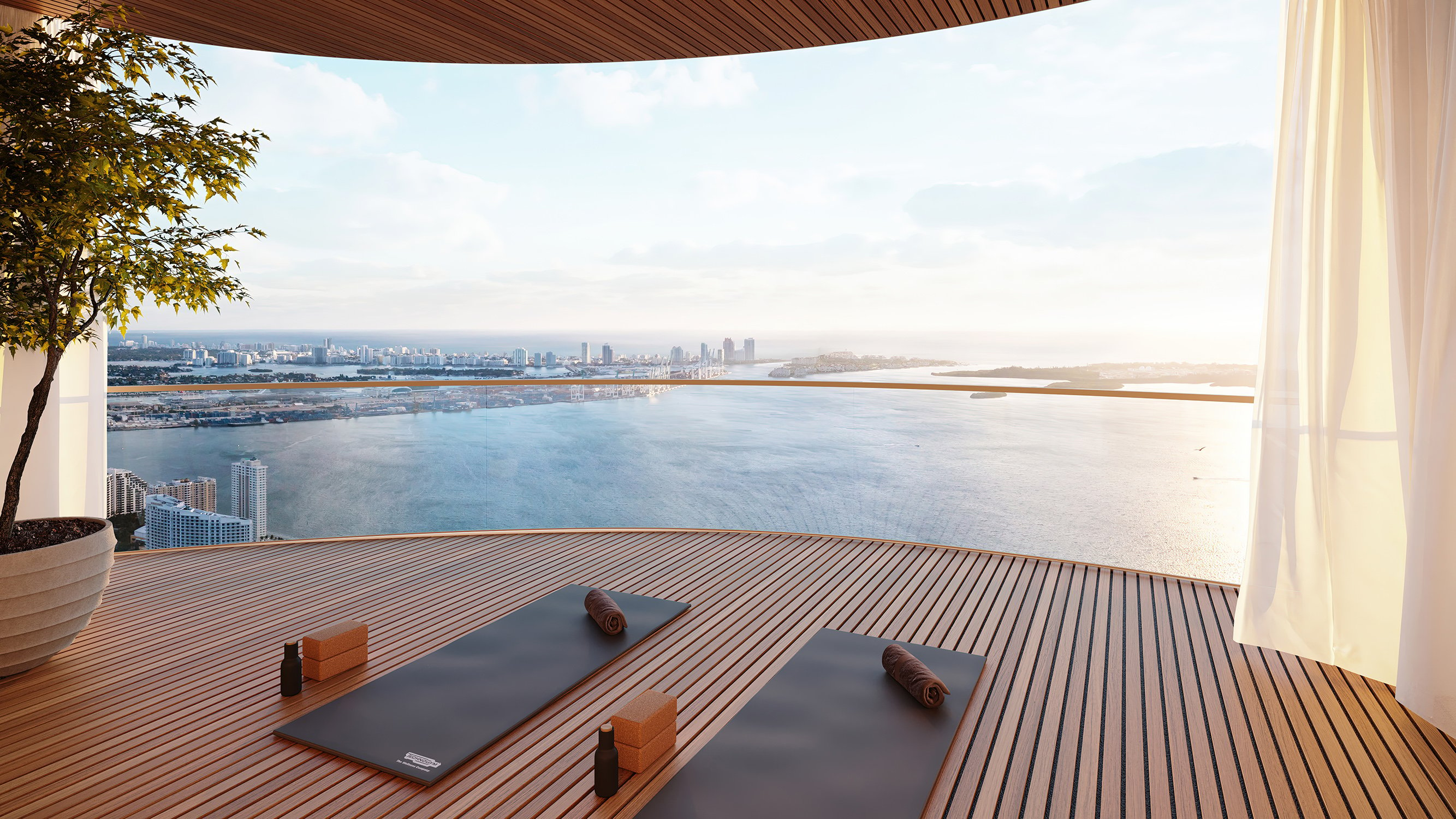
Bayfront property still carries an almost cinematic authority in South Florida. Morning light over Biscayne Bay, the quiet movement of boats, and the rare sense of an open horizon within a dense coastal region remain deeply persuasive. For many buyers, the first emotional response to a residence still begins at the glass.
Yet for the most sophisticated purchasers, the view is no longer the entire story. It is the opening condition. Once the first impression settles, the real evaluation begins: privacy, proportion, service, wellness, arrival, security, building culture, and the way a home performs over the course of an ordinary week. A residence may frame the bay beautifully, but if it lacks ease, discretion, or calm control, the view alone will not carry the decision.
This is the quiet evolution of South Florida luxury. Waterview remains desirable, but it is now measured against a broader lifestyle thesis. The best buyers are not simply asking what they can see. They are asking how they will live.
Water can create openness, but it does not automatically create privacy. In a market defined by glass, terraces, amenity decks, and neighboring towers, the more meaningful question is how exposure is managed. Buyers increasingly study sightlines from adjacent buildings, the relationship between living spaces and terraces, the separation between primary suites and entertaining areas, and whether common spaces feel discreet or theatrical.
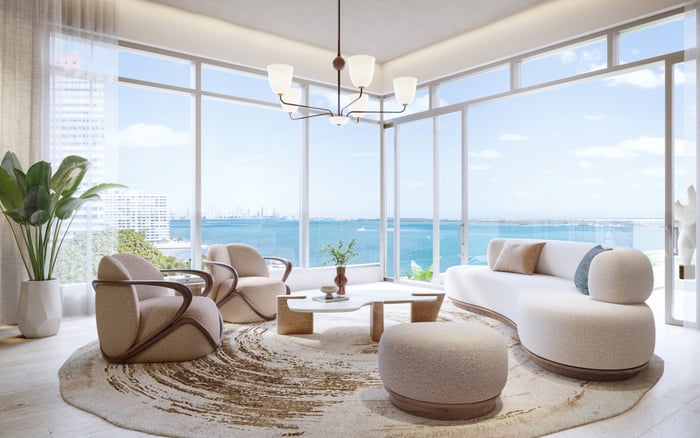
A spectacular bayfront living room is strongest when paired with interior composure. The ability to host without putting the household’s private life on display is a subtle but critical distinction. So is the ability to wake, work, dine, and retreat without feeling visually crowded by the city around you.
This is where architecture matters. Deep setbacks, thoughtful floor plans, private elevator arrivals, controlled amenity access, and layered landscaping can be as valuable as the water itself. For the buyer who already has choice, the question is not whether a property is impressive. It is whether it allows life to feel protected.
In the upper tier, luxury is increasingly judged by what disappears. The best residential experience removes friction from daily life: arrivals are smooth, packages are handled gracefully, vehicles are managed without disruption, guests are welcomed without confusion, and maintenance occurs without intrusion. These details may not photograph as dramatically as a sunset, but they often determine whether an owner remains satisfied.
South Florida’s luxury audience is especially attentive to service because many households move between residences, travel frequently, host often, or maintain demanding professional calendars. A building that can quietly support that rhythm becomes more than a place to sleep. It becomes an operating system for an elevated life.
This does not require excess. In fact, the most desirable service environments are rarely the loudest. They are precise, intuitive, and consistent. A buyer may be drawn in by the bay, but service is what makes the address feel effortless after the novelty of the view has passed.
The luxury wellness conversation has matured beyond a fitness room and a pool. Buyers now look for homes that support sleep, recovery, movement, air, light, and quiet. They examine how a primary suite feels at night, whether elevators and corridors create noise, how natural light moves through the residence, and whether the building offers meaningful places to reset.
Oceanfront and bayfront settings naturally support this desire, but setting alone is not enough. A wellness-oriented home should reduce stress, not simply overlook a beautiful landscape. Spa areas, pools, outdoor rooms, walkable surroundings, and calm amenity programming all play a role, but the deeper value lies in daily rhythm. Can the morning begin with light and air? Can work happen without interruption? Can evenings feel restorative rather than performative?
For many buyers, wellness has become a form of asset protection. A residence that supports health, focus, and recovery has utility beyond aesthetics. It becomes a place that enhances time, often the scarcest luxury of all.
A bay view in the wrong daily context can lose its power. South Florida is not one lifestyle, and the most successful purchases begin with an honest understanding of neighborhood identity. Brickell offers vertical energy, proximity, dining, and an urban cadence. Miami Beach carries a different cultural and coastal language, shaped by sand, architecture, hospitality, and a resort-like social rhythm. Sunny Isles is often read through height, coastline, and expansive residential towers. Coconut Grove speaks more softly, with tree canopy, boating culture, and a village sensibility.
None is universally superior. The right answer depends on how the owner intends to live. Some buyers want an address that supports business lunches, evening reservations, and quick airport access. Others want a slower environment, larger terraces, and a stronger connection to the water. Some prefer the animation of a landmark corridor, while others will pay for a quieter pocket where daily movement feels more private.
The key is not to be seduced by a view in isolation. A residence must belong to a life pattern. If the neighborhood does not match the household’s rhythm, the view becomes a backdrop rather than a foundation.
Water views can make a room beautiful, but they cannot compensate for weak design. Ceiling heights, window proportions, material restraint, kitchen planning, storage, lighting, and acoustic comfort all matter. So does the relationship between interior and terrace. A great bayfront home should not feel like a viewing platform with bedrooms attached. It should feel complete, balanced, and deeply resolved.
Discerning buyers notice when a floor plan has been designed for actual living. They value entries that create pause, kitchens that work for both private mornings and catered evenings, primary suites that feel removed from entertaining zones, and terraces that can be furnished rather than merely admired. The difference is subtle in a brochure and unmistakable in person.
This is why some residences retain desire even when newer inventory appears. A home with architectural clarity and durable materials can hold its appeal beyond a market cycle. The water may attract attention, but design is what creates attachment.
At the highest level, South Florida buyers are not only purchasing a view. They are selecting a long-term position in a coastal market where scarcity, quality, and desirability are closely intertwined. The most disciplined buyers look beyond the instant emotional pull and consider building governance, maintenance standards, reserve strength, staff consistency, and the overall character of ownership.
This is not a colder way to buy. It is a more complete way. A residence should offer beauty, but it should also offer confidence. It should feel extraordinary on a first visit and intelligent after the tenth. It should be easy to lock and leave, gracious to return to, and compelling enough that the owner does not feel constantly tempted by the next new thing.
Bayfront views will always matter in South Florida. They are part of the region’s identity and one of its enduring luxuries. But for the modern buyer, they are only the starting point. The true premium belongs to residences that combine outlook, privacy, service, wellness, design, and neighborhood fit into a life that feels both elevated and deeply livable.
Are bayfront views still important to South Florida luxury buyers? Yes. They remain highly desirable, but sophisticated buyers now evaluate them alongside privacy, service, design quality, and daily convenience.
What does Waterview mean in a luxury search? Waterview generally signals a meaningful visual relationship to water, but buyers should study the quality, permanence, and privacy of that outlook.
Is Oceanfront always more valuable than bayfront? Not necessarily. Oceanfront can offer direct coastal drama, while bayfront may provide calmer water, skyline perspectives, boating appeal, or better neighborhood fit.
Why does privacy matter so much in glass residential towers? Expansive glass can expose interiors to neighboring buildings. The best residences manage sightlines, arrivals, terraces, and amenity access with discretion.
How should a buyer compare Brickell with quieter coastal areas? Brickell often suits buyers who value urban energy and convenience, while quieter coastal areas may better support retreat, privacy, and residential calm.
Is Miami Beach mainly for second-home buyers? No. It can serve primary and secondary lifestyles, depending on the buyer’s desire for coastal access, culture, hospitality, and a more resort-like rhythm.
What attracts buyers to Sunny Isles? Buyers often respond to its vertical residential character, coastal setting, and broad views, while still needing to assess privacy, service, and building culture.
Why is Coconut Grove part of the bayfront conversation? Coconut Grove offers a softer, more village-like waterfront lifestyle, often appealing to buyers who prioritize canopy, boating, and a lower-key cadence.
What should buyers inspect beyond the view during a showing? They should study arrival sequence, noise, light, floor plan efficiency, terrace usability, storage, service standards, and how the home feels at different times of day.
Can a less dramatic view still be the better purchase? Yes. A residence with stronger privacy, better design, superior service, and a more suitable neighborhood can outperform a more dramatic but less livable view.
When you're ready to tour or underwrite the options, connect with MILLION.
If branded residences are on your mind — as a home or as an allocation — we would be glad to share what we are seeing, privately.
Begin a quiet conversation