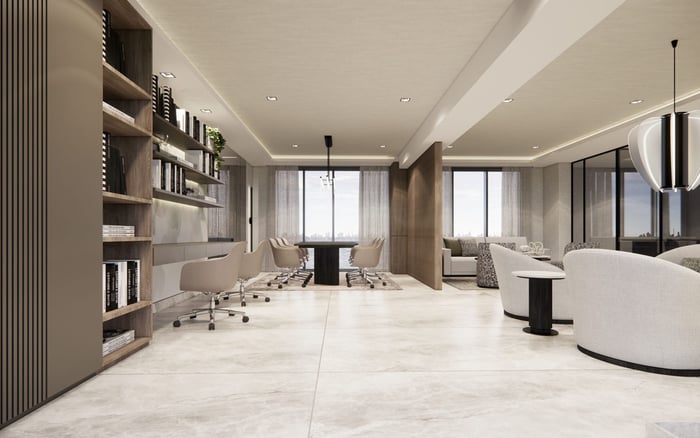
A buyer-focused editorial on when family entry zones can strengthen resale positioning in South Florida luxury homes, especially when they improve circulation, storage, privacy, and daily arrival rituals without compromising the formal arrival sequence.

In South Florida luxury real estate, first impressions are often built around the formal arrival: a dramatic foyer, a gallery wall, a water view revealed at the threshold, or a sculptural stair. Yet a second arrival sequence increasingly deserves attention from sophisticated buyers and sellers. The family entry zone, often positioned near a garage, side door, elevator vestibule, laundry room, or service corridor, can be one of the most practical spaces in the residence.
The question is not whether every home needs a traditional mudroom. South Florida living differs from colder markets, where boots and coats dominate the conversation. The better question is whether the home provides a graceful place for the realities of daily life: school bags, beach towels, golf shoes, pet leashes, deliveries, sports gear, wet umbrellas, and the small objects that otherwise migrate into kitchens, foyers, and powder rooms.
When designed with restraint, a family entry zone can become a resale advantage. It signals that the home was planned not only for presentation, but for living well. In a market where buyers often compare polished finishes, wellness amenities, outdoor rooms, and kitchen specifications, an intelligent transition space can quietly distinguish a residence that photographs beautifully from one that functions beautifully.
A family entry zone earns its place in the resale discussion when it solves a daily problem without announcing itself as utilitarian. The most valuable examples are not oversized catchalls. They are composed, proportionate, and integrated into the architecture of the home.
For a seller, the strongest case appears when the space protects the home’s more formal rooms. If the family entry keeps backpacks off the kitchen island, shoes away from the main foyer, and pet items out of entertaining areas, it supports the larger narrative of order. Luxury buyers respond to calm. A good entry zone creates that calm before the owner even reaches the main living space.
For a buyer, the advantage is clearest when the zone sits along an actual daily route. A beautiful storage wall far from the garage or primary arrival point may be decorative rather than useful. The more naturally it intercepts movement, the more persuasive it becomes.
This matters across South Florida lifestyles. In Miami Beach, sand and pool items may dominate the need. In Brickell, elevator arrival and package management may be more relevant. In Coconut Grove, children, pets, and outdoor living often shape the rhythm of entry. In Fort Lauderdale, boating or waterfront routines may influence storage. In Palm Beach, discretion and service circulation can be especially important. The form changes, but the principle remains consistent: the entry should dignify everyday movement.
The phrase family entry can suggest benches, hooks, and cubbies. Those elements can work, but in the luxury segment they require discipline. Buyers are not looking for a suburban utility alcove inserted into a refined residence. They are looking for concealed function, durable finishes, and architectural continuity.
The strongest versions feel native to the home’s interior language. Cabinetry may align with kitchen millwork or corridor paneling. Hardware should be quiet, not overly thematic. Flooring should tolerate moisture and frequent use while still belonging to the design palette. Lighting should be flattering and practical, with enough clarity for a child finding a backpack or an owner sorting keys before a dinner reservation.
A family entry zone should also avoid becoming a visual liability. Open hooks filled with daily clutter can weaken the impression of a home during showings. Closed storage, integrated drawers, ventilated compartments, and a place for items to disappear are more aligned with high-end resale. The objective is not to display activity, but to absorb it.
Finishes can be improved. Circulation is harder to change. Buyers should evaluate whether the family entry supports the home’s broader plan. Does it connect logically to the garage, elevator, laundry, kitchen, pantry, or staff areas? Can groceries move efficiently from arrival to storage? Can children enter without crossing the formal living room? Can a housekeeper, dog walker, private chef, or visiting family member use the space without disturbing the main entertaining sequence?
In single-family homes, the best family entries often act as a quiet hinge between the garage, kitchen, and service areas. In condominiums, the concept may appear differently: a private elevator vestibule with concealed storage, a widened gallery with built-in cabinetry, or a secondary service entry that gives the home a more gracious operational rhythm.
The resale question is strongest when the layout serves more than one household type. A family with children may see a school-and-sports zone. A seasonal owner may see luggage and beach storage. An owner with pets may see an elegant leash, towel, and grooming station. A frequent entertainer may see a way to keep deliveries and staff movement separate from guests. Flexibility expands the future buyer pool.
Sellers should resist staging the family entry as a novelty. The more refined approach is to present it as part of a complete lifestyle system. During preparation, remove excess items and show only what communicates purpose: a discreet tray, a handsome bench, a closed cabinet, a woven basket if appropriate, and fresh lighting.
If the space has durable flooring, integrated storage, direct garage access, proximity to laundry, or a service corridor connection, those are useful talking points. The language should remain calm and specific. Instead of calling it a mudroom, consider phrases such as secondary entry, family arrival zone, service vestibule, or everyday arrival gallery. The right terminology elevates the space and aligns it with the residence.
Photography should be handled carefully. A family entry rarely needs to lead the marketing story, but it can support it. One well-composed image can communicate that the home is both beautiful and intelligently organized. In showings, the space should feel intuitive, not over-explained.
Buyers should look beyond the presence of built-ins. The key is whether the space can remain elegant under pressure. Are there enough closed compartments? Is there a surface for sorting small items? Is there ventilation if shoes, towels, or sports gear will be stored there? Is the lighting strong enough? Are outlets available where they make sense? Does the door swing interrupt movement? Can the area be used by staff or family without creating bottlenecks?
Scale is equally important. A cramped entry with too much cabinetry can feel oppressive. An oversized room with no clear function can feel wasteful. The ideal is measured and purposeful, with enough room for two or three people to move through naturally.
Buyers should also consider privacy. In a luxury home, not every daily object belongs in public view. A family entry that can be closed off, screened, or visually softened will age better than one that exposes every routine to the main living areas.
Not every family entry zone deserves special resale weight. If it is poorly located, visibly cluttered, cheaply finished, or disconnected from actual arrival patterns, it may be neutral. If it consumes valuable square footage that would be better used for pantry storage, laundry, office space, or a larger primary suite, it can even feel like a planning error.
The feature also matters less when the residence already has exceptional service circulation or abundant concealed storage elsewhere. In that case, the family entry becomes part of a broader operational system rather than a standout selling point.
The best test is simple: would a future owner use it every day without thinking about it? If yes, it may support resale. If it requires explanation, compromise, or a change in habit, its value is more limited.
Treat family entry zones as a resale advantage when they convert daily friction into invisible order. In South Florida, where indoor-outdoor living, beach routines, pets, guests, staff, and seasonal ownership can all shape the way a home functions, the entry sequence deserves more attention than it often receives.
The most compelling homes do not force a choice between glamour and practicality. They choreograph both. A refined family entry allows the formal foyer to remain ceremonial, the kitchen to remain composed, and the private rooms to remain private. That is why, when it is well placed and beautifully executed, this modest zone can carry meaningful weight in the luxury resale conversation.
What is a family entry zone? It is a secondary arrival area used for everyday movement, storage, and transition, often near a garage, service entry, elevator vestibule, or laundry area.
Is a family entry the same as a mudroom? Not necessarily. In luxury homes, it is often more refined, concealed, and integrated into the architecture than a traditional mudroom.
Does every South Florida luxury home need one? No. It matters most when the household has frequent outdoor activity, children, pets, staff circulation, deliveries, or seasonal gear.
Can a family entry improve resale appeal? Yes, when it improves daily function, protects formal spaces from clutter, and feels consistent with the quality of the home.
What should buyers inspect first? Buyers should study the location, circulation, storage depth, lighting, ventilation, and relationship to the kitchen, garage, laundry, and service areas.
Are open cubbies a good idea in luxury resale? They can work sparingly, but closed storage usually photographs better and creates a more polished impression during showings.
How should sellers describe this space? Terms such as family arrival zone, secondary entry, service vestibule, or everyday arrival gallery often feel more elevated than mudroom.
Can condos have family entry zones? Yes. In condos, the idea may appear as a private vestibule, concealed gallery storage, or a service-entry sequence rather than a separate room.
When is the feature less valuable? It is less valuable when it is poorly located, too small to function, visually cluttered, or disconnected from the household’s real arrival patterns.
What is the simplest resale test? Ask whether a future owner would use the space daily without explanation. If the answer is yes, it likely supports the home’s broader value story.
If you'd like a private walkthrough and a curated shortlist, connect with MILLION.
If branded residences are on your mind — as a home or as an allocation — we would be glad to share what we are seeing, privately.
Begin a quiet conversation