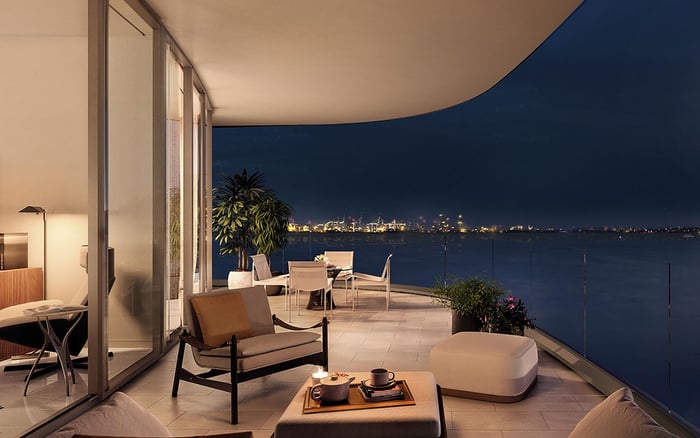
A buyer-focused editorial on how guest-suite separation can make a South Florida penthouse feel less like an occasional trophy home and more like a composed full-time residence.

A penthouse is often judged first by its views, ceiling heights, and terrace drama. Yet for a buyer intending to live there full time, the more important question is quieter: where does everyone go when the home is actually occupied? The distinction between a spectacular weekend residence and a graceful everyday home often begins with guest-suite separation.
In South Florida, the penthouse has evolved beyond the ceremonial showpiece. It may host adult children, visiting parents, private staff, friends from abroad, and long-stay guests who arrive for the season rather than a single weekend. Without thoughtful separation, even generous square footage can feel oddly compressed. Bedrooms open too close to the primary suite. Guests pass through family rooms at the wrong hour. Luggage, service, and privacy compete for the same circulation path.
Good separation does not mean pushing guests away. It means allowing hospitality to coexist with domestic calm. The most livable penthouses give visitors an elegant place to retreat while protecting the owner’s rituals of sleep, work, wellness, and quiet entertaining.
A trophy penthouse may dazzle in a showing. A full-time residence has to perform on an ordinary Tuesday. That is where the plan becomes more revealing than the finishes. Buyers should study the relationship between the primary suite, guest suites, kitchen, staff or service areas, elevator entry, and terrace access.
The best layouts create legible zones. The owner’s wing should feel private without becoming remote. Guest rooms should be easy to reach without requiring visitors to cross the most intimate parts of the home. If the residence includes a family room, library, office, or media space, those rooms should not become accidental corridors.
In Brickell, buyers comparing large-format residences at St. Regis® Residences Brickell or The Residences at 1428 Brickell often focus on skyline presence and service culture. The more enduring question is how the residence would function when guests stay for a week, when one person works early, and when another returns late from dinner.
The phrase guest-suite separation can sound technical, but its emotional value is simple. It allows people to be together by choice rather than by necessity. A guest should be able to make coffee, take a call, or step outdoors without feeling as if they are entering the owner’s private quarters. Likewise, the owner should be able to start the day without performing for the household.
This is especially relevant in homes designed for multigenerational use. A separated guest suite can support independence for parents, adult children, or frequent international visitors. It can also make the residence more flexible over time, as family structures, work habits, and lengths of stay change.
Separation is not only horizontal. In some penthouses, vertical movement, split levels, or private elevator sequences can create a strong sense of distinction. In others, the solution is subtler: a corridor turn, a secondary lounge, a pocket of bedrooms placed away from the primary suite, or guest access that does not interrupt the main entertaining room.
The finest penthouse layouts are often defined by what guests do not notice. Service movement, acoustic privacy, and storage are invisible luxuries until they are missing. When a home is used full time, housekeeping, catering, deliveries, luggage, and maintenance become part of the daily choreography.
A guest suite near a service corridor may work beautifully if the plan is controlled and quiet. The same placement can feel compromised if sound travels or if service traffic passes directly by sleeping areas. Buyers should stand in the room, close the doors, and imagine the home at full occupancy. Where would breakfast be served? Where would suitcases go? Can a guest leave early without waking the household?
Water view is another layer of the equation. In a coastal penthouse, the temptation is to give every major room the same prized exposure. Yet the best full-time residences balance the view hierarchy with livability. A guest suite can feel special without taking the primary corner. A secondary terrace or more discreet outlook can sometimes make the guest experience feel private and serene.
Along the ocean, guest separation takes on a slightly different character. The view is more continuous, the outdoor rooms are more central, and visiting guests may spend more time in residence. A penthouse near the beach must therefore manage the transition between resort energy and residential order.
At The Perigon Miami Beach, buyers may naturally think about the relationship between indoor living and the shoreline setting. For a full-time owner, the deeper question is whether guest rooms, entertaining areas, and private retreats can remain distinct even when the home is open, active, and sunlit throughout the day.
Surfside carries a quieter residential expectation. A buyer considering The Delmore Surfside may value discretion as much as design presence. In that context, a well-separated guest suite is not merely a convenience. It becomes part of the home’s social etiquette, allowing visitors to enjoy proximity without dissolving the owner’s privacy.
Many South Florida buyers begin with a seasonal mindset. Over time, the residence becomes more central to family life. Second-home planning should therefore be more rigorous than occasional use might suggest. The penthouse that works for holidays may not work when it becomes the preferred base for work, wellness, and extended family stays.
New-construction buyers should examine floor plans before becoming attached to finish packages. A beautiful kitchen, a dramatic great room, or a cinematic primary bath will not compensate for a guest bedroom that opens awkwardly into the main living space. Separation is an architectural decision, not a decorative one.
Sunny Isles buyers looking at towers such as Turnberry Ocean Club Sunny Isles may be drawn to height, water, and spectacle. Those qualities matter, but the long-term test is how easily the residence can absorb real life. The more the home is used, the more valuable it becomes to have guest quarters that feel complete, quiet, and intentionally placed.
Begin with the entry sequence. A private elevator foyer may create drama, but it should also clarify movement. From the moment the doors open, the plan should indicate where guests go, where the owner retreats, and where service can operate discreetly.
Next, study bedroom adjacency. A secondary suite immediately beside the primary may be useful for a young child, but less ideal for long-stay adult guests. A guest wing across the residence may offer stronger privacy, provided it has convenient access to common areas and does not feel cut off.
Finally, examine the outdoor rooms. A terrace can unify a residence beautifully, but it can also blur boundaries. If every bedroom opens to the same outdoor area, consider whether that supports or undermines privacy. The goal is not to isolate people. The goal is to let the home expand and contract with grace.
What does guest-suite separation mean in a penthouse? It means guest accommodations are planned apart from the owner’s most private areas, with thoughtful circulation, privacy, and access to shared spaces.
Why is guest-suite separation important for full-time living? Full-time use creates more daily overlap among owners, guests, staff, and family. Separation keeps the residence calm and functional.
Is a larger penthouse always better for guests? Not necessarily. A smaller residence with intelligent zoning can live better than a larger one with poor circulation.
Should guest suites be near the elevator? They can be, if the arrival sequence feels refined and private. The key is avoiding noise, exposure, or conflict with service movement.
Does guest-suite separation help resale appeal? It can support broader lifestyle flexibility, especially for buyers who host family, seasonal visitors, or multigenerational guests.
How should buyers evaluate a floor plan? Trace daily movement from entry to bedrooms, kitchen, terrace, and service areas. The best plans feel intuitive under real occupancy.
Can a guest suite double as an office? Yes, if it has privacy, good proportions, and a bathroom relationship that does not interrupt household life.
What is the biggest layout mistake? Treating guest rooms as leftover space rather than as a dedicated hospitality zone with dignity and discretion.
Do oceanfront penthouses need different planning? They often require careful balance between view exposure, outdoor access, and privacy because guests may spend longer periods in residence.
When should buyers prioritize separation over finishes? Early in the search. Finishes can be changed more easily than circulation, bedroom placement, and the fundamental logic of the plan.
For a tailored shortlist and next-step guidance, connect with MILLION.
If branded residences are on your mind — as a home or as an allocation — we would be glad to share what we are seeing, privately.
Begin a quiet conversation