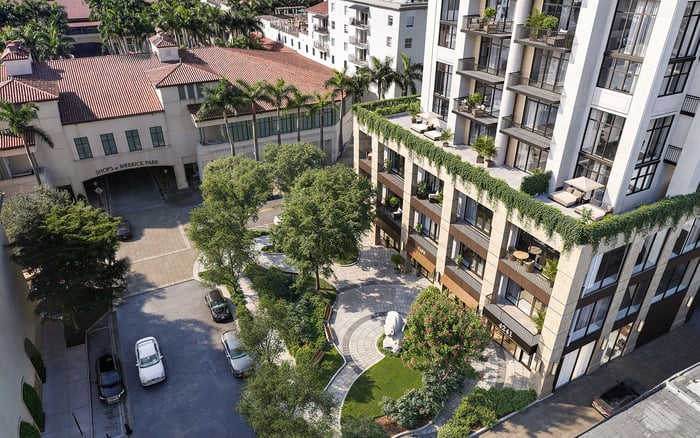
A discreet buyer’s guide to evaluating liquidity, portfolio leverage, interest-rate exposure, and resale confidence before purchasing at Cora Merrick Park in Coral Gables.

A purchase at Cora Merrick Park is not only a residential decision in Coral Gables. For many buyers, it is also a portfolio allocation that can affect cash reserves, securities, operating businesses, alternative investments, and other real estate. The first conversation should therefore be less about whether the residence is desirable and more about what the purchase does to overall flexibility.
The most useful opening question is simple: after deposits, closing costs, carrying costs, taxes, and furnishing, how much immediately accessible liquidity remains? A buyer may be able to afford the residence on paper yet become less agile when a business needs capital, a family event requires cash, or an attractive investment opportunity appears. In a Coral Gables search, the most elegant acquisition is often the one that preserves choice.
This is especially relevant for buyers treating the residence as a second home, a long-term family base, or part of a broader investment strategy. The Merrick Park area’s lifestyle appeal may support future buyer and renter demand, but that does not remove the need to model slower luxury absorption and longer holding periods in weaker markets.
Before signing a contract, buyers should compare three paths: all cash, a traditional mortgage, and portfolio-backed financing. Each carries a different kind of risk. Cash can simplify execution and reduce financing uncertainty, but it also removes capital from portfolios that may be expected to generate returns or remain available for other purposes. The question for the wealth advisor is whether paying cash reduces risk enough to justify that opportunity cost.
A traditional mortgage may preserve more liquidity, but it introduces underwriting, rate, and payment considerations. Portfolio-backed financing, including securities-backed or pledged-asset lines, can be efficient for high-net-worth buyers, but only if the buyer understands the collateral mechanics. The key issue is not merely the rate. It is how the facility behaves under stress.
Buyers comparing Coral Gables opportunities, including Ponce Park Coral Gables and The Village at Coral Gables, should apply the same discipline: determine how the purchase looks in a normal market, then examine what changes when liquidity becomes more expensive or less available.
A lender’s approval is not the same as a resilient financing structure. If a buyer intends to use a securities-backed line, pledged-asset facility, margin loan, or private-bank credit line, due diligence should focus on what happens if markets decline. Could the facility trigger a margin call during a drawdown? What collateral maintenance levels apply? What advance rates are used against different asset classes? How long is the cure period if values fall?
These questions are not technical formalities. They determine whether the residence remains a stable asset or becomes entangled with portfolio volatility. A buyer who finances against concentrated public equities, alternative assets, or illiquid positions should understand whether a temporary market event could force a sale, a capital transfer, or a costly restructuring.
Interest-rate exposure deserves equal attention. Floating-rate debt or a portfolio line of credit may feel flexible at closing, but future carrying costs can change. Buyers should ask how payments behave if rates remain elevated, rise further, or reset at an inconvenient time. A polished capital stack is one that can survive less polished markets.
Private-bank and family-office buyers should coordinate the real estate acquisition with existing credit lines, margin loans, and pledged-asset facilities. The goal is to avoid hidden concentration across lenders, collateral pools, or repayment dates. A residence that appears conservatively financed in isolation may be less conservative when viewed alongside business debt, investment leverage, and other property obligations.
International buyers should add another layer of questions. How does currency volatility affect the true cost of the purchase? Is the buyer taking on more dollar-denominated exposure than intended? How do cross-border tax planning, estate considerations, and future liquidity events affect the acquisition structure? These issues should be addressed before contract execution, not after funds are already committed.
For some buyers, nearby lifestyle alternatives such as Four Seasons Residences Coconut Grove or urban options such as 2200 Brickell may enter the comparison set. The projects differ in character, but the financial questions remain consistent: what capital is tied up, what leverage is introduced, and what flexibility remains.
Resale liquidity should be evaluated before the initial purchase, not only when the owner decides to sell. At Cora Merrick Park, the analysis should be unit-specific. Layout, views, finishes, parking, amenities, and the strength of the condominium association can all affect future market confidence. The most liquid residence is not always the largest or most dramatic; it is often the one that appeals to the deepest pool of qualified buyers.
Buyers should also ask the developer or association for financial and governance information that could influence future carrying costs. The strength of reserves, budgeting discipline, and decision-making structure can shape buyer confidence when the residence is eventually reintroduced to the market. In a condominium context, association fundamentals become part of the investment file.
The correct holding-period assumption is conservative. Even if Merrick Park’s lifestyle appeal supports demand, buyers should model a scenario in which a sale takes longer than desired. If the owner would need to sell quickly to meet another obligation, the purchase may be too tightly financed.
Before moving forward, the buyer’s team should be able to answer a concise set of questions. For the lender: what are the margin-call triggers, collateral rules, advance rates, cure periods, rate-reset terms, and repayment obligations? For the wealth advisor: what is the opportunity cost of cash, and how does the purchase affect portfolio concentration? For tax counsel: how should ownership, cross-border exposure, and future transfer planning be handled?
For the developer or association: what financial and governance information is available, and how might it affect future carrying costs or resale confidence? For the buyer personally: would the acquisition still feel prudent if credit tightened, rates rose, capital markets declined, or luxury absorption slowed?
The best buyers in South Florida are not simply seeking permission to purchase. They are asking whether the acquisition strengthens or weakens their overall position. At Cora Merrick Park, that distinction is the difference between owning beautifully and owning intelligently.
Should I pay cash for Cora Merrick Park? Cash may reduce financing risk, but buyers should weigh that benefit against the opportunity cost of removing capital from investment portfolios.
Is portfolio-backed financing appropriate for this purchase? It can be useful for qualified buyers, but only if collateral maintenance, advance rates, cure periods, and drawdown risk are fully understood.
What is the biggest risk with a pledged-asset line? A market decline could reduce collateral values and create a margin call or additional collateral requirement.
Why does liquidity matter if I can afford the residence? Affordability is not the same as flexibility; the purchase may affect business needs, taxes, family obligations, and future investments.
Should I use a fixed or floating rate? Buyers should stress-test both, especially if considering floating-rate debt or a portfolio line that could become more expensive.
How should international buyers think about the purchase? Currency volatility, cross-border tax planning, and dollar-denominated exposure should be reviewed before funds are committed.
What affects future resale liquidity? Layout, views, finishes, parking, amenities, and the condominium association’s strength can influence buyer confidence.
Should I review association finances before buying? Yes. Governance and financial information can affect carrying costs, owner confidence, and eventual resale positioning.
How long should I assume I may need to hold? Buyers should model longer holding periods, especially in weaker market conditions or slower luxury absorption cycles.
Who should be involved before signing? The lender, wealth advisor, tax counsel, tax counsel, developer, and condominium association should all be part of the diligence process.
When you're ready to tour or underwrite the options, connect with MILLION.
If branded residences are on your mind — as a home or as an allocation — we would be glad to share what we are seeing, privately.
Begin a quiet conversation