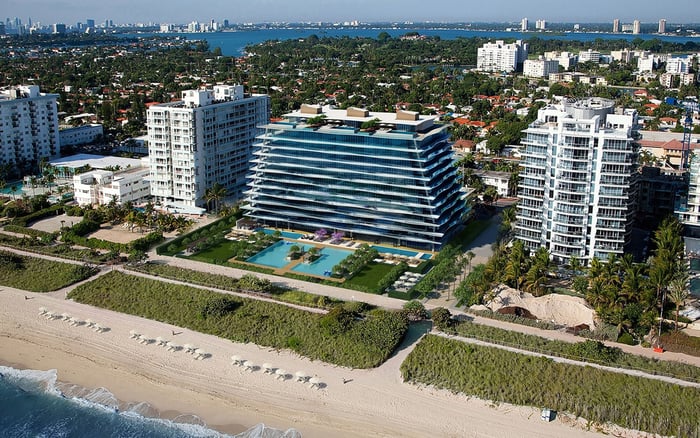
For trust and entity buyers in Surfside, a well-structured acquisition begins with seller-status documentation, a transaction-specific deed-tax calculation, precise title coverage, and a plan for the eventual sale.

An oceanfront residence in Surfside may be chosen for its outlook and the way it accommodates family life. The purchasing structure deserves equally deliberate attention. For a buyer using a trust, LLC, partnership, or corporation, the question extends beyond whose name appears on the deed: tax treatment, signing authority, insurance, and eventual disposition must work together.
A buyer considering Arte Surfside should bring that discipline to the transaction before the closing calendar tightens. The objective is a coordinated file: documented seller status, a written tax calculation, an acceptable title commitment, and an ownership memo that looks beyond acquisition. These are recommended planning requests, not universal legal requirements.
FIRPTA generally requires a buyer to withhold when a foreign person disposes of U.S. real property. The seller’s status drives this inquiry-not simply the buyer’s nationality or choice of entity. Having a closing agent administer the transaction does not remove the buyer’s withholding responsibility.
Request the seller’s FIRPTA status documentation early and have counsel confirm the appropriate treatment. Where withholding applies, the general rate is 15% of the amount realized, typically the gross sale price rather than profit or proceeds remaining after commissions. At that rate, a $5 million sale produces $750,000 of withholding; a $10 million sale produces $1.5 million. These figures are illustrations, not assumptions about any particular residence.
Withholding is not the seller’s final tax bill. It is a payment toward U.S. tax liability, with excess withholding generally reconciled through a tax return and refund claim. That distinction matters when discussing closing liquidity or a request for reduced withholding.
Residence-use relief is conditional. Qualifying purchases of $300,000 or less may avoid withholding, while qualifying purchases above $300,000 and up to $1 million may receive a 10% rate. A trust or entity buyer should not assume that personal occupancy establishes eligibility. Ask counsel to confirm whether the proposed structure qualifies and what documentation is needed.
If reduced or eliminated withholding is contemplated, request a written withholding-certificate plan. A federal withholding certificate can authorize that treatment, but the contract should address cooperation, responsibility, and timing-not leave them for closing-day discussions.
Ask counsel and the closing agent to identify who obtains the documentation, prepares the filings, handles the withheld funds, and confirms payment. FIRPTA withholding generally must be reported and paid within 20 days after transfer, subject to special rules, including those involving timely withholding-certificate applications.
The plan should explain how a pending application affects the transaction and which deadlines remain in effect. A request for relief is not confirmation that relief has been granted. Have counsel translate the proposed approach into contract protections appropriate to the sale.
Miami-Dade’s base documentary stamp tax on deeds is $0.60 for each $100 of consideration, rather than the $0.70 rate generally applicable elsewhere in Florida. The county also imposes a $0.45-per-$100 surtax on transfers outside the single-family-dwelling exemption.
For a condominium acquisition, request a written explanation of the specific unit’s treatment. Do not accept a blanket assumption that every Surfside condominium bears a combined 1.05% deed tax. The calculation should identify taxable consideration, the applicable property classification, and the basis for applying or excluding the surtax.
When evaluating Fendi Château Residences Surfside, keep the residence’s appeal separate from the transaction’s tax classification. Buying through a trust or LLC does not itself establish a different deed-tax rate.
Also request the contract’s actual allocation of documentary stamp costs. Calculating the tax correctly and agreeing on who pays are separate matters. Both should be clear before reviewing the final closing figures.
Request the proposed owner’s title policy form and the title commitment well before closing. Florida has an ALTA owner’s policy form with Florida modifications, but the practical review should focus on the proposed coverage, insured ownership, and exceptions for this transaction.
Ask for owner’s coverage at the full purchase price and have counsel check that the proposed insured and deed vesting accurately reflect the intended ownership arrangement. Review the commitment’s requirements and proposed exceptions, then identify acceptable exceptions and any agreed endorsements in the contract. Do not assume that a sample policy clause establishes a mandatory contract standard or guarantees an endorsement’s availability.
For a purchase at Ocean House Surfside, the same principle applies: the ownership selected during planning should carry through consistently to the closing documents and proposed coverage. Ask the title professional to explain the effect of exceptions rather than treating the commitment as an administrative attachment.
Request an ownership-document checklist from the closing agent early. Depending on the structure, trust agreements or certifications, partnership documents, and entity resolutions may be needed to establish authority and proper vesting.
The checklist should identify the authorized signers, the capacity in which each will sign, and the documents the title insurer requires. Discuss privacy preferences directly, but do not assume that a redacted trust certificate will satisfy the insurer. Obtain its requirements before relying on abbreviated disclosure.
This is also the time to reconcile any differences among the ownership memo, purchase contract, proposed deed, and title commitment. The aim is consistency, not a last-minute choice of purchasing vehicle.
Before committing, request a written comparison of direct ownership, corporations, partnerships, and trusts. These arrangements can produce materially different U.S. income, estate, gift, and FIRPTA consequences. Selecting an entity solely for privacy or liability protection leaves important questions unanswered.
For buyers weighing The Surf Club Four Seasons Surfside, the planning horizon should extend beyond possession. Ask the tax adviser to address rental income, sale gains, succession, and projected net sale proceeds under the proposed structure.
Today’s buyer may become tomorrow’s foreign seller, with FIRPTA withholding affecting cash available at disposition. The exit model should distinguish withholding from estimated final tax liability. It should also examine alternatives to a direct deed sale: certain transactions or distributions involving partnerships, estates, trusts, and corporations can carry FIRPTA-related withholding consequences.
A well-prepared acquisition file therefore answers four questions: who must withhold, how deed tax is calculated, whose interest is insured, and how ownership can eventually be transferred. Review those answers with transaction counsel and a qualified tax adviser before committing to the structure.
For a considered approach to your Surfside residence search, explore MILLION.
If branded residences are on your mind — as a home or as an allocation — we would be glad to share what we are seeing, privately.
Begin a quiet conversationNo. FIRPTA generally requires buyer withholding when a foreign person disposes of U.S. real property, even when a closing agent handles the paperwork.
The general rate is 15% of the amount realized, typically the gross sale price rather than the seller’s profit. At that rate, withholding on a $5 million sale would be $750,000.
No. It is a payment toward the seller’s U.S. tax liability, with excess withholding generally reconciled through a tax return and refund claim.
Eligibility should be confirmed by counsel for the proposed structure. Qualifying purchases of $300,000 or less may avoid withholding, while qualifying purchases above $300,000 and up to $1 million may receive a 10% rate.
Generally within 20 days after transfer. Special rules can apply, including those involving timely withholding-certificate applications.
Do not assume so. Miami-Dade’s base rate is $0.60 for each $100 of consideration, with a $0.45-per-$100 surtax on transfers outside the single-family-dwelling exemption; request a unit-specific determination.
An LLC or trust does not itself establish a different rate. The calculation depends on taxable consideration and the applicable property classification, while payment allocation should be checked in the contract.
Request the proposed owner’s policy form, title commitment, exceptions, and any proposed endorsements. Ask for coverage at the full purchase price and confirm that insured ownership and deed vesting match the intended structure.
Do not assume it will. Obtain the insurer’s document requirements early, including what it needs to establish signing authority and proper vesting.
It should compare structures across income, estate, gift, and FIRPTA consequences, including rental income, sale gains, succession, and projected net proceeds. Certain entity or trust transactions and distributions also warrant analysis beyond a direct deed sale.