A discreet buyer’s guide to the Miami residence profiles most aligned with quiet elevator arrival, short corridors, privacy, and calm daily movement.
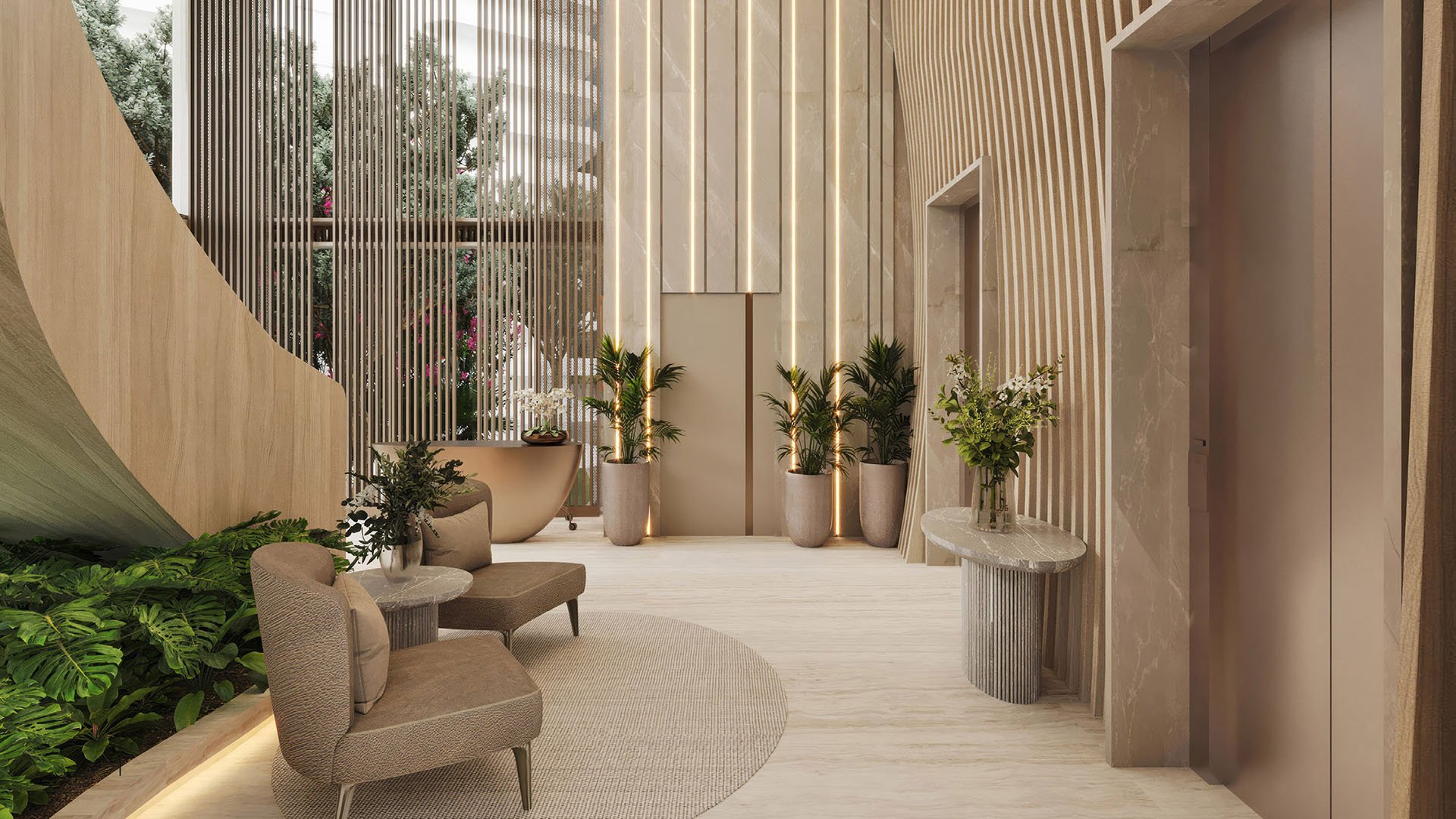
In Miami’s upper tier, the first impression of a residence often begins before the front door. It begins at the elevator threshold, in the hush of the landing, in the number of steps between arrival and home, and in whether the corridor feels like a private gallery or a shared passage. For buyers who prize discretion, quiet elevators and short corridors are not minor details. They are signals of a building’s attitude toward privacy.
This is especially relevant for buyers comparing larger urban towers with more intimate coastal and garden-neighborhood residences. A dramatic lobby may photograph beautifully, but daily life is shaped by repetition: returning after dinner, receiving guests, bringing luggage upstairs, stepping out early for a flight, or arriving home with children asleep. The most composed residences minimize friction in those moments.
A quiet elevator experience is not only about mechanical sound. It is also about where the elevator opens, how many homes share the landing, whether bedrooms sit near elevator shafts, how corridor finishes absorb or amplify sound, and how often service traffic crosses the same path. A short corridor is similarly nuanced. It can mean fewer doors, fewer turns, clearer sightlines, and a stronger sense that the home begins the moment the elevator opens.
1. Private-entry residence - direct arrival
The most compelling option for privacy-minded buyers is a residence with private elevator entry or a clearly defined private vestibule. In this profile, the transition from elevator to home is compressed, controlled, and ceremonial. The arrival sequence feels residential rather than hotel-like, with less exposure to neighbors or corridor traffic.
The essential diligence is both acoustic and spatial. Buyers should study whether the elevator core is buffered from bedrooms and primary living areas, whether the foyer has enough depth to create separation, and whether the elevator doors open into a genuinely private zone rather than a shared landing dressed to feel private.
2. Corner residence - fewer corridor adjacencies
Corner residences often appeal to buyers seeking a quieter interior experience because they may reduce shared corridor frontage and internal adjacency. The value is not only light or view. It is the possibility of a home that feels set apart from the building’s circulation pattern.
The best examples place the front door or elevator landing near the home’s social areas while keeping bedrooms deeper inside the plan. Buyers should look for layouts where arrival is intuitive and brief, without a long internal hallway that recreates the corridor experience they are trying to avoid.
3. Low-rise or lower-floor residence - simplified movement
For some buyers, the quietest elevator is the one used less intensely or for a shorter ride. A low-rise or lower-floor residence can offer a more immediate relationship to the building’s amenities, parking, gardens, or street-level arrival. This profile is not about sacrificing prestige. It is about choosing ease over spectacle.
The tradeoff is context. Lower floors require careful attention to exterior noise, privacy from neighboring buildings, and service routes. When the plan is well considered, the result can be highly livable: fewer minutes in transit, fewer shared thresholds, and a calmer daily rhythm.
4. Boutique residence - fewer homes per landing
A boutique residence is often attractive to buyers who dislike long hotel-style corridors. When a building has fewer residences per floor, the arrival experience can feel more personal, and the corridor can read as an extension of the home rather than a public lane. The key word is can, because the layout matters as much as the building scale.
Buyers should examine the number of front doors visible from the elevator, the location of service rooms, the width and finish of the corridor, and whether the lighting feels residential. A short corridor that is poorly detailed can still feel exposed, while a slightly longer one with excellent acoustics and proportions can feel serene.
5. End-of-corridor residence - reduced pass-by traffic
An end-of-corridor residence can provide a quieter threshold because fewer neighbors pass the door. This profile is particularly appealing to buyers who want a conventional front-door experience but dislike the sense of constant movement beyond it. The residence becomes the destination, not a point along a route.
The buyer’s focus should be on what sits behind and beside that final door. Trash rooms, stairwells, mechanical closets, and service elevators can all affect the perceived calm. The strongest end-of-corridor plans combine privacy with clean separation from back-of-house functions.
In Brickell, buyers often weigh vertical drama against daily efficiency. A residence may offer impressive height, but the quality of the elevator bank, the number of homes per floor, and the length of the residential corridor will influence how private the home actually feels. The most composed choices are usually those where the arrival path is short, legible, and separated from heavy amenity traffic.
In Miami Beach and Surfside, the conversation often shifts toward serenity, discretion, and the relationship between the residence and the water. A quiet elevator sequence can reinforce the sense of retreat that coastal buyers expect. Short corridors also matter for guests, staff, and family members who want the home to feel intuitive from the first step off the elevator.
In Bay Harbor and Coconut Grove, buyers may be drawn to a more residential scale. The appeal is not simply lower density. It is the feeling that movement through the building is calmer, more neighborhood-like, and less theatrical. For buyers who value privacy over spectacle, that subtle difference can carry more weight than a grander lobby or a busier amenity deck.
The best time to evaluate elevator and corridor quality is not during a perfectly staged showing. Visit at moments that approximate real life: early morning, late afternoon, and evening. Listen as the elevator arrives. Notice whether doors close softly, whether voices carry, whether service carts share the same path, and whether the corridor feels acoustically settled.
Inside the residence, stand quietly near the entry and then in the bedrooms. A buyer should understand what can be heard from the corridor, the elevator landing, and adjacent service areas. Door weight, seals, wall assemblies, and layout can all influence whether the home feels cocooned or porous.
Also consider the emotional cadence of the plan. A short corridor should not feel abrupt or exposed. The most elegant arrival sequences provide a moment of decompression: a foyer, a turn, a framed view, or a measured transition into the living space. Quiet luxury is rarely about eliminating every step. It is about making every step feel intentional.
Long corridors are not inherently undesirable, but they can create a more institutional feeling if too many doors, turns, or service functions compete for attention. In a luxury residence, the corridor should feel calm, edited, and proportionate. It should not make the buyer feel like one of many.
Short corridors can also improve the guest experience. Visitors understand where to go. Deliveries are less conspicuous. Family members move more easily between elevator, entry, and living areas. For seasonal owners, that simplicity is especially valuable because the residence must feel effortless immediately upon arrival.
Ultimately, the most desirable Miami residences for this buyer are not defined by a single feature. They combine elevator quietness, limited shared circulation, thoughtful adjacencies, and a floor plan that protects the private rooms. When those elements align, the residence feels calmer before the view is even considered.
Why do quiet elevators matter in a luxury residence? They shape the daily sense of privacy and calm, especially during early mornings, late evenings, and guest arrivals.
Is a private elevator always better? Not always. A well-designed shared landing can feel more private than a poorly buffered private-entry layout.
What makes a corridor feel short? Fewer doors, fewer turns, clear sightlines, and a direct relationship between elevator, foyer, and residence entry.
Should buyers avoid homes near elevator shafts? They should evaluate them carefully. Layout, wall separation, and room placement matter more than proximity alone.
Are boutique buildings usually quieter? They can be, particularly when fewer residences share each floor, but corridor design and service routing remain critical.
Do lower floors offer a quieter experience? Sometimes. They may reduce elevator time, but buyers should also assess exterior noise and privacy conditions.
What should I listen for during a showing? Elevator arrival sounds, corridor voices, service movement, door closures, and any noise transfer inside bedrooms.
Is an end-of-corridor residence a good choice? It can reduce pass-by traffic, provided it is not next to noisy service rooms, stairwells, or mechanical areas.
How important is the foyer? Very important. A good foyer creates a pause between shared circulation and private living space.
Can a high-rise residence still feel discreet? Yes. The key is a calm arrival sequence, limited shared circulation, and strong acoustic separation.
For a discreet conversation and a curated building-by-building shortlist, connect with MILLION.
If branded residences are on your mind — as a home or as an allocation — we would be glad to share what we are seeing, privately.
Begin a quiet conversation