A yacht-first assessment of five Downtown Miami residential choices, distinguishing integrated marina access from nearby transient or separately contracted berthing. The ranking emphasizes route geometry, documented slip rights, vessel dimensions, and practical access to Biscayne Bay and Government Cut.
For a yacht owner, even the most impressive residential amenity can become secondary to three practical questions: Where will the vessel berth, can that right transfer with the residence, and what fixed structures stand between the dock and open water? In Downtown Miami, the answers distinguish genuine marine utility from an attractive water view.
Most condominiums do not automatically convey a deeded slip. A berth may instead be separately owned, licensed, leased, assigned under restrictions, reserved for transient use, or offered solely as an amenity. Buyers should therefore regard “marina access” as the beginning of diligence, not proof of an enduring property right.
The strongest integrated proposition is Aston Martin Residences Downtown Miami, positioned at the mouth of the Miami River beside Biscayne Bay. For buyers considering a separate-marina strategy, Waldorf Astoria Residences Downtown Miami and One Thousand Museum Downtown Miami place residential selection and berthing into distinct transactions.
Marina access is valuable, but documented transferability determines whether it travels with the home.
1. Aston Martin Residences - 300 Biscayne Boulevard Way
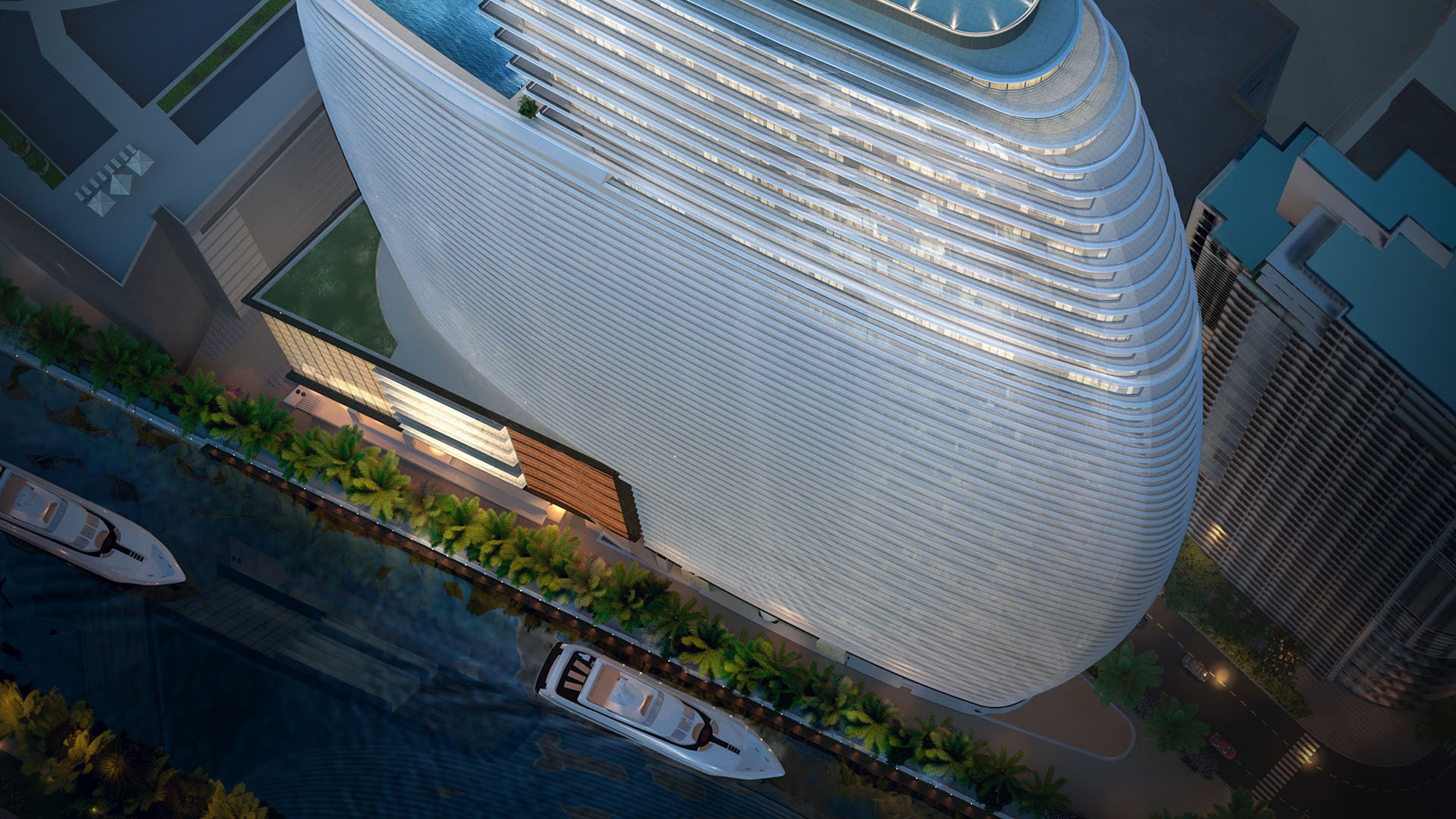
Aston Martin Residences ranks first because its marine proposition is integrated into the completed tower. The property incorporates an exclusive superyacht marina with approximately 900 linear feet of dockage, a 15-foot draft, and access through Biscayne Bay and Government Cut.
Its defining advantage is route geometry. From the mouth of the Miami River, a yacht can proceed toward open water without encountering a bridge. Earlier marina descriptions referenced 490 linear feet rather than 900, so buyers should confirm the current dock configuration, actual berth availability, vessel limits, and precise legal form of any use or transfer right.
2. Epic Residences / Epic West Condo - 200 Biscayne Boulevard Way
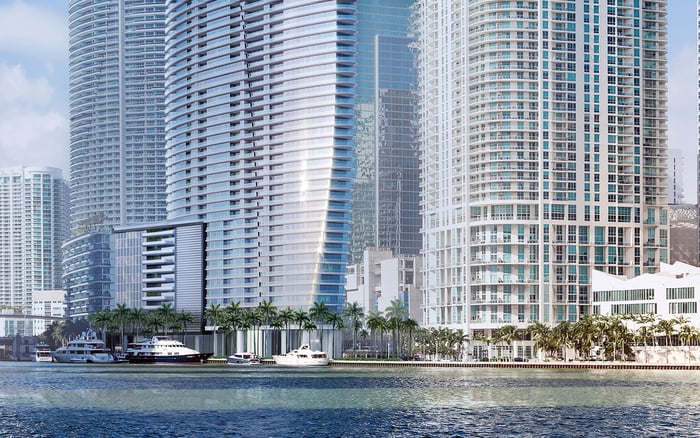
Epic stands beside large-vessel transient dockage at the mouth of the Miami River. With no intervening bridge before Biscayne Bay, the location offers compelling navigational logic for tall yachts that might be constrained elsewhere.
The distinction is legal and operational. Epic Marina is a transient or drop-off facility capable of receiving vessels of approximately 300 feet or more, not an automatically included deeded-slip program for residences. The condominium purchase and any dockage arrangement should be evaluated independently.
3. Waldorf Astoria Residences Miami - 300 Biscayne Boulevard
This planned branded tower ranks third for its road proximity to Yacht Haven Grande on Watson Island, approximately a 7- to 10-minute drive away. The marina can accommodate yachts up to approximately 550 feet and has a dockside depth of 27 feet.
The property facts do not document an on-site residential marina. Its appeal therefore lies in pairing a refined Downtown residence with separately secured large-yacht berthing. Contract duration, renewal provisions, assignment rules, utilities, insurance requirements, and vessel acceptance remain central considerations.
4. One Thousand Museum by Zaha Hadid - 1000 Biscayne Boulevard
One Thousand Museum offers a similar two-part ownership model. The architect-branded tower is approximately a 7- to 10-minute drive from Yacht Haven Grande and is also near Miamarina at Bayside.
Miamarina provides approximately 130 slips and a dockside depth of 10 feet, making it better suited to conventional recreational yachts than to the largest superyachts. Berthing depends on a separate marina arrangement rather than an on-site slip conveyed with the residence.
5. Downtown Miami and Watson Island corridor - separate-marina strategy
The fifth position encompasses the broader branded-residence catchment spanning the Downtown waterfront and Watson Island corridor. Its practical yacht bases are Yacht Haven Grande for very large vessels and Miamarina for more conventional recreational craft, each subject to separate availability and marina contracts.
This model can suit an owner who prioritizes residential brand, architecture, or skyline position while accepting a short transfer between home and yacht. It is less compelling for a buyer who requires the berth to form part of the same transferable real-estate interest.
Berth length and depth matter, but the lowest fixed bridge along the complete route determines whether a yacht can reach open water. Across much of the Atlantic Intracoastal Waterway, fixed bridges generally provide about 65 feet of vertical clearance. Miami’s Julia Tuttle Causeway is approximately 56 feet, while the A1A fixed bridge at Haulover provides approximately 32 feet.
Those clearances can eliminate an otherwise attractive route for a yacht with a tall mast, tower, antenna array, or other superstructure. The critical measurement is the vessel’s actual air draft under operating conditions, assessed against every fixed bridge between berth and ocean. Tide, water level, route direction, and any operational limits should also be confirmed before selecting a residence around a marina plan.
This is why bridge-free access from the Miami River mouth carries such weight. It removes a major navigational constraint, though not the need for diligence on channel depth, dockside depth, turning room, beam, utilities, security, or marina rules.
In branded residences, the word “marina” can describe very different legal relationships. A buyer should determine whether the berth is a deeded parcel, limited common element, license, lease, club privilege, or transient access. The governing documents should also establish whether it can be sold or assigned with the residence, transferred separately, rented, inherited, or revoked.
For Aston Martin, the integrated facility warrants review of the condominium declaration, marina agreement, amendments, berth allocation, fees, vessel specifications, and assignment provisions. For Epic, Yacht Haven Grande, or Miamarina, the safer assumption is that the home and berth are separate transactions unless recorded documents establish otherwise.
Technical review should address vessel length overall, beam, air draft, operating draft at low tide, power and water service, fueling arrangements, tender procedures, storm protocols, insurance, crew access, and waiting-list exposure. The objective is not simply to secure a place beside the water, but to align the residence, vessel, route, and legal right in one workable ownership plan.
Aston Martin offers the clearest combination of integrated dockage and bridge-free ocean access, subject to verification of the current marina configuration and transferable rights. Epic is compelling for transient large-vessel arrival, while Waldorf Astoria and One Thousand Museum support a separate-berth strategy centered on Watson Island or Bayside. Across all five choices, waterfront prestige is strongest when legal control and navigational reality are evaluated together.
For confidential guidance on aligning a Downtown Miami residence with your yacht profile, connect with MILLION.
If branded residences are on your mind — as a home or as an allocation — we would be glad to share what we are seeing, privately.
Begin a quiet conversationUsually not. Buyers should verify whether a berth is deeded, licensed, leased, assignable, transient, or simply an amenity.
Aston Martin Residences incorporates an exclusive superyacht marina, but berth availability and legal rights still require document-level review.
It combines integrated marina access with a bridge-free route through Biscayne Bay and Government Cut, plus a reported 15-foot draft.
Current property marketing describes approximately 900 linear feet, while earlier descriptions referenced 490 feet. Buyers should confirm the present configuration.
The adjacent Epic Marina is characterized as transient or drop-off dockage, not an automatically transferable deeded-slip program.
The lowest fixed bridge on the complete route can determine whether a yacht reaches open water, regardless of berth length or marina depth.
The fixed bridge is approximately 56 feet, below the roughly 65-foot clearance common along much of the Atlantic Intracoastal Waterway.
The A1A fixed bridge at Haulover has approximately 32 feet of clearance, restricting many taller yachts.
Both are identified as approximately a 7 to 10-minute drive from the Watson Island marina.
Yes, unless recorded documents establish transferable rights. This is especially important when relying on Epic Marina, Yacht Haven Grande, or Miamarina.