A buyer-focused examination of water-risk documentation at Aston Martin Residences and Faena Residences Miami, separating construction allegations from verified system specifications and outlining the records needed to evaluate protection and response.

For a Downtown Miami buyer, confidence in a residence should extend beyond its finishes to what happens when water appears where it should not. Detection, isolation, and restoration are distinct capabilities. An alarm does not establish automatic shutoff, and a service promise does not establish a timed emergency response.
The buyer files for Aston Martin Residences Downtown Miami and Faena Residences Miami Downtown Miami therefore demand careful distinctions. Aston Martin’s water-related construction-defect allegations must be distinguished from established conditions. This buyer file does not establish a comparable leak-detection, automatic-shutoff, or damage-response specification for either project. Neither circumstance supports a conclusion that one project offers superior protection.
The appropriate standard is documentary: identify what is installed, what it controls, who acts, and how each action is recorded. For branded residences, the brand experience and the water-response infrastructure warrant separate scrutiny.
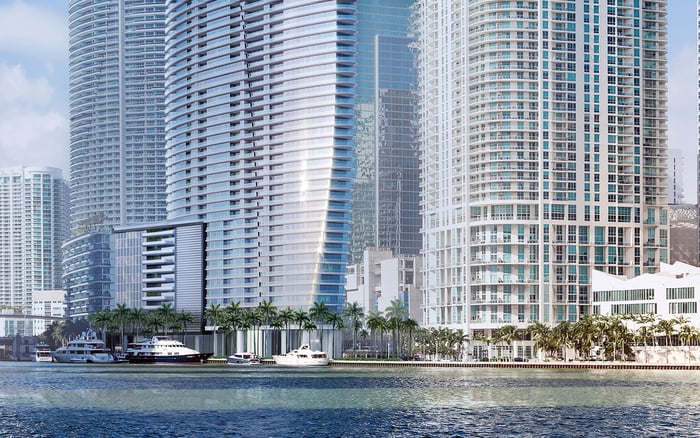
Aston Martin Residences stands at 300 Biscayne Boulevard Way and contains 391 residences across 66 stories. The water-related allegations addressed in this buyer file include waterproofing deficiencies, plumbing problems, and fire-protection-system issues. They concern balconies, the pool, spa, water features, and fire-protection components.
Other alleged conditions include concrete cracking, spalling, exposed reinforcement, unsealed openings, and post-tension-system issues. Some balconies allegedly had drainage slopes that could direct water toward building surfaces rather than away from them. The allegations also include active or historical leakage around pool and water-feature areas, alongside corrosion concerns.
These remain allegations, not adjudicated findings. This account should not be treated as confirmation of the current legal or repair status. Before drawing conclusions about an individual residence or the building, a buyer should request current claim information, engineering assessments, repair documentation, and any subsequent testing.
This buyer file does not establish a detailed unit-level leak-detection or automatic-water-shutoff specification for Aston Martin. Nor does it establish a published response-time guarantee for emergency isolation, drying, remediation, or restoration.
The distinction is essential: an undisclosed system is unverified, not necessarily absent. Older marketing information should not be treated as evidence of equipment installed or operating today.
For Faena, this buyer file likewise does not establish technical specifications for the same protections. It would be equally inappropriate to assume comprehensive automation or to assume no protection exists. Request project-specific specifications and clarify whether each feature is proposed, contractually committed, installed, commissioned, or operational.
Apply the same questions when considering Waldorf Astoria Residences Downtown Miami within a broader search. This is a diligence standard, not a claim about that project's equipment or performance.
Ask for a sensor-location schedule identifying the spaces and equipment covered within the residence. Have the technical team explain whether detection relies on local moisture sensors, flow monitoring, or another specified approach. The purpose is to establish actual coverage, rather than accept a general description such as smart-home protection.
Next, confirm whether the residence has a dedicated water shutoff valve and whether it closes automatically after a qualifying event. Request the valve location, the conditions that trigger closure, and the procedure for testing and reopening it. Clarify which supply lines it controls and which systems remain outside its reach.
Monitoring requires a separate answer. Determine whether an alert reaches only an owner's phone, a staffed building desk, a professional monitoring service, or some combination. Ask what happens when the owner is traveling, an alert goes unanswered, or connectivity is interrupted.
A useful buyer file pairs specifications with commissioning records and current test or maintenance logs. Where documentation remains unclear, classify the capability as unverified rather than filling the gap with an assumption.
A unit plumbing control does not, by itself, establish protection against balcony drainage problems, building-envelope intrusion, or leakage from pools and water features. At Aston Martin, the alleged concerns extend beyond interior plumbing to envelope, drainage, and aquatic-feature conditions.
Buyers should separate the unit-level inquiry from the common-element inquiry. For the residence, review plumbing controls and any documented water-loss history. For shared areas, request relevant engineering assessments, maintenance records, repair scopes, and evidence of completed corrective work.
Ask whether identified conditions were investigated, what repairs were authorized, and how completion was evaluated. Board minutes and maintenance contracts can help connect a technical finding to a decision and subsequent work. The objective is to understand the documented condition and response without treating every allegation as proven or every repair as conclusive.
A meaningful response standard should describe the sequence from alarm to incident closure. Request written procedures covering alarm routing, acknowledgment, dispatch, water isolation, after-hours escalation, drying, remediation, restoration, and owner notification.
For each stage, ask who is responsible and whether a defined time commitment exists. Distinguish an operational target from a contractual obligation. An assurance that someone is available around the clock does not establish how quickly water will be isolated or remediation will begin.
Request the access procedure for an unoccupied residence and the authority required to engage emergency contractors. Ask how the incident is documented, how owners receive updates, and what evidence is retained before repairs conceal affected areas. These are diligence questions, not representations that either project follows a particular protocol.
The most useful package brings together governing documents, system specifications, turnover and engineering assessments, maintenance contracts, relevant board minutes, and water-loss or repair records. Have appropriate legal and technical advisers reconcile any differences between marketing language, contractual commitments, and operational evidence.
For Aston Martin, that means evaluating the water-related allegations alongside current condition and corrective-work documentation. For Faena, it means establishing actual specifications and response commitments rather than inferring them from positioning. The defensible comparison is not which name sounds more reassuring, but which protections and responsibilities can be demonstrated in writing.
For a discreet conversation about your Downtown Miami search, connect with MILLION.
If branded residences are on your mind — as a home or as an allocation — we would be glad to share what we are seeing, privately.
Begin a quiet conversationAston Martin Residences is located at 300 Biscayne Boulevard Way in Downtown Miami. The condominium contains 391 residences in a 66-story tower.
This buyer file describes allegations, not adjudicated findings. Buyers should obtain current legal and corrective-work documentation rather than assume the historical status remains unchanged.
This buyer file does not establish a detailed unit-level automatic-shutoff specification. That leaves the capability unverified, not necessarily absent.
This buyer file does not establish Faena's technical standards for detection, shutoffs, or damage response. A superiority claim is therefore unsupported.
Detection and automatic isolation are separate capabilities. Ask whether a qualifying alert actually triggers a dedicated shutoff valve and which supply lines it controls.
A unit plumbing shutoff does not by itself establish protection against balcony drainage, envelope intrusion, or pool and water-feature leaks. Those conditions require separate investigation.
Confirm who receives alerts and whether monitoring is local, app-based, staffed, or professionally managed. Ask how unanswered alerts and after-hours incidents are escalated.
This buyer file does not establish a published response-time guarantee for isolation, drying, remediation, or restoration. Request current written commitments.
Request governing documents, system specifications, turnover and engineering assessments, maintenance contracts, relevant board minutes, and water-loss or repair records.
Older marketing materials should not be treated as proof of current installed equipment or operating standards. Seek current specifications, commissioning records, and maintenance or testing documentation.