In South Florida, the most sought-after gated addresses increasingly treat privacy as a system, not a promise. Buyers looking beyond prestige are prioritizing layered access control, quiet arrival sequences, limited points of entry, and identity-based credentialing that reduces reliance on easily shared fobs, cards, and gate codes. This guide frames what “discretion” and “biometric security” realistically mean in residential settings, then ranks ten communities that are widely recognized for privacy-forward living and controlled access. While specifics vary by association rules and vendor choices, the through-line is the same: fewer touchpoints, fewer unknowns, and a lifestyle designed to stay out of the spotlight.
In ultra-premium South Florida, security is less about optics and more about choreography. The most discerning buyers aren’t asking for louder gates or larger guardhouses. They want fewer variables: limited access points, managed visitor flow, and a residential environment that keeps daily routine private.
Discretion is a lifestyle feature. You feel it in the arrival sequence, the way guests are verified, the scheduling of vendors, and how sites are oriented to reduce sightlines from public roads and waterways. Biometric security belongs in this conversation because it replaces shareable credentials with identity-based verification. Used with restraint, it can reduce credential leakage and tighten access at high-sensitivity points such as amenity levels, private elevators, and resident-only lobbies.
“Biometric” is often used as shorthand, but in practice it can refer to several distinct systems:
Facial recognition at controlled entrances or turnstiles.
Fingerprint readers on doors that separate public and private zones.
Iris recognition in high-security environments.
Voice authentication used for concierge or call-box confirmation.
In residential communities, the best results come from selective deployment. Buyers should expect associations to balance security with frictionless living-especially for families, guests, and household staff. Biometric checkpoints work best when paired with clear protocols, modern camera coverage, and a well-managed credential system for everyone who touches the property.
Before focusing on any single technology, evaluate the environment it operates within. High-discretion communities tend to share five fundamentals:
Limited points of entry. Fewer entrances generally mean tighter control.
Structured guest management. Visitor pre-registration and clear rules reduce improvisation.
Service separation. Deliveries and vendors move through designated paths when possible.
Low-visibility streetscapes. Mature landscaping, setbacks, and controlled sightlines matter.
Governance with teeth. Rules are only as strong as enforcement, especially around short-term use, vendor access, and amenity behavior.
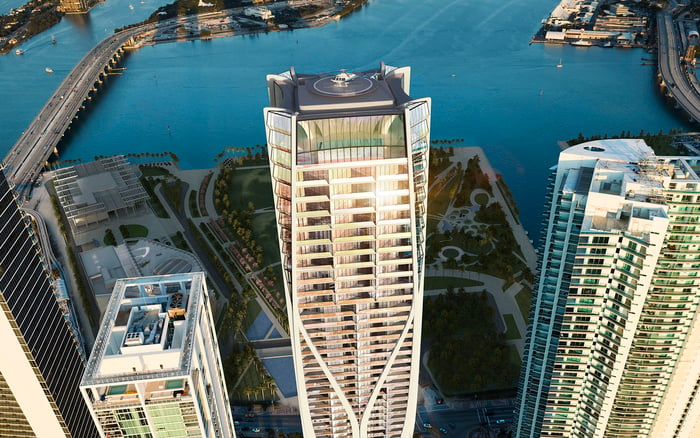
For buyers weighing a gated single-family enclave versus a high-security condominium, remember that discretion can be vertical, too. In Brickell, certain boutique towers emphasize lobby privacy, resident-only circulation, and controlled amenity access. A project such as 2200 Brickell illustrates the appeal of a smaller residential profile in an urban core where visibility is part of daily life.
Below are ten South Florida communities widely recognized for privacy-forward living and controlled access. Biometric features can vary by building, association policy, and vendor selection, but each entry reflects an ecosystem where discretion is a primary value.
1. Fisher Island - island-only access and tightly controlled arrivals
Fisher Island is the archetype of low-access living: an enclave where arrival is curated. Physical separation from the mainland naturally limits through-traffic, while private infrastructure supports a quieter, more predictable rhythm.
For buyers who prioritize discretion, the appeal isn’t just exclusivity-it’s reliability. Fewer unknown visitors, fewer incidental encounters, and a setting where high-touch staffing can be organized and consistent. Nearby residential options such as The Links Estates at Fisher Island reflect the island’s orientation toward privacy and controlled circulation.
2. Indian Creek - guarded entry and minimal public exposure
Indian Creek’s reputation is built on strict access control and a limited perimeter, a combination that supports a privacy-first lifestyle. The community’s scale and singular identity reinforce an environment where unplanned access is the exception.
Biometric technology, where present in residential ecosystems, is best viewed here as an enhancement to already controlled ingress and egress. For buyers, the higher-order question is operational: how staff, contractors, and guests are managed-because that is where discretion is won or lost.
3. Bay Harbor Islands (select waterfront enclaves) - calm streets, controlled access culture
Bay Harbor Islands offers a quieter counterpoint to nearby high-visibility corridors, with a residential tone that favors privacy and routine. While not uniformly “gated” in the traditional master-planned sense, many buyers treat the area as a discretion play because the lifestyle is inherently lower-friction and lower-profile.
For a wellness-forward, boutique approach to privacy, projects like The Well Bay Harbor Islands can align with buyers who want controlled access, attentive staffing, and a calmer arrival experience-without sacrificing proximity to Miami’s center of gravity.
4. Bal Harbour (guarded luxury pockets) - limited corridors and high-expectation governance
Bal Harbour’s luxury culture is defined by high standards and a preference for quiet living. While the security posture differs by building and street, the broader environment supports discretion through controlled circulation and a resident base that values privacy.
Newer luxury development in the area, including Rivage Bal Harbour, reflects buyer demand for secure lobbies, managed access, and amenity zones that feel intentionally separated from public movement.
5. Key Biscayne (guard-gated and island-minded living) - fewer entry routes, more control
Key Biscayne’s geography does some of the work: limited access routes can make traffic patterns more predictable, and the community tends to operate with an island sensibility. Buyers drawn here often want a family-forward setting with privacy that feels natural rather than performative.
Biometric security in this context is most valuable when it reduces reliance on shared credentials and strengthens resident-only zones. The larger advantage is the island rhythm: fewer outsiders, fewer spontaneous disruptions.
6. Pinecrest (select gated estates) - estate-scale setbacks and low-visibility streets
Pinecrest appeals to buyers who use space as a privacy tool. Larger lots, deeper setbacks, and layered landscaping can reduce sightlines and soften the exposure that can come with high-profile architecture.
In gated pockets, the best discretion comes from layering: gates, long driveways, camera coverage, and guest procedures that keep arrivals calm and controlled. Biometrics, if used, typically make the most sense at the home level for secure internal zones rather than at community-scale gates.
7. Coral Gables (select guarded enclaves) - heritage streets with modern security expectations
Coral Gables offers a distinct kind of discretion: a legacy setting where the streetscape itself feels composed. In its most controlled enclaves, the privacy advantage comes from continuity, predictable traffic, and strong neighborhood norms.
For buyers who want proximity to the city without sacrificing an insulated daily routine, the Gables can provide a measured alternative. Nearby boutique residential development such as Cora Merrick Park speaks to demand for controlled-entry living in a classic, residential context.
8. Sunny Isles Beach (high-security oceanfront towers within controlled footprints) - vertical gating
Sunny Isles Beach is often discussed for skyline and beachfront access, but for the right buyer it can also function as vertical gated living. In well-run towers, security is experienced through resident-only circulation, controlled elevator access, and amenity separation.
Biometrics can be especially relevant in vertical environments where lobbies, elevators, and amenity floors are the pinch points. For those drawn to branded privacy and high-touch staffing, Bentley Residences Sunny Isles reflects the market’s move toward curated, resident-centric access.
9. Boca Raton (select guard-gated clubs and estates) - structured entry and community rules
Boca Raton’s gated landscape can deliver what many privacy-minded buyers value most: consistency. Strong associations, established security routines, and amenity cultures that emphasize member experience can keep day-to-day life predictable.
Discretion here is often governance-driven. The best communities make guest access simple but controlled, and vendor activity routine rather than improvisational.
10. Palm Beach (select gated and guarded enclaves) - quiet power and low visibility by design
Palm Beach has long treated discretion as a cultural norm. In its most controlled enclaves, privacy is reinforced by limited access, strong neighborhood expectations, and a preference for understated movement.
Where biometrics enter the picture, they tend to function as a high-grade credentialing layer-not a headline feature. For buyers who want refined privacy with modern residential infrastructure nearby, the broader market includes options such as Alba West Palm Beach that speak to secure, service-oriented living on the mainland side of the equation.
A privacy-first buyer should ask questions that reveal process-not marketing:
Where are the biometric checkpoints, and what happens when they fail?
Who can enroll new identities, and what approvals are required?
How are guests handled, including frequent visitors and household staff?
Is there a secure alternative method that does not degrade the system?
The most discreet communities treat exceptions as part of the plan. The goal isn’t to create friction; it’s to eliminate improvisation-because improvisation creates exposure.
Even the best technology is only as strong as the human layer operating it. Discretion depends on training, turnover, and clarity of rules. Buyers should pay attention to how the property feels at the point of entry. Calm is a telltale sign of a system that has been rehearsed.
In the highest-discretion settings, you will also notice what isn’t happening: no chaotic delivery traffic, no public congregation in threshold spaces, and no casual access to resident-only zones.
South Florida offers three distinct privacy archetypes:
Island seclusion: fewer access routes and naturally limited traffic.
Guard-gated estate living: space, setbacks, and controlled entry points.
Vertical privacy: secure lobbies, controlled elevators, and resident-only amenity layers.
The right choice depends on what you want to protect: identity, routine, or visibility. Many buyers find the most effective solution is a blend, pairing a low-profile primary residence with a secure pied-à-terre for convenience.
What makes a gated community truly discreet? Discretion comes from limited entry points, enforced guest rules, and low-visibility design.
Is biometric security safer than key fobs? It can be, because biometrics are harder to share, but it should be one layer in a broader system.
Where do biometrics make the most sense in luxury buildings? At pinch points like resident-only lobbies, elevator access, and amenity floors.
Can a community be private without biometrics? Yes. Strong access control, staffing, and governance can deliver privacy without it.
What is the biggest privacy risk in gated living? Poorly controlled guests, vendors, and deliveries can create exposure even behind gates.
Should I worry about biometric data storage? You should ask how enrollment is managed, who has access, and how exceptions work.
Do islands automatically provide better security? They often reduce access variables, but daily operations and enforcement still matter.
How do I assess a community’s security culture during a visit? Watch the entry sequence, guest handling, and whether resident-only areas stay controlled.
Can vertical towers feel as private as gated estates? Yes, when circulation is resident-only and amenity access is tightly managed.
What should I request before closing in a high-security community? Ask for written guest policies, staff access rules, and a clear credentialing process.
To compare the best-fit options with clarity, connect with MILLION Luxury.
If branded residences are on your mind — as a home or as an allocation — we would be glad to share what we are seeing, privately.
Begin a quiet conversation