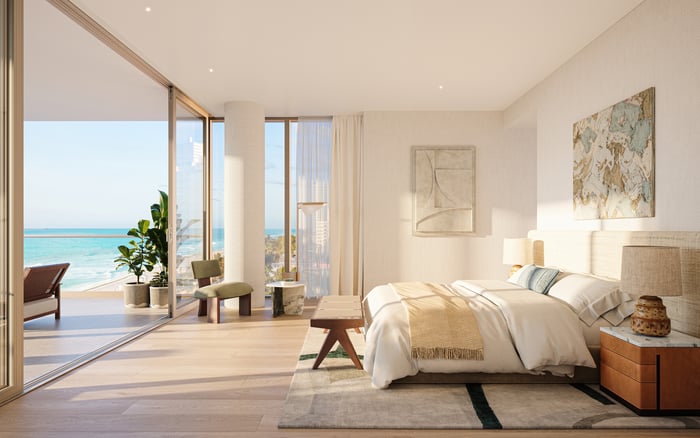
A discreet buyer’s framework for evaluating South Beach residences through the lens of art placement, environmental discipline, service access, and building delivery protocol.

For the South Beach buyer with serious art, a residence is not simply a place to live. It is a private setting for stewardship, presentation, and movement. A beautiful room can fail if the walls cannot receive weight with confidence, if glazing creates uncontrolled exposure, or if the delivery route turns every installation into a negotiation with the building.
The real test is quieter than a view corridor or a finish package. It asks whether ownership will feel composed after closing, when a crate arrives, an installer needs a staging area, and a favorite work requires a stable wall that does not compete with speakers, thermostats, or door swings. In this sense, art-readiness is not decoration. It is infrastructure.
South Beach adds another layer. Buyers are often balancing coastal lifestyle, compact urban access, privacy expectations, and service coordination. In the language of search and ownership shorthand, South of Fifth, Sofi, Miami Beach, Art-basel, New-construction, and Penthouse are not just labels. They point to different expectations around arrival, scale, ceiling height, views, entertaining, and the way a collection can live within a residence.
An art-ready wall is not merely a broad white surface. It is a system of structure, proportion, lighting, and adjacent circulation. During a private showing, buyers should slow down in the rooms that appear easiest to furnish. The most obvious wall may be interrupted by returns, outlets, switches, speakers, air grilles, or millwork. A secondary wall may offer more calm, better distance, and a cleaner approach from the entry sequence.
The first question is capacity. A buyer does not need to rely on assumptions during a tour. The stronger approach is to request clarity on wall composition, allowable anchoring, and any building or association rules that affect installation. Large works, dimensional pieces, and specialty mounts require more than enthusiasm. They require documentation and a building team that understands why precision matters.
The second question is scale. Some rooms photograph as generous but leave little uninterrupted plane once furniture, circulation, and view orientation are considered. A collector should stand where guests will stand, then where the owner will sit each morning. If the art is only visible from a pass-through, the wall is not performing at its highest level.
South Florida residences demand a careful reading of light. Buyers should look beyond brightness and consider direction, reflection, and seasonal variation. A residence can feel luminous and still require a thoughtful lighting plan for works on paper, photography, textiles, or sensitive materials. Even when a buyer intends to use protective glazing or conservation framing, the room itself should not force constant compromise.
Artificial lighting deserves equal attention. A refined residence should allow layered illumination rather than a single decorative gesture. Ceiling conditions, track possibilities, dimming zones, and the distance between fixtures and walls all influence whether a piece can be lit with restraint. Harsh glare, uneven washes, and competing decorative fixtures can make important works feel secondary.
Climate is another part of the ownership test. Buyers should ask how consistently the residence can maintain interior comfort, how air movement interacts with art walls, and whether storage areas are appropriate for temporary holding. The point is not to turn a home into a museum. It is to ensure that daily living does not create avoidable stress for the collection.
For art-focused buyers, the loading path is as important as the living room. Before contract, the buyer’s team should understand how large items enter the property, where vehicles may stop, which routes are approved, and how far a crate must travel before reaching the residence. A pristine lobby is not a logistics plan. A service entrance without adequate scheduling flexibility can still create friction.
Freight elevator access should be reviewed in practical terms. Buyers should ask about dimensions, protective padding, reservation procedures, hours, staffing, certificates of insurance, and whether simultaneous moves or building events can limit availability. The right residence is supported by a building culture that treats controlled delivery as normal, not exceptional.
Staging is often overlooked. Installers may need a place to uncrate, inspect, assemble, or temporarily hold packing materials. If a building requires all work to happen within a narrow time window, the buyer should know that in advance. The same applies to after-hours rules, weekend limitations, dock access, and the process for bringing in specialized vendors.
A serious buyer should tour the residence twice: once emotionally and once operationally. The emotional tour confirms whether the home has the right atmosphere. The operational tour tests whether ownership will be easy. Bring a floor plan if available, mark possible art walls, note every obstruction, and walk the route from building entry to the primary display areas.
In the main living space, test sightlines from the entry, terrace doors, seating areas, and dining positions. A significant work should have room to breathe. If the room demands that every major wall be assigned to television, storage, or circulation, the collection will become a guest rather than a defining presence.
In bedroom corridors, studies, and foyers, consider smaller works. These spaces often shape the private character of a residence. They also reveal how disciplined the architecture is. A well-planned hall can become an intimate gallery sequence, while a poorly interrupted one leaves little more than fragments.
The strongest questions are direct. What is behind the primary art walls? Are there restrictions on drilling, hanging, or specialty installation? Can the building provide freight elevator dimensions and service rules? How much notice is required for deliveries? Are there approved vendor protocols? Where can crates be staged? What insurance documentation is required before access is granted?
Buyers should also ask how future renovations would be handled. Lighting, millwork, reinforced backing, and specialty storage may be part of a post-closing plan. Even if the residence is visually complete, collection-driven ownership may require subtle adjustments. The difference between a good purchase and a great one is often the ability to refine without unnecessary resistance.
Association rules, staff communication, and management responsiveness matter. A buyer does not need a building that says yes to everything. A buyer needs a building that can explain the process clearly, apply it consistently, and coordinate with professionalism.
A residence passes when the art plan, the living plan, and the service plan align. The walls feel intentional. The light can be controlled. The delivery path is known. The building rules are legible. The buyer can imagine not only the first installation, but the fifth, the seasonal rotation, and the quiet arrival of a newly acquired piece.
This is where South Beach ownership becomes more nuanced than square footage or finish quality. For the buyer who cares about art, the residence must support a private rhythm of acquisition, installation, care, and display. Beauty still matters, but beauty without logistics is fragile.
Treat these questions as part of due diligence, not as afterthoughts. The most elegant homes are those that allow complex ownership to feel effortless.
What makes a South Beach residence art-ready? It should offer usable wall planes, controllable light, stable interior comfort, and a practical path for delivery and installation.
Should buyers inspect walls before making an offer? Yes. Buyers should request clarity on wall composition, anchoring rules, and any restrictions that affect installation.
Why do freight elevators matter for collectors? Large works, crates, and specialty installers need predictable access. Elevator size, reservation rules, and staffing can shape the entire ownership experience.
Is natural light always a benefit for art display? Not always. Brightness should be balanced with exposure control, glare management, and the needs of specific materials.
Can a beautiful residence still be difficult for art logistics? Yes. A refined interior can still have constrained service access, limited staging space, or rules that complicate delivery.
What should buyers ask building management? Ask about service entrances, freight dimensions, delivery hours, insurance requirements, vendor access, and staging procedures.
Do penthouse residences automatically work better for collections? Not automatically. A Penthouse may offer scale, but buyers still need to test walls, light, elevator access, and installation routes.
How should buyers evaluate hallways and foyers? They should look for uninterrupted surfaces, comfortable viewing distance, and lighting that can support smaller works with subtlety.
Are post-closing improvements common for art-focused owners? They can be useful. Lighting refinements, reinforced walls, and discreet storage adjustments may improve long-term collection care.
What is the best mindset for this type of purchase? Treat the residence as both a home and an operating environment for valuable objects, with logistics considered from the beginning.
To compare the best-fit options with clarity, connect with MILLION.
If branded residences are on your mind — as a home or as an allocation — we would be glad to share what we are seeing, privately.
Begin a quiet conversation