A discreet buyer’s guide to Coral Gables for collectors, design patrons, and families who want calm residential architecture with practical access to Miami’s cultural core.
Quiet luxury in South Florida is not simply a matter of finishes, pedigree, or a recognizable address. At its best, it is a discipline of daily life: calm arrivals, shaded streets, proportionate architecture, and the ability to participate in Miami’s cultural calendar without living inside its volume. For buyers who care about art, collectible design, private dinners, and the gravitational pull of the Design District, Wynwood, and Miami Beach, Coral Gables makes a distinct case.
The appeal is not that Coral Gables imitates Miami’s more visibly branded neighborhoods. It does the opposite. Its value lies in restraint. Homes are often judged less by spectacle than by site planning, gardens, privacy, room scale, and the quality of restoration or new construction. For a buyer who wants proximity to galleries, fairs, showrooms, and restaurants, but prefers a home environment that feels composed rather than performative, Coral Gables remains one of Miami’s most durable answers.
This is especially relevant for collectors and design-driven families who do not want to choose between culture and quiet. The city offers a residential rhythm that can feel removed from the intensity of Miami’s social corridors, while remaining connected enough for spontaneous evenings, advisor appointments, or a week anchored around Art Basel.
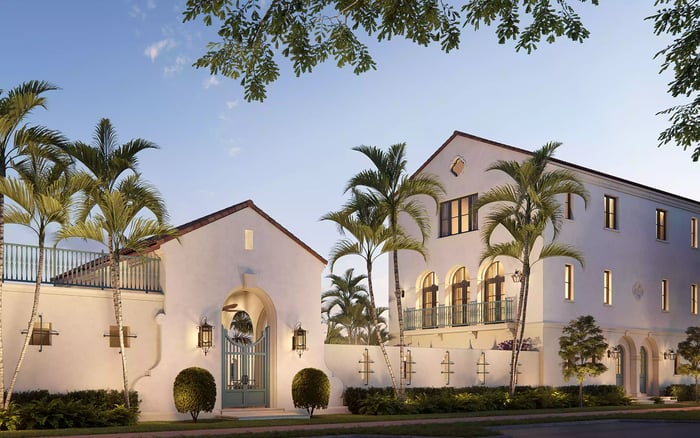
In many luxury markets, status is expressed through height, frontage, or brand alignment. In Coral Gables, it is often expressed through discretion. A compelling property may reveal itself slowly: a deep setback, mature landscaping, a restrained entry sequence, a gracious stair, a library that actually works, or terraces designed for conversation rather than display.
That sensibility matters to buyers coming from denser urban luxury environments. The point is not to abandon Miami’s energy. The point is to control when it enters the home. Coral Gables supports that boundary. Its residential fabric gives owners a sense of arrival distinct from pulling into a tower porte cochere or stepping directly from nightlife into a lobby. The privacy is physical, but also psychological.
This is where Coral Gables earns its place in the ultra-premium conversation. It offers a version of Miami living confident enough to be quiet. For some buyers, that is the ultimate luxury: not withdrawal, but selectivity.
The buyer considering Coral Gables is not necessarily choosing domestic seclusion. Many are highly engaged in Miami’s cultural and design ecosystem. They may visit galleries, commission interiors, host visiting artists, attend fair-week dinners, or maintain relationships with dealers and makers. For this audience, proximity still matters, but it is judged differently.
The question is not whether a home is steps from a gallery opening. The question is whether a buyer can reach the cultural core without compromising the character of home life. Coral Gables sits well in that equation for those who prefer a calmer base. It keeps the design world accessible while preserving a residential setting that feels private, established, and less reactive to trends.
Wynwood and the Design District reward immediacy. Brickell rewards access to finance, dining, and vertical luxury. Miami Beach rewards ocean proximity and social cadence. Coral Gables rewards continuity. For the buyer who attends selectively, collects seriously, and entertains with intention, that continuity may be more valuable than constant adjacency.
A design-aware buyer in Coral Gables should look beyond surface styling. The strongest homes tend to have a coherent architectural language, not just expensive materials. Proportion, circulation, ceiling height, natural light, landscape integration, and the relationship between formal and informal rooms all matter. A home can be newly improved and still feel unresolved if its plan does not support modern living.
Renovation quality is equally important. Quiet luxury is unforgiving because it has fewer distractions. Millwork, stone selection, lighting temperature, door hardware, window systems, and acoustic comfort become more visible when the design is restrained. Buyers should evaluate whether the details are genuinely considered or simply upgraded.
Outdoor space deserves the same scrutiny. In Coral Gables, the garden is often part of the architecture. Covered terraces, courtyards, pool placement, and privacy planting can determine whether a property feels gracious or exposed. For families who entertain collectors, designers, and international guests, these transitions between interior and exterior spaces may define the experience of the home.
Coral Gables is not trying to compete with every South Florida luxury address on the same terms. That is part of its strength. Compared with Brickell, it offers a more residential posture and less vertical intensity. Compared with Coconut Grove, it may feel more formal and civic in character, while the Grove often reads as more bohemian, tropical, and village-like. Compared with Miami Beach, it trades immediate ocean culture for privacy, gardens, and a sense of permanence.
For buyers mapping lifestyle rather than simply price, these distinctions are essential. A family with children, household staff, art storage needs, and a preference for quiet evenings may evaluate Coral Gables differently than a buyer prioritizing resort amenities or branded residences. The right decision depends on how culture is used. If art and design are part of life but not the stage on which life must constantly be performed, Coral Gables becomes especially persuasive.
There is also a portfolio logic. Some ultra-high-net-worth buyers maintain a beach residence, a city apartment, or a seasonal home elsewhere. In that context, Coral Gables can function as the grounded Miami residence: elegant, private, and less susceptible to the shifting fashion of newly hot corridors.
Luxury buyers often speak in terms of views, finishes, and square footage, but daily friction is just as important. The most successful Coral Gables purchase reduces that friction. It should make school routines, private appointments, dinners, airport movements, and cultural evenings feel manageable. A beautiful home that works poorly in daily life is not quiet luxury. It is decoration with inconvenience attached.
This is why location within Coral Gables should be judged with precision. Two properties can offer very different lives depending on street character, access patterns, lot configuration, and surrounding context. A buyer should visit at different times of day, understand the arrival sequence, and consider how guests, service providers, and family members will move through the property.
The same applies to new-construction and renovated homes. Newness alone is not the point. The best version of new or newly reimagined Coral Gables living respects privacy, scale, and architectural discipline. It should not feel like a showroom transplanted into a historic residential environment.
The quiet luxury case for Coral Gables is strongest for buyers who already understand Miami’s cultural geography and do not need their home to prove participation. They want access to the art world, the design conversation, and the social calendar, but they also want a residence that restores equilibrium. That combination is increasingly rare.
In MILLION’s taxonomy, this sits at the intersection of Coral Gables, Coconut Grove, Brickell, Wynwood, Art Basel, and new construction, but the emotional center is unmistakably residential. Coral Gables is for buyers who value a graceful edit. It is for people who know that the most compelling room at the party is sometimes the one they return to after leaving it.
Is Coral Gables a good fit for art and design collectors? Yes. It offers a calm residential base while keeping Miami’s cultural and design destinations within practical reach.
Does Coral Gables feel too removed from Miami’s energy? Not for buyers who prefer selective access. The neighborhood is better suited to those who want to engage with the city on their own terms.
What defines quiet luxury in Coral Gables? Privacy, proportion, landscape, architectural coherence, and low-friction daily living define the strongest properties.
Should buyers prioritize renovated homes or new construction? Both can work. The key is execution, including layout, material quality, light, acoustics, and respect for the setting.
How does Coral Gables compare with Brickell? Brickell is more vertical and urban. Coral Gables offers a more residential, private, and composed lifestyle.
How does Coral Gables compare with Coconut Grove? Coconut Grove often feels more tropical and informal. Coral Gables usually reads as more formal, planned, and restrained.
Is Coral Gables mainly for families? Families are a major audience, but the neighborhood also suits collectors, executives, seasonal owners, and privacy-focused buyers.
What should design-focused buyers inspect first? Start with proportion, circulation, natural light, ceiling heights, millwork, landscape design, and the quality of recent improvements.
Does proximity to Art Basel matter for Coral Gables buyers? It can, especially for collectors and patrons. The advantage is access without making fair-week intensity part of everyday home life.
What is the biggest mistake when buying in Coral Gables? Overvaluing surface upgrades and undervaluing setting, privacy, street character, and the way the home functions day to day.
For a discreet conversation and a curated building-by-building shortlist, connect with MILLION.
If branded residences are on your mind — as a home or as an allocation — we would be glad to share what we are seeing, privately.
Begin a quiet conversation