A discreet buyer’s guide to evaluating porte-cochère design, chauffeur waiting areas, and arrival privacy in South Florida’s luxury residential market.
In South Florida luxury real estate, the private-driver test is simple: can a resident arrive, pause, transfer bags, greet a guest, and disappear into the building without friction or unwanted exposure? The answer is rarely found in brochure language. It is found in the geometry of the porte-cochère, the choreography of valet and security, and the dignity extended to drivers who may wait for hours rather than minutes.
For buyers accustomed to chauffeurs, executive protection, visiting family offices, or simply a highly managed lifestyle, arrival privacy is not a decorative flourish. It is part of the residence’s operating system. A magnificent penthouse can still feel compromised if the arrival court is shallow, the lobby is overexposed, or the driver must circle the block while a principal finishes a meeting upstairs.
That is why the most discerning walk-throughs begin before the elevator. In Brickell, for example, buyers comparing vertical luxury at The Residences at 1428 Brickell will naturally study not only views and finishes, but also how the arrival sequence supports a more private urban routine.
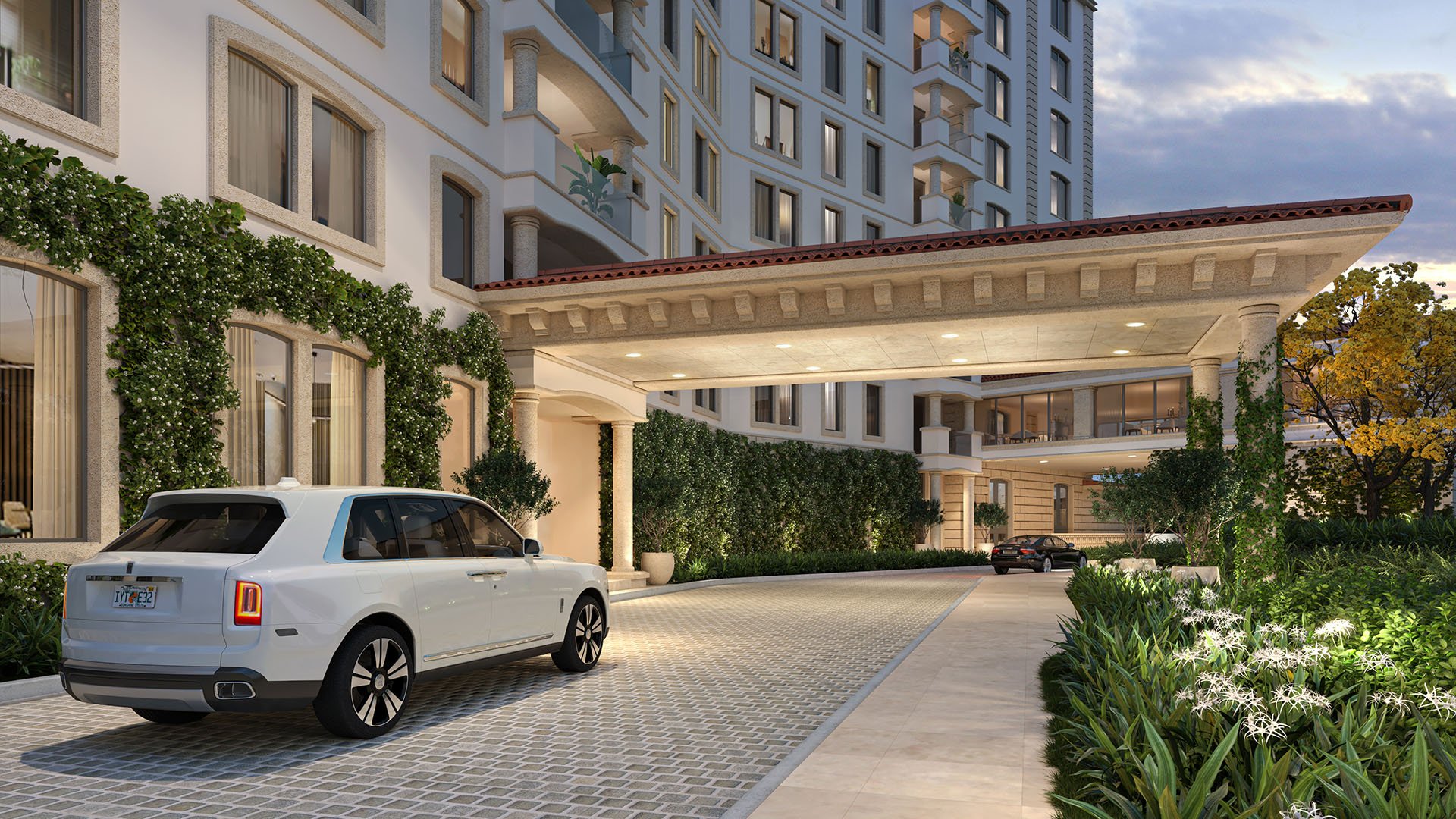
A porte-cochère is not merely a covered driveway. At its best, it is a transition chamber between the public street and private life. It should reduce weather exposure, soften traffic noise, support luggage handling, and allow the resident to move from vehicle to lobby without feeling staged for an audience.
The first question is capacity. Can more than one vehicle pause without blocking the next? Can a family car, a chauffeured sedan, and a guest arrival coexist without confusion? In a luxury building, the porte-cochère should not rely on improvisation. It should make each movement legible: where the car stops, where the door opens, where valet stands, where luggage goes, and where the resident proceeds.
The second question is sightline control. A dramatic glass lobby can be beautiful, but privacy often depends on what cannot be seen from the curb. The best arrival courts create a sense of enclosure without becoming fortress-like. Landscaping, columns, canopy depth, lighting, and angled approaches can all create discretion while preserving elegance.
A residence that accommodates private drivers well is usually designed around the resident’s real life. Chauffeurs need a logical place to wait, communicate, and re-enter the arrival sequence without obstructing valet or residents. If the driver has no place to pause, the burden shifts back to the owner through delays, phone calls, and repeated repositioning.
For buyers, the practical test is direct. Ask where a driver waits during dinner, school pickups, medical appointments, spa visits, and evening events. Ask how the building handles multiple private cars at peak times. Ask whether waiting is on-site, nearby, formally managed, or left to street conditions. The answer reveals how seriously the property treats daily service.
This matters across property types. In island environments, the question may be calm access and controlled approach. At The Residences at Six Fisher Island, buyers thinking about Fisher Island living will instinctively consider privacy as part of the broader residential rhythm, from arrival to retreat.
Many buyers focus on the private elevator, but privacy begins earlier. The sequence starts with the street approach, then the turn into the property, the canopy, the door opening, the handoff to staff, the lobby path, the elevator vestibule, and the final residence entry. A weakness at any point can make the entire experience feel public.
A strong sequence offers options. A resident may want to be seen when hosting, but unseen when returning from travel. A building should accommodate both moods. It should allow a formal arrival when appropriate and a quiet passage when discretion matters.
Security should also feel integrated rather than theatrical. Overly visible control points can make an arrival feel institutional. Subtle staffing, clear vehicle recognition, and intelligent circulation often create a more luxurious impression. Privacy is strongest when it feels effortless.
A buyer can learn a great deal in five minutes at the curb. Watch how vehicles stack. Notice whether doors open comfortably. Observe whether valet staff must step into traffic. Look at where luggage carts are staged. Study whether pedestrians, cyclists, delivery vehicles, and resident cars share the same conflict points.
Time of day matters. A porte-cochère that feels serene at noon may behave differently during school runs, dinner departures, stormy afternoons, or event nights. If private-driver use is central to the lifestyle, the arrival should be observed under pressure, not only during a polished showing.
In coastal and resort-like settings, the same logic applies with a softer visual language. Buyers considering Miami Beach addresses such as The Perigon Miami Beach may weigh how arrival discretion complements beach access, hospitality-style service, and a calmer residential identity.
There is no single perfect porte-cochère. The right answer depends on context. In dense urban neighborhoods, the goal is often precision: quick recognition, efficient off-street movement, and a lobby sequence that buffers the intensity of the city. In waterfront or garden settings, the goal may be ceremony: a slower turn, a softened canopy, and a more gracious reveal.
Coconut-grove buyers often respond to a more residential cadence, where arrival should feel composed rather than commercial. At Four Seasons Residences Coconut Grove, the name itself places the buyer in a service-oriented frame of mind, making the quality of arrival an important part of the overall expectation.
Sunny Isles buyers may think differently again, especially when towers meet beachfront living and frequent guest arrivals. At St. Regis® Residences Sunny Isles, a buyer’s private-driver test should consider how brand-level service expectations translate into the everyday act of entering and leaving home.
The most refined buyers ask operational questions early. How does the building handle a resident with a full-time driver? What happens when several residents return at once? Are guests directed to the same entry as residents? Where do rideshare vehicles stop? Is there a separate path for deliveries and service? How is privacy maintained when events or holiday gatherings increase volume?
The answers do not need to be theatrical. In fact, the best answers are usually calm, specific, and practical. A property team that can clearly explain the arrival sequence is often a property team that understands how luxury actually functions.
The private-driver test is ultimately about respect for time. A great residence minimizes waiting, ambiguity, and exposure. It allows the owner to arrive without performance, depart without delay, and trust that the space between street and sanctuary has been designed with the same care as the residence itself.
What is the private-driver test in luxury real estate? It is a practical way to evaluate whether a residence supports chauffeured arrivals, waiting, privacy, and smooth daily movement without friction.
Why does porte-cochère design matter to buyers? It shapes the first and last moments of each day, especially for residents who value discretion, efficiency, and sheltered transfers.
Is a covered driveway enough? Not always. True luxury arrival design also considers vehicle stacking, sightlines, staff choreography, luggage handling, and privacy.
What should I ask about driver waiting areas? Ask where a driver waits, how re-entry is handled, and whether the system works during peak arrival and departure times.
How can I judge privacy during a tour? Study what is visible from the street, how exposed the lobby path feels, and whether residents can enter without crossing public activity.
Do urban buildings need different arrival solutions? Yes. Urban luxury often depends on efficient off-street circulation, fast recognition, and a calm buffer from surrounding traffic.
Do coastal residences have different priorities? Often, yes. Coastal arrivals may emphasize ceremony, landscape, weather protection, and a relaxed transition into private resort-style living.
Should guest and resident arrivals be separated? Separation can be valuable, but the key is clarity. Guests, residents, service providers, and valet should not compete for the same space.
Can arrival design affect resale appeal? For privacy-focused buyers, yes. A graceful and efficient arrival sequence can strengthen the perceived quality of the entire property.
When should I evaluate the porte-cochère? Visit during active periods when possible, because the best test is how the arrival performs under real daily pressure.
If you'd like a private walkthrough and a curated shortlist, connect with MILLION.
If branded residences are on your mind — as a home or as an allocation — we would be glad to share what we are seeing, privately.
Begin a quiet conversation