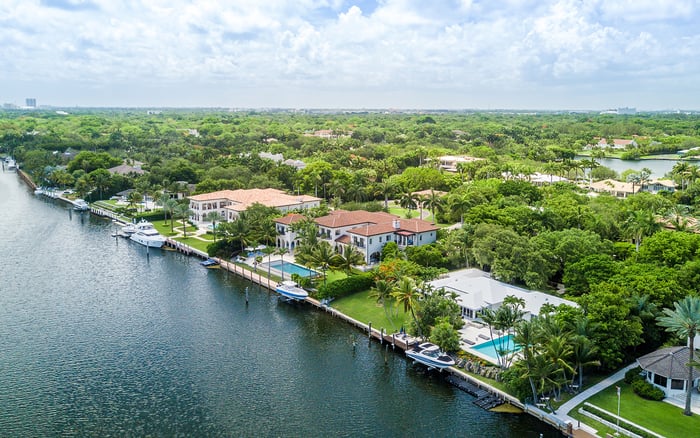
A discreet framework for evaluating staff access across South Florida condos, estates, and private islands, with emphasis on privacy, circulation, vendor control, and daily household rhythm.

For ultra-prime buyers, staff access is not a secondary operational detail. It shapes how a residence lives every day. A home may be architecturally exceptional, beautifully positioned, and finished with rare materials, yet still feel compromised if housekeepers, chefs, drivers, estate managers, security teams, nannies, contractors, and visiting wellness professionals must move through the same ceremonial spaces as family and guests.
The most successful properties treat service circulation as a form of discretion. The purpose is not to hide the people who make a home function. It is to give every role a logical path, a defined arrival point, and a way to operate without friction. In South Florida, where buyers may compare waterfront towers, gated estates, and island residences in a single search, the differences can be substantial.
A condominium offers structure and managed protocol. An estate offers control and customization. A private island introduces arrival logistics, layered privacy, and a greater need for planning. The right choice depends less on prestige than on the rhythm of the household.
In a luxury condominium, staff access is governed by the building as much as by the residence itself. Buyers should understand how vendors enter, where deliveries are received, which elevators may be used, and how long contractors can remain on site. These questions matter most for households with frequent entertaining, daily staff, private chefs, or regular wardrobe, art, floral, and wellness services.
A well-run tower can deliver a polished experience because expectations are standardized. The concierge, security desk, loading area, and management office can become part of the household’s support system. The tradeoff is shared infrastructure. Service elevators, receiving rooms, parking access, and dock or garage entries may follow rules that serve the building efficiently but do not always align with one family’s preferences.
In dense urban settings such as Brickell, this becomes especially important. Buyers considering residences such as The Residences at 1428 Brickell or St. Regis® Residences Brickell should evaluate not only the private floor plan, but the complete sequence from curb or garage to residence. The question is simple: can staff work elegantly within the building’s operating culture?
Single-family estates generally offer greater autonomy. Owners can determine how staff arrive, where vehicles stage, how deliveries are accepted, and how exterior circulation is organized. For families with full-time household teams, that control can be invaluable. A thoughtful estate may allow service vehicles to enter without interrupting guest arrival, provide practical storage and prep areas, and preserve a clear distinction between public, family, and operational zones.
The risk is assuming that land alone solves access. Some estates were designed for visual grandeur rather than operational depth. A long driveway may be beautiful, but if every vendor, staff member, guest, and delivery vehicle uses the same route, privacy can suffer. Similarly, a spectacular kitchen may entertain beautifully but function poorly for chefs if it lacks service support, staging space, or discreet paths to dining and outdoor areas.
When comparing estates with condominium residences, buyers should ask whether the home has true back-of-house logic. This can include separate staff entries, laundry access, utility corridors, secondary stairways, staff parking, and a practical relationship between kitchen, garage, service court, pool, and guest areas. In private residential settings, elegance is often measured by what guests never notice.
Private islands and island-style enclaves raise the staff-access conversation to another level. The core issue is no longer only how people move through the residence. It is how they reach the property, how access is authorized, and how daily service remains dependable without diluting privacy.
On an island residence, the arrival sequence can involve multiple thresholds. Staff may pass through a community gate, marina, ferry, bridge, private dock, or security checkpoint before reaching the home. Each layer can enhance privacy, but each also requires planning. Owners should consider how early-morning housekeeping, late-night drivers, catering teams, maintenance vendors, and emergency repairs are handled when access depends on more than a simple street address.
For buyers drawn to Fisher Island, residences such as The Residences at Six Fisher Island invite a particularly careful review of arrival choreography. The priority is not only exclusivity. It is predictability. Staff access should feel secure, legible, and repeatable, with clear instructions that do not require the owner to intervene in ordinary daily operations.
The most useful comparison begins with a household map. Who comes to the property daily, weekly, seasonally, and for special events? Does the owner employ live-in staff, daytime staff, rotating vendors, a property manager, private security, or visiting specialists? Does the home host formal dinners, extended family stays, school-age children, pets, or art and wardrobe maintenance?
Once that map is clear, the buyer can compare three categories. First, physical circulation: where staff enter, park, wait, store supplies, and move vertically. Second, administrative control: who authorizes access, how vendors are registered, and whether recurring staff can be pre-cleared. Third, privacy preservation: whether staff and guests have overlapping paths at sensitive moments.
In Miami Beach, for example, a buyer reviewing The Perigon Miami Beach may place particular emphasis on elevator programming, receiving procedures, and the distinction between resident arrival and service movement. In Coral Gables, a buyer considering The Village at Coral Gables may focus more on the relationship between street, garage, home entry, and daily domestic routines. The asset type changes the questions, but the objective remains constant: seamless living without unnecessary exposure.
Staff access is often discussed in mechanical terms, but the human factor is just as important. The best properties make it easy for trusted people to do their jobs with dignity and clarity. Confusing routes, inconsistent instructions, and improvised approvals create stress for staff and inconvenience for owners. A strong access plan reduces both.
Security should feel calm rather than theatrical. Buyers should look for systems that distinguish between family, guests, recurring staff, one-time vendors, and deliveries. Too little control can expose the household. Too much rigidity can make the home difficult to run. The ideal balance is quiet certainty: the right people arriving through the right path at the right time.
This is where condominium management, estate management, and island administration differ. A condo may provide a professional operating framework with less owner-specific flexibility. An estate may provide maximum control, but require the owner to create the system. A private island may provide exceptional discretion, but require more coordination around movement and timing.
A serious buyer should walk the property as staff would. Enter through the service point, ride the designated elevator, stand in the loading area, open the staff door, inspect the path to kitchen and laundry, and consider where a florist, chef, driver, or maintenance technician would wait. In an estate, trace the route from gate to garage to service entry. On an island, test the full journey from mainland arrival to the front door.
The strongest residences do not merely accommodate staff. They anticipate them. For a seasonal owner, this can determine whether the home is ready on arrival. For a family in residence year-round, it can define the texture of daily life. For a collector, frequent host, or executive with security needs, it can mark the difference between a beautiful property and a genuinely livable one.
Terms such as gated community and single-family home are useful shorthand, but they do not replace close inspection. A gated estate may still lack service separation. A condominium may outperform a house if its management culture is exceptional. A private island may be sublime if access is well choreographed, or cumbersome if it is not.
What is staff access in a luxury residence? It is the complete system for how household staff, vendors, drivers, security, and service providers enter, move through, and support a property.
Why does staff access matter in a condominium? Condos rely on shared systems such as service elevators, loading areas, security desks, and building rules, all of which affect daily convenience.
Are estates always better for staff access? Not always. Estates offer more control, but the design must still support discreet entries, parking, storage, and back-of-house movement.
What makes private island staff access different? Private islands add arrival logistics, access authorization, transportation timing, and contingency planning to the usual household flow.
Should buyers ask about service elevators? Yes. In a condo, service elevators can determine how efficiently staff, deliveries, contractors, and event teams move without disrupting residents.
How should frequent entertainers evaluate access? They should study catering routes, vendor staging, guest arrival, valet or driver flow, and the connection between kitchen and entertaining areas.
Is a separate staff entrance essential? It is highly valuable, especially for larger households, but the full circulation plan matters more than the entrance alone.
Can strong building management improve staff access? Yes. Clear protocols, responsive management, and predictable approvals can make a condominium feel highly efficient for staffed households.
What should seasonal owners prioritize? They should focus on pre-arrival preparation, trusted vendor access, property management coordination, and secure delivery procedures.
What is the best way to shortlist comparable options for touring? Start with location fit, delivery status, and daily lifestyle priorities, then compare stacks and elevations to validate views and privacy.
When you're ready to tour or underwrite the options, connect with MILLION.
If branded residences are on your mind — as a home or as an allocation — we would be glad to share what we are seeing, privately.
Begin a quiet conversation