A discreet comparison of The Links Estates at Fisher Island and Oceana Bal Harbour for buyers prioritizing acoustic comfort, technology control, and remote-work privacy.
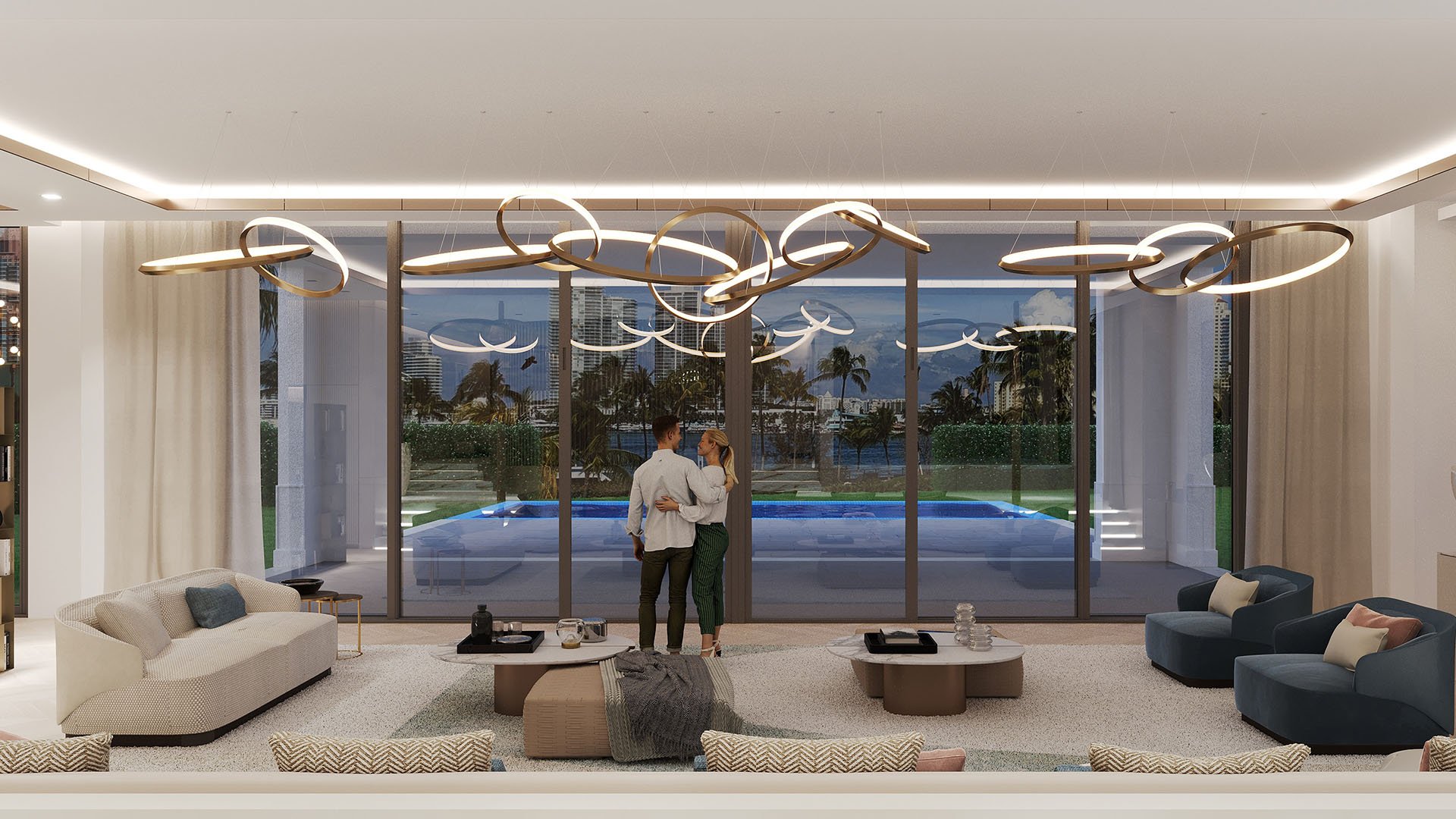
For South Florida’s ultra-prime buyer, the most consequential residential questions are no longer limited to frontage, finishes, or arrival sequence. The deeper conversation sits inside the walls, across the plan, and within the ownership structure itself. How quiet is the residence when the market is not watching? How much control does the owner have over technology infrastructure? Can a principal take confidential calls, run a global family office, or move through a board meeting without feeling the presence of neighbors, staff, guests, elevators, or shared systems?
That is the useful distinction between The Links Estates at Fisher Island and Oceana Bal Harbour. One is best understood as an estate-based ownership model within Fisher Island’s private residential context. The other is a condominium-tower model in Bal Harbour. Both appeal to sophisticated buyers, but they solve privacy, sound, and infrastructure in fundamentally different ways.
This is not a ranking. It is a question of fit. A buyer who wants maximum control over the private envelope may read one model differently from a buyer who values a serviced tower, curated amenity life, and a lock-and-leave rhythm by the ocean.
The Links Estates at Fisher Island is framed here as an estate-based ownership model rather than a conventional condominium building. That distinction matters because estate ownership begins with spatial separation. There is no typical shared-wall condition to evaluate in the same way one would assess a tower residence. The ownership experience is considered through site planning, building-envelope decisions, landscape buffering, and the organization of interior zones for family, staff, guests, and work.
For acoustic comfort, the estate model’s advantage is not a guaranteed technical rating. It is the capacity to shape the problem. A buyer can focus diligence on custom construction choices, room placement, glazing strategy, mechanical locations, and the relationship between private outdoor areas and adjacent activity. In a large estate, a principal’s office can potentially be removed from entertaining areas, family bedrooms, service corridors, and guest circulation in a way that is far more difficult to replicate in a standardized condominium stack.
Technology infrastructure follows the same logic. The estate model offers more owner-controlled customization potential than a standardized condominium environment. Buyers focused on enterprise-grade connectivity, discreet equipment locations, dedicated work suites, security integration, audiovisual distribution, or future upgrades may prefer an ownership structure where many decisions can be made at the property level. The appeal is not merely having technology. It is the ability to design around one household’s operating requirements.
For remote-work privacy, the estate model is especially compelling when the residence is also expected to function as a private headquarters. The Links Estates at Fisher Island allows the conversation to move from “Where is the den?” to “How does the entire property work?” Staff circulation, delivery handling, guest arrival, family movement, and principal work zones can be coordinated as one private system. For buyers managing sensitive calls, multiple time zones, and the need to compartmentalize professional and domestic life, that estate-scale control may be the defining luxury.
Oceana Bal Harbour represents a different proposition. It is considered here as a condominium-tower model in Bal Harbour, where the ownership experience is less about isolated control and more about refined convenience within a vertical community.
For many buyers, that is exactly the point. A serviced condominium can deliver a polished daily experience with amenities, staffing, and building operations already embedded into the lifestyle. The tower model can be especially appealing to owners who divide time between residences and prefer a home that feels managed, attended, and immediately usable. Oceanfront living in Bal Harbour carries its own rhythm: views, access, social ease, and proximity to a polished coastal setting.
Acoustic comfort in a tower, however, must be evaluated through tower-specific conditions. Unit adjacency matters. Floor and ceiling assemblies matter. Glazing matters. Elevators, corridors, amenity locations, and shared mechanical systems all become part of the buyer’s diligence. A quiet tower residence is possible, but the sound profile differs from that of an estate. Rather than asking only about distance and envelope control, the buyer studies vertical and lateral neighbors, service patterns, and the building’s shared systems.
Remote-work privacy is also mediated differently at Oceana Bal Harbour. A condominium tower introduces a governance environment, shared access, amenity traffic, elevators, staff presence, guests, and other residents. These elements can support convenience, but they also shape privacy. The question for a remote-work buyer is not whether the building is luxurious. It is whether the specific residence, floor position, plan, and daily circulation patterns align with the owner’s need for discretion.
The acoustic diligence for The Links Estates at Fisher Island starts with estate-scale variables. A buyer would study how the residence sits within its setting, how rooms are distributed, and where quiet functions can be insulated from social or service functions. Reduced shared-wall exposure is a core conceptual advantage. Custom construction choices can further support the desired environment, provided the buyer and advisory team treat sound as a design priority rather than an afterthought.
At Oceana Bal Harbour, diligence is more forensic. A buyer may consider what is above, below, beside, and behind the residence. Is the home near elevator cores or service zones? How do the principal bedroom and office relate to neighboring units? What role does glazing play in oceanfront sound control? How might amenity usage, staff movement, or shared mechanical systems influence the experience at different times of day?
Neither ownership model should be reduced to a simple “quiet” or “not quiet” label. The estate model offers more physical separation and owner-directed design possibilities. The tower model offers the potential for highly refined living, but it asks the buyer to understand the building as an acoustic ecosystem.
For technology-sensitive buyers, ownership structure can be as important as bandwidth. In an estate setting, infrastructure decisions can often be planned around the household’s own priorities. Dedicated work areas, equipment rooms, backup considerations, privacy-oriented layouts, and future cabling pathways can be approached as part of a broader residential system, subject to the actual property, plans, and applicable approvals.
That flexibility is central to the appeal of The Links Estates at Fisher Island. The buyer is not simply selecting a residence within a standard stack. The buyer is evaluating a custom estate environment where technology can be considered alongside architecture, staffing, security, and family operations.
At Oceana Bal Harbour, the value proposition is different. A condominium tower typically operates within standardized building systems, association procedures, and shared infrastructure. For some owners, that is an advantage because it reduces the burden of managing every component independently. For others, especially those with unusually complex remote-work, security, or technology requirements, the question becomes how far the residence can be tailored within the framework of the building.
In market shorthand, this comparison touches Fisher Island privacy, Bal Harbour convenience, oceanfront living, and gated-community expectations. The labels matter less than the operating reality. Buyers should examine how each ownership model supports confidential work, streaming, calls, smart-home controls, and future upgrades without assuming that luxury automatically equals technical readiness.
Remote-work privacy is no longer a secondary feature for high-net-worth buyers. It is part of the architecture of daily life. The modern principal may need a residence that supports video calls before sunrise, private advisory meetings, secure document review, and a quiet transition between family and professional roles.
At The Links Estates at Fisher Island, the advantage is the potential to manage privacy at the estate level. Work areas can be separated from guest entertaining. Staff can circulate without crossing sensitive zones. Family life can unfold without every movement being tied to an elevator lobby or shared corridor. The entire property can be thought of as a privacy map.
At Oceana Bal Harbour, privacy is more curated than isolated. The tower setting can provide service, amenity access, and oceanfront ease, but the buyer should evaluate how the building mediates daily movement. Elevators, lobby procedures, guest access, staff routes, amenity floors, and building governance all shape the lived experience. For some owners, that structure feels secure and effortless. For others, an estate may feel more compatible with confidential work.
The estate buyer is often someone who wants control, discretion, and customization to be built into the property’s logic. The residence may need to operate as a family home, a hosting environment, and a private office compound. This buyer is likely to value separation, quiet zones, and the ability to shape technology and circulation around personal routines.
The tower buyer may prioritize a different kind of luxury: oceanfront immediacy, amenities, thoughtful design, and a serviced residential environment. Oceana Bal Harbour may be more attractive to someone who wants a refined coastal home with managed convenience and less responsibility for every operational layer of the property.
Both choices belong in the upper tier of South Florida residential thinking. The difference is not prestige. It is architecture, governance, and control.
Is The Links Estates at Fisher Island a condominium tower? No. It is addressed here as an estate-based model rather than a conventional condo building.
Is Oceana Bal Harbour an estate community? No. Oceana Bal Harbour is discussed here as a condominium-tower model in Bal Harbour.
Which model may offer more acoustic separation? The estate model may offer more separation because it reduces shared-wall exposure and allows sound planning at the property scale.
Can a tower residence still be acoustically comfortable? Yes. The buyer should evaluate adjacency, glazing, elevators, floor and ceiling assemblies, and shared mechanical systems.
Which option gives more control over technology infrastructure? The Links Estates at Fisher Island may offer more owner-controlled customization potential than a standardized condominium environment.
Why does building governance matter for remote work? Governance can shape alterations, systems, access, staff movement, guest procedures, and the use of shared areas.
Who is best suited to Oceana Bal Harbour? A buyer who values oceanfront living, amenities, service, and a condominium environment may find it compelling.
Who is best suited to The Links Estates at Fisher Island? A buyer seeking estate-level control over space, staff circulation, technology, and work privacy may prefer this model.
Should buyers assume luxury homes are ready for complex remote work? No. Connectivity, privacy, acoustics, and systems should be evaluated carefully before purchase.
Is this comparison mainly about location? No. Location matters, but the core distinction is between estate-scale control and condominium-tower convenience.
To compare the best-fit options with clarity, connect with MILLION.
If branded residences are on your mind — as a home or as an allocation — we would be glad to share what we are seeing, privately.
Begin a quiet conversation