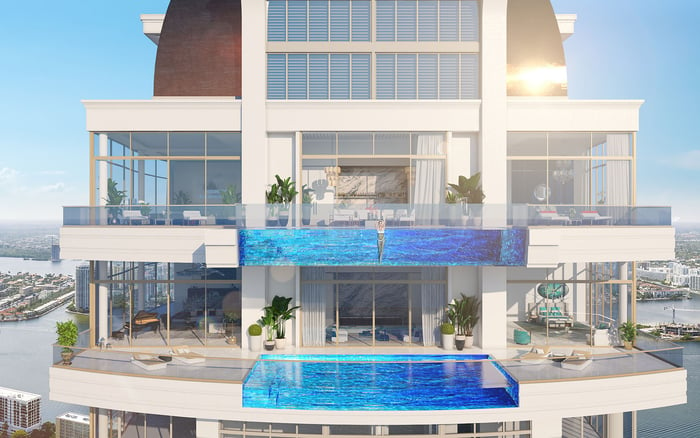
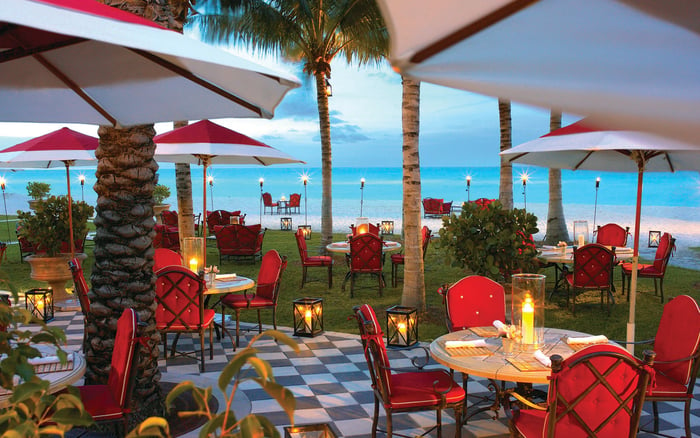
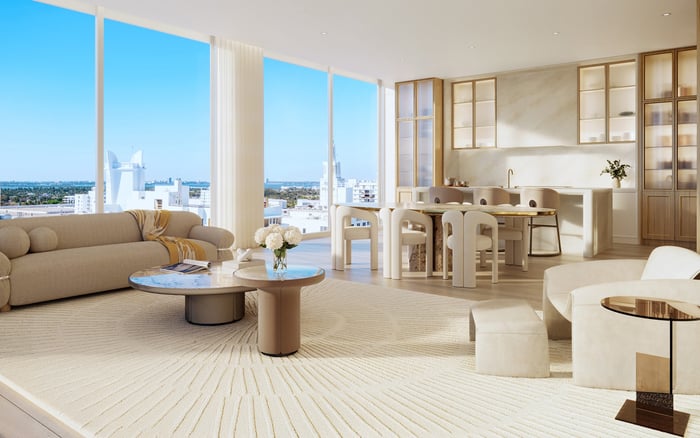
A discreet owner’s guide to evaluating private dining, entertaining flow, and acoustic separation when comparing full-time luxury living in Sunny Isles and South Beach.
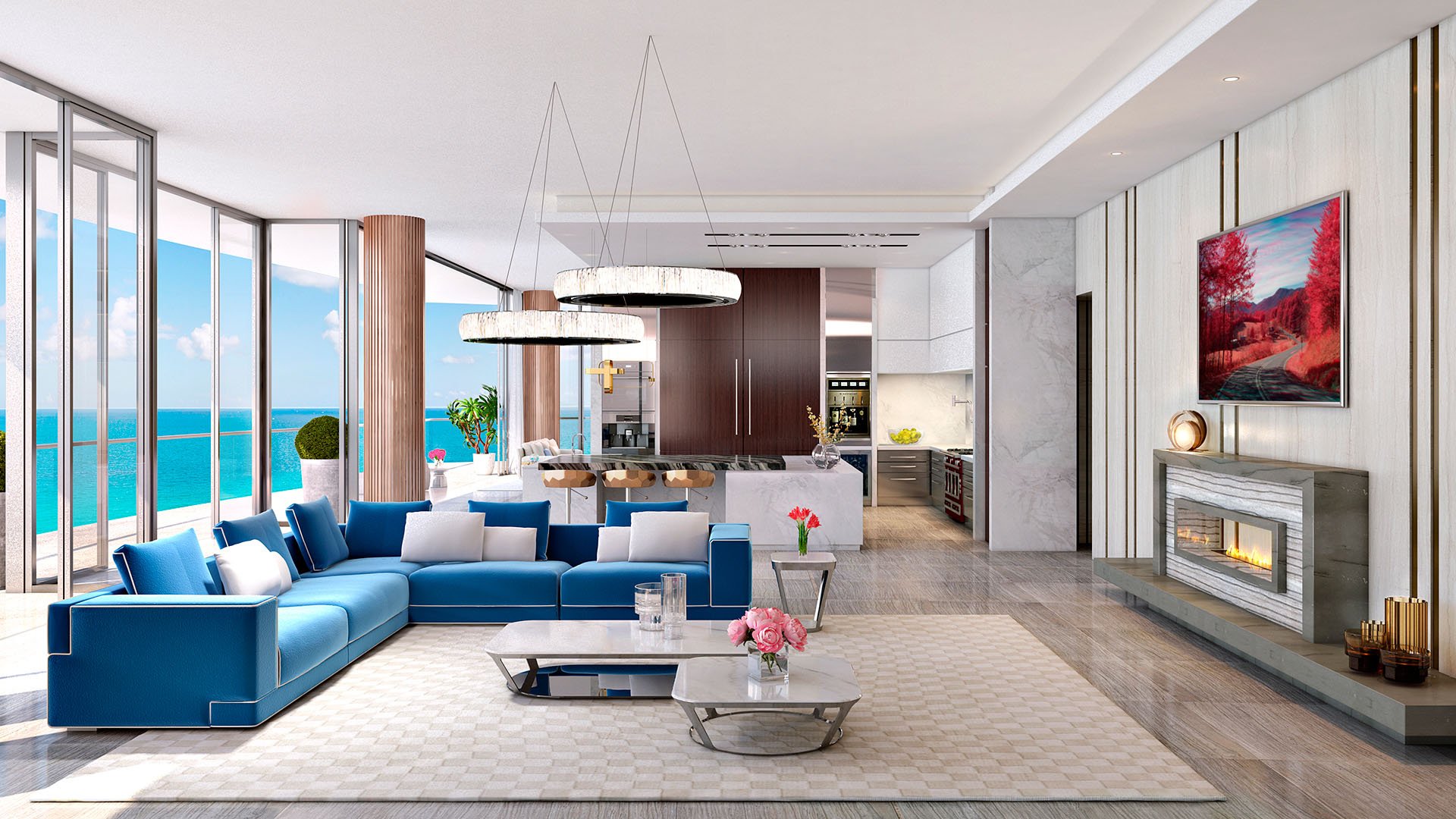
For seasonal buyers, a residence can often be judged by spectacle: the first view, the ceremonial lobby, the terrace at dusk. Full-time owners have a more exacting brief. They need to understand how a home performs on a Tuesday morning, during a family dinner, after a catered evening, and in the quiet hours when privacy becomes the rarest amenity.
That is why a comparison between The Estates at Acqualina Sunny Isles and The Ritz-Carlton Residences® South Beach should not be reduced to glamour alone. The more useful inquiry is operational: how each residence supports private dining, entertaining flow, acoustic separation, and the boundary between household life and social life.
This is especially important for owners moving from large single-family homes, where service circulation, guest arrival, kitchen back-of-house space, and bedroom privacy are often physically separated. In a vertical residence, those same priorities must be achieved through plan discipline, elevator sequencing, amenity policies, and construction details that are not always visible during a brief showing.
Private dining has become one of the most desired ideas in luxury condominium living, but full-time owners should define the term carefully. It may refer to a reservable amenity room, an in-residence dinner prepared by outside staff, a chef’s kitchen suited to entertaining, or a combination of building services and personal household support.
The essential question is control. Owners should ask how far in advance a private dining space can be reserved, whether resident priority changes during holidays, how guest access is managed, and whether service staff can move discreetly without crossing the principal entertaining zones. If a dining program exists, its value lies less in the name of the room than in the predictability of its use.
For residents who entertain often, rules matter. Are outside chefs permitted? Is there a preferred vendor protocol? Can floral, wine, and tableware deliveries arrive through a service route? Is cleanup handled in a way that avoids disrupting the host’s residence? These questions separate a polished concept from a genuinely livable entertaining platform.
At The Estates at Acqualina Sunny Isles, buyers are often evaluating a resort-minded Sunny Isles lifestyle with a high expectation of privacy and service. At The Ritz-Carlton Residences® South Beach, the conversation may lean toward cultural access, dinner-party convenience, and the ability to entertain in a setting closely tied to Miami Beach energy. In both cases, the owner should request confirmed operating procedures rather than rely on atmosphere alone.
Entertaining flow begins before a guest steps inside the residence. Full-time owners should study how visitors are announced, where they wait, how they ascend, and whether the arrival sequence feels ceremonial or congested. The best residences create a sense of arrival while protecting the household from unnecessary exposure.
Inside the home, the plan should allow three movements to happen at once: guests gather, staff serve, and family members retreat. If these paths overlap too tightly, even a beautiful residence can feel compromised during an event. A host should be able to welcome guests without revealing the working kitchen, children’s rooms, private studies, or everyday storage.
Dining and living spaces should connect naturally without collapsing into one undifferentiated room. A gracious flow allows conversation to move from cocktails to dinner to terrace or lounge without forcing every guest through the same narrow point. For larger gatherings, powder room placement, coat storage, and the distance from elevator entry to entertaining space become practical luxuries.
Full-time owners should also consider the day after. Where do rented chairs go before pickup? Can staff stage service items without occupying the family’s main living area? Does the residence have enough concealed storage for entertaining pieces used only a few times a year? These are not decorative questions. They determine whether hosting remains pleasurable or becomes disruptive.
Acoustic separation is one of the least glamorous topics in luxury real estate, yet it has one of the greatest effects on daily satisfaction. A residence can be visually serene and still fail if sound travels too easily between entertaining areas, bedrooms, corridors, mechanical spaces, or neighboring units.
Full-time owners should listen for three categories of sound: exterior sound, internal household sound, and building sound. Exterior sound may include traffic, beach activity, nightlife, wind, or general urban movement. Internal sound includes music, dinner conversation, kitchen work, media rooms, and footsteps. Building sound can come from elevators, refuse rooms, mechanical systems, amenity levels, or adjacent residences.
A serious buyer should visit at different times of day when possible. Morning quiet, afternoon activity, and evening energy can reveal different acoustic profiles. If construction details are available, buyers should ask about glazing, slab design, demising walls, entry door assemblies, and mechanical isolation. The goal is not silence, which is unrealistic in any dynamic coastal setting. The goal is separation, so one zone of life does not intrude on another.
For owners who host frequently, acoustic planning should be tied to the floor plan. Bedrooms should feel protected from the main entertaining axis. A den or media room should not broadcast into guest suites. Elevator arrival should not create sound spill into private rooms. The more full-time the use, the more these details matter.
The choice between Sunny Isles and South Beach is as much about rhythm as geography. Sunny Isles is often associated with a more residential, tower-oriented coastal lifestyle, while South Beach carries a more urban social cadence, with restaurants, culture, and nightlife closer to the daily experience. Those broad patterns should guide, but not replace, residence-level due diligence.
A buyer considering The Estates at Acqualina Sunny Isles may be prioritizing privacy, family-scale living, and a sense of retreat. A buyer considering The Ritz-Carlton Residences® South Beach may be placing greater weight on walkable social energy and proximity to Miami Beach’s cultural texture. Buyers who want a branded Sunny Isles reference point may also review The Ritz-Carlton Residences® Sunny Isles as part of a broader market conversation, but the fit still depends on daily use.
This comparison sits at the intersection of coastal privacy, Miami Beach access, oceanfront living, and second-home planning, even when the final decision is for full-time occupancy. That distinction is important. A residence that works beautifully for occasional visits may not provide enough acoustic calm, service discretion, or storage for daily life.
Owners should therefore walk through a realistic week. Where does breakfast happen? Where does a spouse take a call during a dinner setup? Where do teenagers go when adults are entertaining? Where does staff enter? Where does music stop being enjoyable and start becoming audible in the bedroom wing? The answers will reveal more than the most dramatic rendering.
Before selecting either residence, full-time buyers should ask for clarity in writing whenever possible. Private dining rules, guest policies, service elevator access, delivery hours, amenity reservation protocols, and move-in restrictions all influence the lived experience. What feels minor during purchase can become meaningful once the home becomes a primary address.
The best approach is to test the residence like a host, a family member, and a neighbor. Stand in the kitchen and imagine a chef working. Stand in the primary suite while others gather in the living room. Trace the path from elevator to dining table. Ask how sound, service, and guests move through the building as well as through the residence.
Luxury, in this context, is not only marble, views, or brand identity. It is the ability to entertain generously without surrendering privacy, to dine beautifully without logistical strain, and to live full-time with the quiet confidence that the home can absorb both celebration and routine.
What should full-time owners ask about private dining? They should ask about reservation rules, guest limits, staffing, outside chef access, delivery procedures, and cleanup logistics before assuming the program fits their lifestyle.
Why does entertaining flow matter in a luxury condominium? Entertaining flow determines whether guests, family members, and service staff can move comfortably without crowding the same spaces or exposing private areas.
How can a buyer evaluate acoustic separation during a showing? Visit at different times if possible, listen near bedrooms and entry points, and ask about glazing, wall assemblies, mechanical isolation, and elevator proximity.
Is private dining always better than hosting inside the residence? Not always. A private dining amenity can be useful, but in-residence hosting may offer greater control if the floor plan and service access are strong.
What is the key difference between Sunny Isles and South Beach for owners? Sunny Isles may appeal to buyers seeking a more retreat-oriented coastal rhythm, while South Beach may suit owners who value urban social energy.
Should owners prioritize views or floor plan performance? Views are important, but full-time owners should weigh circulation, storage, acoustics, and privacy just as carefully because those factors shape daily comfort.
What service questions are most important for frequent hosts? Ask how caterers enter, where deliveries are staged, what hours apply, whether service elevators are available, and how guest access is coordinated.
Can a dramatic open plan create problems for entertaining? Yes. An open plan can be beautiful, but it may need careful zoning so dining, conversation, service, and private family life do not conflict.
Why are powder rooms and storage so important? Their placement affects guest comfort, visual order, and post-event cleanup, especially for owners who entertain regularly throughout the year.
What is the best way to shortlist comparable options for touring? Start with location fit, delivery status, and daily lifestyle priorities, then compare stacks and elevations to validate views and privacy.
For a tailored shortlist and next-step guidance, connect with MILLION.
If branded residences are on your mind — as a home or as an allocation — we would be glad to share what we are seeing, privately.
Begin a quiet conversation