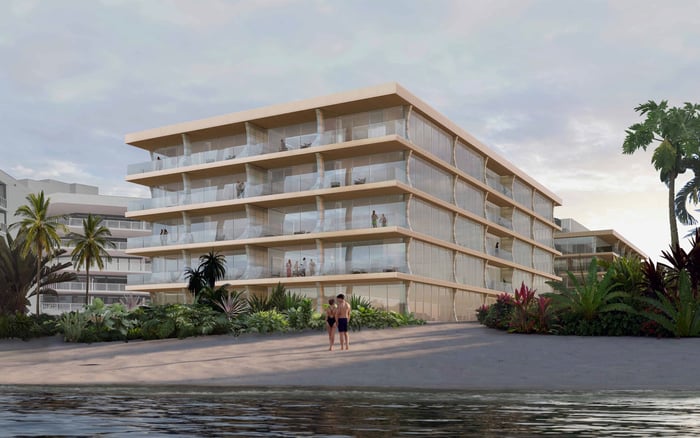
A buyer-focused due-diligence guide to evaluating AI-enabled building services at The Bristol Palm Beach, with emphasis on specifications, privacy, costs, resilience, and contract clarity.

At the top of the South Florida market, technology is increasingly presented as atmosphere: a serene arrival sequence, a frictionless elevator ride, a residence that appears to anticipate light, temperature, security, and service. For buyers considering The Bristol Palm Beach, that promise warrants a more disciplined reading. AI-enabled building services, if offered, should be treated less as a design flourish and more as legal, mechanical, operational, and financial infrastructure.
The central point is simple: a rendering is not a specification. An image may suggest intelligence, privacy, or ease, but it does not confirm what will be installed, who will operate it, who will maintain it, how resident data will be governed, or what happens when a vendor changes. Without confirmed documentation for any specific AI-enabled feature at The Bristol Palm Beach, buyers should verify every technology claim before assigning value to it.
The most useful first request is a complete written specification for any smart-building or AI-enabled system. That means vendor names, hardware models, software platforms, integration points, warranty terms, service-level commitments, and the party responsible for performance after closing. A polished sales phrase such as smart access, intelligent security, adaptive climate, or AI concierge should be translated into a documentable system with a clear scope.
This is especially important in the Palm Beach and West Palm Beach luxury conversation, where presentation can be exceptionally refined. New-construction buyers often underwrite views, finishes, staff quality, parking, and private amenities with care, yet treat digital infrastructure as a lifestyle accessory. It should be examined with the same rigor as elevators, generators, glazing, mechanical systems, reserves, and association budgets.
If an AI-enabled access-control claim appears in sales language or is implied by the building experience, the buyer should ask what is actually being installed. Is entry managed through mobile credentials, key fobs, license-plate systems, biometric hardware, staffed verification, or some combination? If biometrics are mentioned, the question is not simply whether the feature sounds advanced. The question is whether it is mandatory, optional, replaceable, auditable, and supported by clear privacy language.
A serious review should cover opt-in and opt-out policies, resident and guest data retention, backup access during outages, access for domestic staff and service providers, and procedures for revoked credentials. Luxury is not only the absence of friction. It is also the confidence that a resident can control how personal information is used and still enter the building when technology fails.
AI-enabled security can mean many things. It may refer to camera analytics, motion detection, package-area monitoring, entry alerts, anomaly detection, or merely a digital interface used by staff. Buyers should not assume that the word intelligent means a fully integrated, monitored, cybersecurity-hardened system. The better question is: what does the system actually do, where does it operate, and who is watching?
Camera locations, analytics features, monitoring responsibility, cybersecurity controls, and resident privacy disclosures all matter. So do the rules governing amenity spaces, parking areas, elevators, service corridors, and package rooms. In a luxury condominium, the boundary between protection and overreach can be thin. The most valuable buildings define that boundary clearly, in documents residents can understand before closing.
Predictive climate control, adaptive lighting, and energy management can sound elegant in a sales presentation, particularly in a residence where glare, humidity, and solar exposure can shape daily comfort. Yet these claims should be verified through equipment schedules, building-management-system documentation, commissioning reports, and post-occupancy maintenance plans.
Buyers should ask whether intelligence resides inside an individual residence, in common-area systems, in a central building-management platform, or in a third-party application. They should also ask whether systems can be overridden manually, what happens after a software update, and whether replacement components will be commercially available in the future. Ultra-modern comfort is valuable only if it remains serviceable.
An AI concierge may sound like a defining amenity, but the phrase can describe very different realities. It could be a true building-integrated resident-services platform. It could be a third-party app. It could be a chatbot layered over standard messaging. It could also be staff-assisted communication presented in digital form.
The distinction matters because each model carries different costs, service expectations, and liability questions. If residents can book amenities, communicate with staff, approve guests, arrange packages, request valet service, or manage maintenance through one interface, buyers should ask who owns the platform, who controls the data, who trains staff, and what obligations survive a vendor change.
For an investment-minded buyer, technology should be evaluated not only for pleasure, but for durability. Smart-home, access-control, parking, amenity-booking, elevator, package-room, and building-management systems may generate resident data. Buyers should verify who owns that data, how long it is retained, whether it is shared, and how it can be deleted or transferred.
Cost allocation is equally important. AI-enabled systems may be included in the purchase price, funded through association dues, billed through subscriptions, or exposed to future vendor price increases. The cleanest luxury experience is usually the one where operational obligations are transparent before closing. Hidden subscriptions and fragile vendor dependencies can diminish the very ease the technology was meant to provide.
The right posture is not skepticism for its own sake. It is precision. If The Bristol Palm Beach presents technology as part of its residential experience, buyers should welcome the possibility while asking for evidence. What is installed? Who operates it? Who pays for it? What data is collected? What works during outages? What is guaranteed in the governing documents, purchase materials, association disclosures, or vendor agreements?
A rendering can describe an aspiration. A specification describes a deliverable. For South Florida’s most discerning buyers, that difference is where real confidence begins.
Are AI-enabled building services confirmed at The Bristol Palm Beach? Specific AI-enabled services should be treated as unverified unless confirmed in official project, sales, association, or vendor documentation.
What is the first document a buyer should request? Request written specifications naming vendors, hardware, software, warranties, service levels, and post-closing maintenance obligations.
Should facial recognition be assumed if smart access is mentioned? No. Buyers should verify the actual access hardware, consent policies, opt-out rights, data retention, and backup entry procedures.
What should be reviewed for AI-enabled surveillance? Review camera locations, analytics functions, monitoring responsibility, cybersecurity controls, and resident privacy disclosures.
How can buyers test climate or lighting claims? Ask for equipment schedules, building-management-system documentation, commissioning reports, and maintenance plans.
Is an AI concierge always a true integrated building service? Not necessarily. It may be a third-party app, a chatbot, staff-assisted messaging, or a deeper building-integrated platform.
Who may own resident data from smart systems? Ownership should be verified in the relevant agreements for access, parking, amenities, elevators, packages, and building systems.
Can AI-enabled services create future costs? Yes. Costs may appear through association dues, subscriptions, vendor renewals, software updates, or future price increases.
What happens if a technology vendor changes? Buyers should ask whether data, hardware, credentials, warranties, and service obligations can transfer without disrupting residents.
What is the best way to shortlist comparable options for touring? Start with location fit, delivery status, and daily lifestyle priorities, then compare stacks and elevations to validate views and privacy.
For a discreet conversation and a curated building-by-building shortlist, connect with MILLION.
If branded residences are on your mind — as a home or as an allocation — we would be glad to share what we are seeing, privately.
Begin a quiet conversation