A mobility-focused comparison of The Bristol Palm Beach and Nora House West Palm Beach for buyers prioritizing car storage, EV charging, valet flow, and private-driver logistics.

For a certain Palm Beach buyer, a residence is not fully understood until the arrival sequence is understood. Bedrooms matter, as do the view, service culture, and elevator privacy. Yet for collectors, executives, seasonal residents, and families with multiple drivers, the real test begins downstairs: where cars live, how charging is handled, how valets sequence arrivals, and whether a private driver can operate without friction.
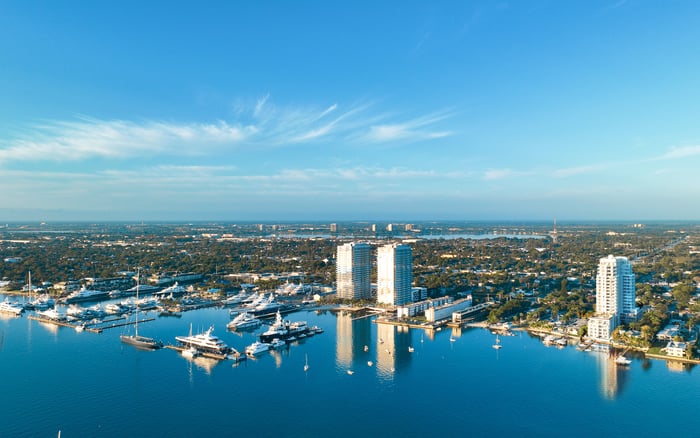
That is the lens for comparing The Bristol Palm Beach with Nora House West Palm Beach. The Bristol is positioned as the ultra-prime waterfront option and, importantly for this discussion, as an established luxury residence. Nora House belongs to a different buyer narrative: a West Palm Beach urban-district setting where walkability, neighborhood energy, and evolving lifestyle infrastructure may carry more emotional pull.
The question is not which name is more glamorous. It is which address better fits a buyer whose daily life depends on vehicle capacity, EV readiness, and chauffeur coordination.
The strongest case for The Bristol is operational maturity. A delivered ultra-luxury condominium gives buyers something that pre-purchase renderings and lifestyle language cannot fully replace: the ability to evaluate the building as it functions. That matters when the issue is not simply parking, but the choreography of arrivals and departures.
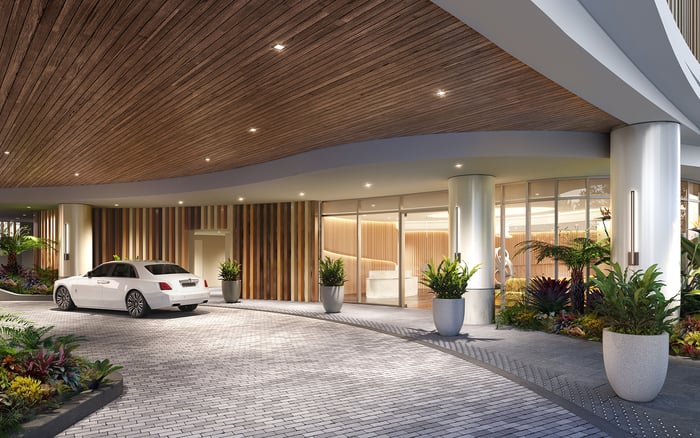
For buyers with multiple vehicles, The Bristol should be examined for parking flexibility, the availability and location of spaces, garage circulation, valet staffing patterns, and the ease with which a guest, driver, or service vehicle can be received. In a waterfront building at this level, the porte-cochère is not just an architectural gesture. It is the building’s social and logistical threshold.
The Bristol’s appeal is clearest for buyers who want the confidence of an already operating luxury environment. If the household includes a daily driver, weekend vehicles, visiting family, and airport pickups, the difference between an elegant arrival and a congested one becomes more than convenience. It becomes part of the residence’s value proposition.
Nora House enters the comparison from a different angle. Its draw is tied to the West Palm Beach urban-district lifestyle, where buyers may value a more neighborhood-oriented routine and proximity to dining, retail, wellness, and cultural movement. For some residents, that can reduce dependence on cars for certain daily outings. For others, it simply changes how cars are used.
That is why Nora House should not be dismissed by mobility-focused buyers. Urban living can be highly efficient when the building’s parking, valet, EV, and pickup areas are designed and managed well. The caution is that buyers should make the mobility package part of the core review rather than a late-stage question. Before choosing Nora House for a multi-car or EV-heavy household, confirm the practical terms: assigned versus unassigned parking, the handling of additional spaces, charging availability, charging location, service protocols, and how private drivers are expected to wait, stage, or return.
For a buyer comparing Palm Beach ease with West Palm Beach urbanity, the practical split is often resale certainty versus new-construction optionality. That does not make one better for every buyer. It makes the due diligence different.
In luxury real estate, “EV charging” can describe very different realities. Buyers should press on whether charging is available at assigned spaces, in shared common areas, through valet-controlled access, or through a limited set of chargers that may become more competitive as adoption increases.
For a single-EV household, shared charging may be sufficient if the building has efficient scheduling and resident-friendly rules. For a household with two or more EVs, or one that expects to transition its full garage over time, scalability becomes central. The best question is not, “Does the building have charging?” It is, “Can this building support my charging needs three, five, and ten years from now?”
At The Bristol, the benefit is that a buyer can evaluate an existing luxury operation and ask precise questions about present-day capacity. At Nora House, the buyer should focus on the stated parking and charging framework before finalizing expectations. Either way, EV readiness should be treated as infrastructure, not an amenity line.
Private-driver logistics are often under-discussed because they feel invisible when they work well. They become obvious only when the driver has nowhere appropriate to wait, a ride-share pickup blocks the arrival court, or valet retrievals stack at the same time as dinner departures.
For households using black cars, family drivers, security-aware transportation, or frequent airport transfers, the building’s arrival plan matters as much as its lobby. Look for a porte-cochère that can accommodate simultaneous movement, valet teams that understand peak timing, and clear policies for ride-share pickups, guest drop-offs, and service vehicles. A building that appears serene at noon may perform differently at 7 p.m. on a winter evening.
This is where The Bristol’s established status is valuable. Buyers can observe real patterns and ask about actual procedures. Nora House may still appeal to buyers who prefer an urban setting, but private-driver households should request a detailed explanation of arrival, staging, and pickup logistics before treating it as equal on this criterion.
The Bristol and Nora House are not the only names shaping the buyer’s mental map. A mobility-focused purchaser may also compare the broader West Palm Beach luxury field, including Alba West Palm Beach, Mr. C Residences West Palm Beach, and The Ritz-Carlton Residences® West Palm Beach. These references are useful not because every building solves mobility the same way, but because they remind buyers to compare operations, not just finishes.
In a sophisticated search, the parking conversation should happen early. Buyers should ask whether spaces are deeded or assigned, whether additional spaces can be acquired or licensed, whether oversized vehicles are accommodated, where EV chargers are located, and how guest cars are handled. They should also ask whether valets can manage a collection with different usage patterns: the daily SUV, the seasonal convertible, the airport sedan, and the low-mileage car that needs careful handling.
If the priority is immediate confidence around established building operations, The Bristol Palm Beach is the more natural fit from the available facts. Its waterfront positioning and delivered-residence status make it better suited to buyers who want to inspect how the building handles cars, valets, charging, and private-driver movement today.
Nora House West Palm Beach may be the more compelling emotional choice for buyers who want an urban-district lifestyle and are comfortable completing a deeper mobility review before committing. It could suit a buyer who values neighborhood energy and expects to use the car less frequently for daily outings. But for households where vehicle storage, EV charging, and chauffeur logistics are non-negotiable, the final decision should wait until those operating details are clearly confirmed.
The cleanest answer is conditional. Choose The Bristol if operational certainty, waterfront privacy, and a tested arrival sequence are the priority. Consider Nora House if the urban setting is the greater lifestyle draw and the parking, EV, and driver protocols meet the household’s specific requirements.
Which residence is better for buyers with multiple cars? The Bristol Palm Beach is the stronger fit for buyers prioritizing an established building operation that can be evaluated in real time.
Is Nora House a poor choice for car-focused buyers? Not necessarily. It should be reviewed carefully for parking allocation, EV access, valet procedures, and driver logistics before a final decision.
What is the biggest EV question buyers should ask? Ask whether charging is available at assigned spaces or only through shared common-area chargers.
Why does EV scalability matter? A building that works for one EV today may feel constrained as more residents adopt electric vehicles over time.
What should private-driver households inspect first? Focus on porte-cochère capacity, valet efficiency, pickup locations, and where drivers can wait appropriately.
Does waterfront living help with driver logistics? It can, if the building has a disciplined arrival sequence and enough room for discreet vehicle movement.
Does an urban-district residence reduce parking needs? It may reduce some daily driving, but it does not eliminate the need for clear parking and pickup protocols.
Should buyers ask about valet staffing? Yes. Staffing patterns and peak-hour procedures can affect the experience as much as the physical garage.
Is assigned EV charging better than shared charging? For multi-EV households, assigned or dedicated charging access is usually more predictable than shared access.
What is the practical bottom line? The Bristol favors certainty, while Nora House favors urban lifestyle appeal pending a detailed mobility review.
For a tailored shortlist and next-step guidance, connect with MILLION.
If branded residences are on your mind — as a home or as an allocation — we would be glad to share what we are seeing, privately.
Begin a quiet conversation